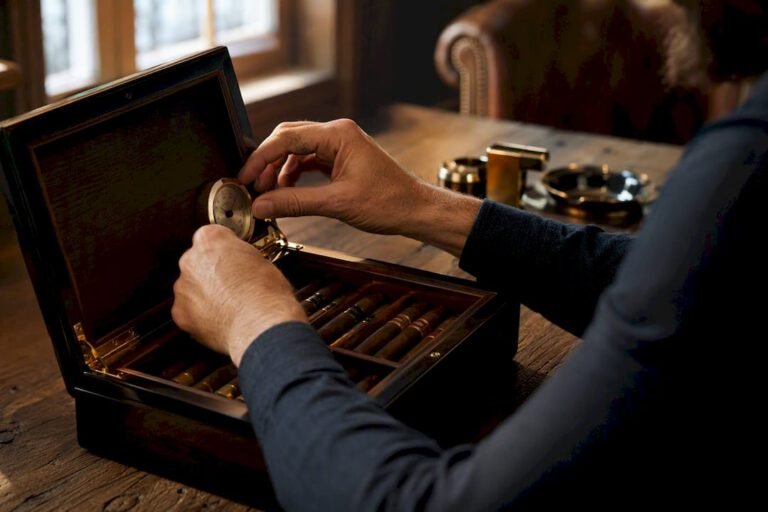
3 RH Bands to Set Ideal Humidor Humidity for Smoking and Aging
Set your humidor to 65–70% relative humidity for everyday smoking, 62–65% if you’re aging cigars long-term, and treat anything above 72% as a mold and beetle risk zone. Most readers should default to 65–70% and adjust only if they’re cellaring vulnerable wrappers or live somewhere hot. None of it means much, though, unless your hygrometer is calibrated and your humidor has been properly seasoned first.
TL;DR:
- Most cigar collectors should aim for 65–70% relative humidity, adjusting down to 62–65% for long-term aging or fragile wrappers.
- Temperature variations impact humidity effectiveness, requiring adjustments of RH setpoints when storage rooms are hotter or cooler than standard conditions.
- Properly seasoning a new humidor with distilled water or seasoning packs ensures accurate humidity control and prevents cigars from drying out.
- Regular calibration of hygrometers every 6 to 12 months with the salt test is essential for precise humidity readings.
- Two-way humidity packs are recommended for low-maintenance, stable humidity, while electronic systems need periodic verification with an independent hygrometer.
Table of Contents
- What Each Humidity Band Means and How to Choose One
- Why Temperature Changes What “70% Humidity” Actually Means
- How to Season a New Humidor Before You Load It
- How to Measure and Calibrate a Hygrometer Correctly
- Humidification Options and How to Maintain Them
- Fixing Low RH, High RH, Mold, and Beetles
- Thor’s Cigar Vault’s Take on Getting Humidity Right
- Get Your Humidor Dialed In With the Right Gear
- Quick Takeaways for Humidor Owners
- Sources
- FAQ
What Each Humidity Band Means and How to Choose One
Relative humidity governs how a cigar burns, how it tastes, and how fast it ages. Too dry and the wrapper cracks and the burn runs hot and fast. Too wet and you’re inviting mold and tobacco beetles into a box you paid good money for. The range that most cigar authorities settle on runs from about 65% to 72% RH, but that’s a wide window, and where you land inside it should depend on what you’re actually doing with the cigars.
- 62–65% RH: Slower aging, lower mold and beetle risk. Best for long-term cellaring and for wrappers that are especially sensitive to moisture, like delicate Connecticut Shade or aged Cuban-seed leaf.
- 65–70% RH: The balanced, general-purpose setting. Good draw, good flavor, manageable risk. This is where most collections should live.
- 70–72% RH: Fuller, denser smoke, but you’re flirting with condensation and mold, especially if your room runs warm.
Pro Tip: If you smoke a box within a few weeks of buying it, lean toward 65–68%. If a box is going to sit for a year or more, drop to 62–65% and forget about it.
Collectors tend to favor 62–65% for long-term aging and 65–70% for daily rotation, and that split is a reasonable starting point for almost anyone building a first serious collection.
Why Temperature Changes What “70% Humidity” Actually Means
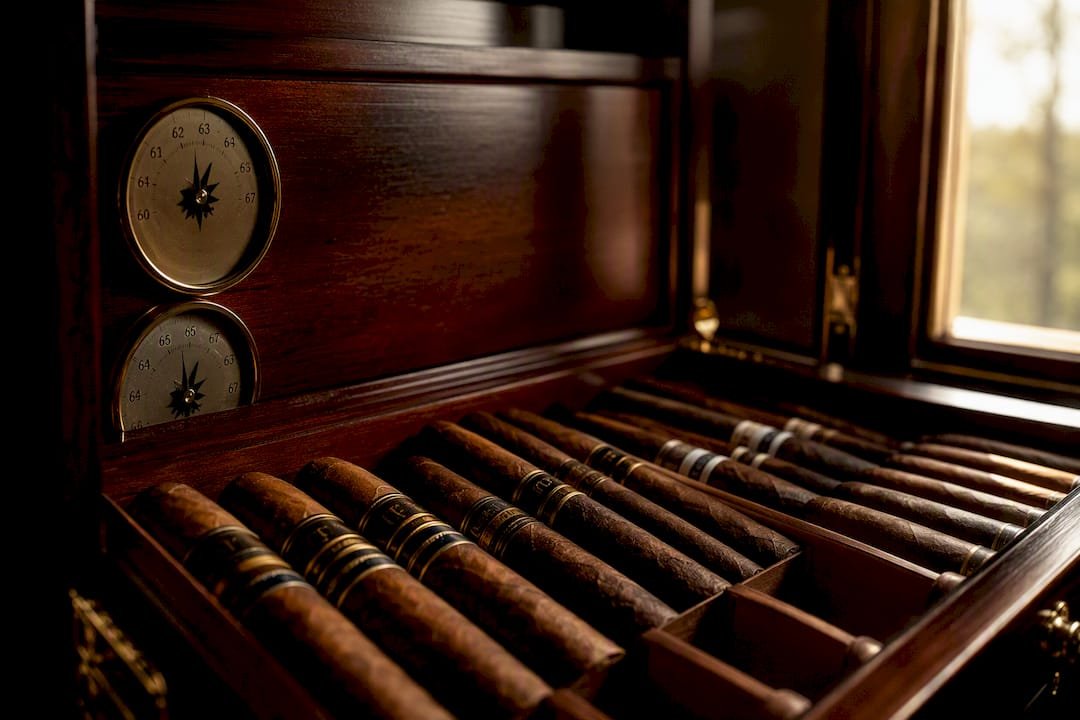
Warm air holds more absolute moisture, so 72% RH at 78°F is meaningfully riskier than 72% RH at 68°F, even though your hygrometer shows the same percentage in both rooms. Heat also speeds up mold growth and gives beetle eggs a better environment to hatch in.
Practical adjustments matter more than the number on the dial:
- If your storage room regularly runs above 72°F, drop your RH setpoint 3 to 5 points to compensate.
- If your room runs cool, below 65°F, you can nudge RH up slightly, but watch closely for condensation on the humidor’s interior.
- Keep humidors away from windows, vents, radiators, and anywhere direct sunlight hits the case for even part of the day.
Cigar storage temperature and RH are a pair, not two separate numbers you set once and ignore.
How to Season a New Humidor Before You Load It
Skip seasoning and you’ll pull moisture straight out of your cigars, because raw, unseasoned Spanish cedar is thirsty. It pulls humidity from whatever is closest, and if that’s your cigars instead of the wood itself, you’ll dry out an entire box before you notice the hygrometer never stabilized.
- Wipe the interior cedar down with a cloth dampened in distilled water, never tap water, which leaves mineral deposits behind.
- Place 72% seasoning packs inside (or use the shot-glass method: a small dish of distilled water left open inside the closed humidor).
- Add your calibrated hygrometer and close the lid.
- Check readings daily. Most humidors stabilize in 7 to 14 days.
- Once RH holds steady for two to three consecutive days, load your cigars.
Pro Tip: Boveda seasoning packs or an acrylic humidor’s built-in stabilization system both work well as alternatives to the shot-glass method. What you should never do is soak the cedar directly or douse it with tap water. Both warp the wood and leave mineral residue that ruins future readings.
How to Measure and Calibrate a Hygrometer Correctly
Every hygrometer drifts over time, analog units especially, and a humidor that seems to be “losing humidity” is often just reporting bad numbers from an instrument that needs recalibrating. Check calibration every 6 to 12 months.
- Fill a small bottle cap or bag with table salt and add a few drops of water until it forms a damp paste.
- Seal the salt and your hygrometer together in a plastic bag, keeping the hygrometer face visible if possible.
- Leave it for 8 to 12 hours at stable room temperature.
- The salt paste creates a microenvironment of almost exactly 75% RH. Whatever your hygrometer reads is your offset.
Pro Tip: Place your hygrometer in the middle of the humidor, away from the lid and walls, where readings run less accurate. Owners of digital humidors often keep a cheap secondary analog hygrometer inside just to cross-check the built-in sensor, since even electronic units can be wrong for months before anyone notices.
Humidification Options and How to Maintain Them
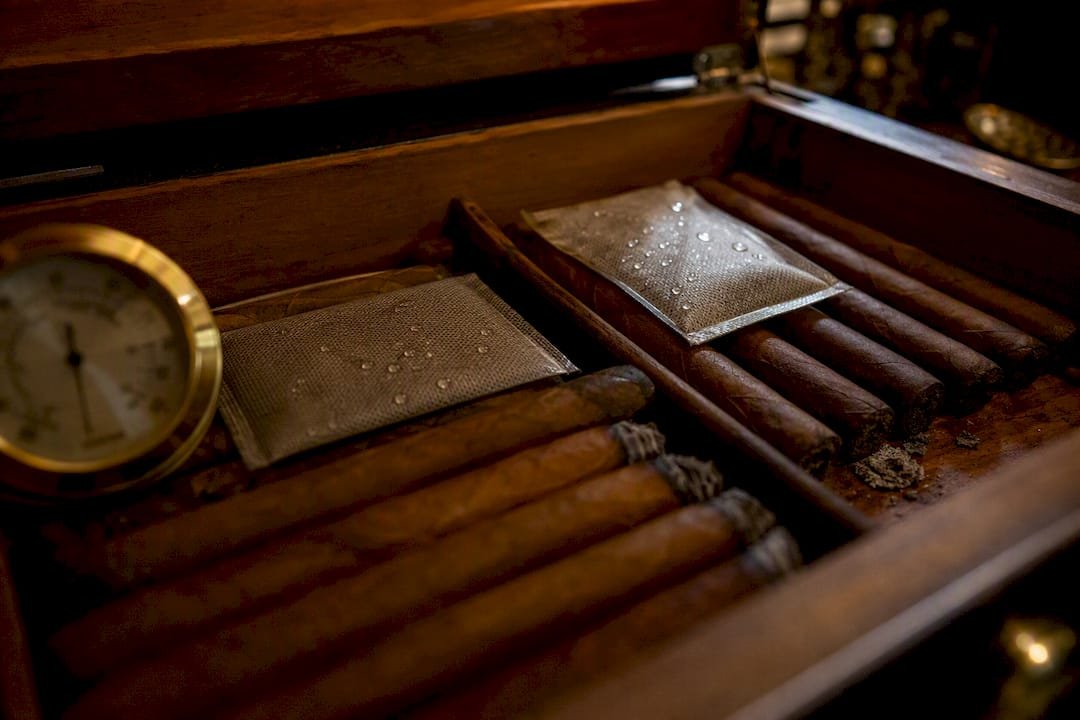
Two-way humidity packs are the lowest-maintenance option and the one most new owners should start with. Boveda and similar packs come in fixed setpoints, commonly 62%, 65%, 69%, and 72%, and they both add and absorb moisture to hold that exact number. Size packs to your humidor’s capacity (roughly one 60-gram pack per 25 to 50 cigars) and replace them every 2 to 3 months.
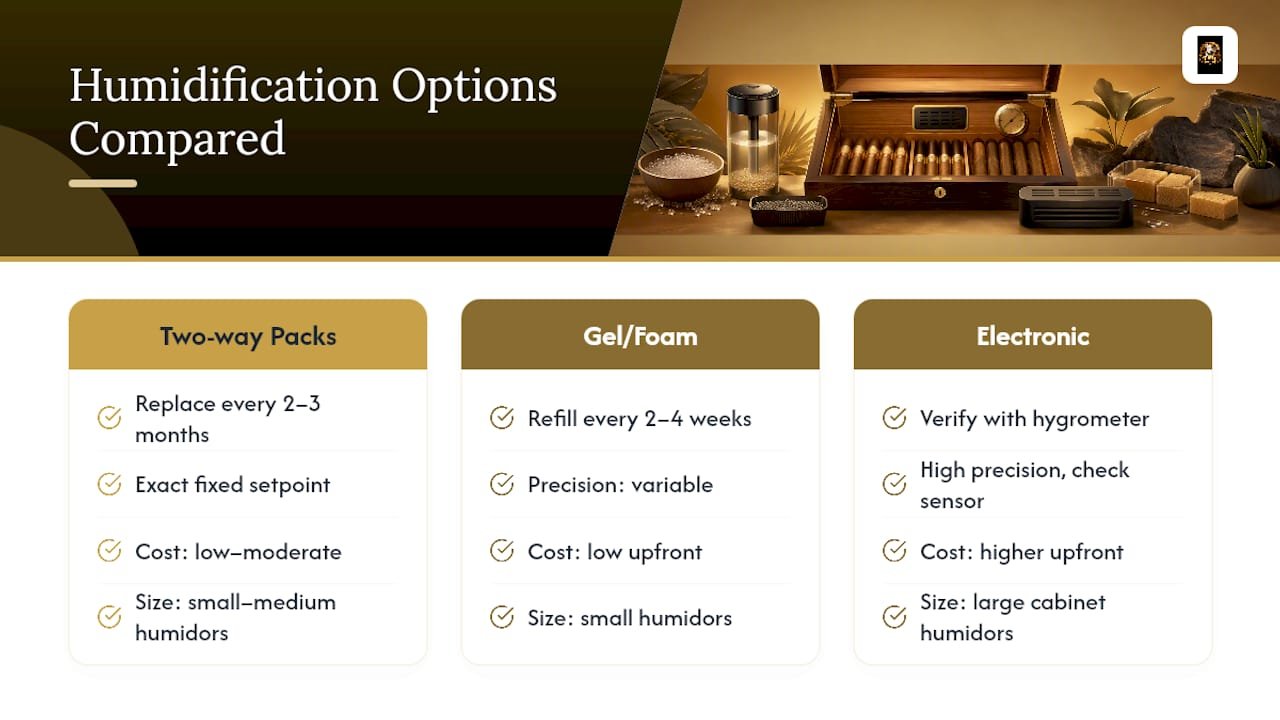
Gel or foam inserts cost less upfront but need more attention. Refill with distilled water every 2 to 4 weeks, and inspect regularly for mineral crust or mold spots on the foam surface.
Electronic humidification systems make sense for large cabinet humidors where a few packs can’t move enough moisture. Always verify their output with an independent hygrometer, since built-in sensors on electronic units can read differently from reality.
Across every method, the same maintenance rules apply: use distilled water only, replace any humidification media that looks or smells off, rotate cigars monthly so ones near the humidifier don’t over-humidify, and inspect the lid seal for gaps at least once a season.
Fixing Low RH, High RH, Mold, and Beetles
Most humidor problems trace back to one of four causes, and a methodical check clears up almost all of them: unseasoned cedar, an undersized humidifier, a leaky seal, or a room that’s too hot or too cold.
- Low RH: Reseason the box, upsize your humidifier or add a second pack, and check the seal by closing the lid on a strip of paper. If it slides out easily, the seal needs adjustment.
- High RH: Drop your setpoint, prop the lid open for an hour in dry air, or pull the humidifier out temporarily until readings settle.
- Mold: Isolate affected cigars immediately, wipe cedar surfaces with a barely damp distilled-water cloth, and let the box air out with the lid open. Discard any cigar showing active fuzzy mold growth rather than trying to salvage it.
- Beetles: Keep vulnerable or aged cigars at 62–65% RH and cooler temperatures, inspect new inventory for pinholes before loading it in with the rest of your collection, and only consider a short freezer quarantine if a manufacturer’s own guidance recommends it for that specific product.
- Uneven readings: Never overfill past about 80% of capacity. Crowded boxes choke off airflow, which is often the real reason one side of a humidor reads differently than the other.
Thor’s Cigar Vault’s Take on Getting Humidity Right
Thor’s Cigar Vault built its humidor and accessory selection around one idea: the box matters as much as what’s inside it. Staff regularly help customers match humidification packs and hygrometers to specific collection sizes and climates, because a setup that works in a dry basement won’t work in a humid coastal apartment. If you’re unsure which setpoint or media fits your situation, reach out and ask.
— Kevin
Get Your Humidor Dialed In With the Right Gear
A cigar deserves a humidor that actually holds its number, not one you’re constantly fighting. Thor’s Cigar Vault carries premium humidors built with tighter seals and better cedar than most starter boxes on the market, alongside calibrated hygrometers and two-way humidity packs sized for cabinets of every capacity.

Whether you’re seasoning your first humidor or replacing a hygrometer that’s been lying to you for a year, the shop carries the gear to fix it in one order. Pair a new humidor with a starter set of humidity packs and a calibrated hygrometer, and you’ll skip the trial-and-error phase most new collectors go through. Browse the full Thor’s Cigar Vault storefront and, if you’re not sure what your setup needs, ask staff for a recommendation before you buy.
Quick Takeaways for Humidor Owners
- Default to 65–70% RH and roughly 70°F for everyday storage.
- Drop to 62–65% for long-term aging or for wrappers prone to mold.
- Avoid sustained readings above 72%, especially in warm rooms.
- Season a new humidor for 7 to 14 days before loading cigars.
- Recalibrate your hygrometer with the salt test every 6 to 12 months.
Sources
- Season, calibrate, and mold-proof humidors
- How to Fix Low RH in a Humidor – Boveda
- Cigar humidor maintenance guide: seasoning, calibration, humidity control and troubleshooting
- What is the best humidity for cigars? — The Manual
FAQ
Is 65% Humidity Too Low for Cigars?
No.
What Is the 70/70 Rule for Cigars?
The temperature half of the rule matters because warmer air holds more absolute moisture at the same RH reading, which raises risk even when the humidity percentage looks unchanged.
Is 75% Humidity Too High for a Humidor?
Yes, for most storage goals. Sustained readings near 75% push well past the 65–72% range most authorities recommend and significantly raise the odds of mold and tobacco beetle activity.
Is 80% Humidity Too Much for Cigars?
Yes. If your humidor reads anywhere near that level, lower the setpoint and check your humidifier and seal right away.
How Often Should I Calibrate My Hygrometer?
Check calibration every 6 to 12 months using the salt test, which should read close to 75% RH when done correctly. Replace any hygrometer that reads more than a few points off after recalibration.