4 Cigar Strength Levels That Match What You Will Feel
Cigar strength is the nicotine punch you feel in your body, not the flavor on your tongue. It runs on a scale from mild to full, with medium and medium-full sitting in between. New smokers should start with mild and work up gradually; medium suits most regular smokers; full-bodied cigars are best left to people who already know their tolerance. Manufacturer strength labels are house conventions, not lab measurements, so treat them as a starting point rather than a guarantee.
TL;DR:
- Nicotine strength depends on filler priming, with ligero leaves contributing most to the punch, not the wrapper color or cigar size.
- Most cigars are categorized into four strength levels—mild, medium, medium-full, and full—each with consistent effects once experienced, but labels are not standardized.
- Regular retrohaling, smoking slowly, and starting with milder cigars help smokers gauge their tolerance before moving to stronger options safely.
- Factors like smoking pace, food intake, personal tolerance, and hydration significantly influence how strong a cigar feels during each session.
- Using sampler packs and asking tobacconists about blend strength are the best ways to discover personal tolerance and avoid surprises.
Table of Contents
- What Cigar Strength Actually Measures (and What It Doesn’t)
- The Four Strength Levels and What Each One Feels Like
- What Actually Determines a Cigar’s Strength
- How Strength Gets Labeled and How You Can Test It Yourself
- Choosing Your Strength and Moving Up Safely
- Thor’s Cigar Vault Guidance on Finding Your Strength
- Why This Guide Exists
- Sources
- FAQ
What Cigar Strength Actually Measures (and What It Doesn’t)
Strength refers to the physiological hit of nicotine, the thing that makes your head buzz or your stomach turn if you overdo it. Body is a different measurement entirely: it’s the weight and density of flavor on your palate, independent of nicotine content. A cigar can be full-bodied with rich, layered flavor and still be relatively mild in strength, and the reverse happens constantly with lighter-tasting cigars that hit surprisingly hard.
Catalogs and marketing copy blur this distinction constantly, and that’s where most confusion starts. A box that says “full-bodied” might mean heavy flavor, heavy nicotine, or both, depending on which brand printed the label. Cigar Strength Chart: Mild, Medium & Full · Cigarista draws a hard line between the two, treating strength as the nicotine axis and body as the flavor axis, and that separation matters more than most buying guides admit.
Visual shortcuts fail here too. A few habits worth dropping if you’re shopping by feel:
- Don’t judge strength by wrapper color. A dark maduro wrapper often signals sweetness from extra fermentation, not nicotine punch, and plenty of maduros smoke mild.
- Don’t assume price tracks strength. Rare and expensive cigars are priced on scarcity and tobacco quality, not nicotine content.
- Don’t trust ring gauge or length as a strength predictor. A thin cigar can be loaded with ligero, and a fat one can smoke mild start to finish.
- Don’t rely on box art or brand reputation alone. A brand’s mild line and its full-strength line can share a label design.
The Manual’s cigar strength guide backs this up directly: wrapper color and price are consistently poor predictors, and the better move is asking the blender or your tobacconist what’s actually in the blend.
The Four Strength Levels and What Each One Feels Like
Most of the industry sorts cigars into four bands: mild, medium, medium-full, and full. The lines between them are fuzzy by design, since no governing body enforces the labels, but each level does carry a fairly consistent physical experience once you’ve smoked a few examples from each.
Mild. These cigars deliver a gentle, easy smoke with little to no nicotine buzz, even smoked on an empty stomach. They’re built around Connecticut-style or other lighter wrapper leaves paired with filler that’s low in ligero. Good for a morning smoke, a long conversation, or your first cigar ever. Think of this tier as the entry point for building your palate without wrecking your afternoon.
Medium. This is where most everyday cigars sit, and where most regular smokers eventually land. You’ll feel a mild to moderate nicotine presence, noticeable but not disruptive, alongside more complexity in the flavor than a mild stick typically offers. It’s the tier that works for an evening on the porch or a round of golf without demanding much caution.
Medium-full. Some makers treat this as its own category; others fold it into either medium or full depending on the blend. It’s the half-step where you start feeling real weight in the smoke, both in flavor and in physical effect, but it hasn’t tipped into anything you’d call heavy. If a catalog lists this tier, treat it as a signal the cigar leans stronger than a typical medium.
Full. Full-bodied and full-strength cigars carry a serious nicotine load, often built around a heavy dose of ligero in the filler. You’ll feel it in your chest, sometimes in your stomach, and definitely in your focus if you’re not paced or fed. These are best reserved for after a meal, with a drink in hand, and ideally not your first cigar of the week.
The Manual frames this same mild through full progression as the industry’s working standard, and it advises exactly what shows up here: start mild, move up slowly, and don’t assume yesterday’s medium is today’s medium once you switch brands.
What Actually Determines a Cigar’s Strength
Strength isn’t random, and it isn’t just “more tobacco equals more punch.” It comes down to where the leaf grew on the plant, what filler makes up the blend, and how long that tobacco fermented and aged before it ever got rolled.
Priming is the biggest single factor. Tobacco plants are harvested in sections, called primings, from the bottom of the stalk up. Lower leaves (volado) are thin and mild. Middle leaves (seco) add flavor without much punch. The top leaves, called ligero, grow in the most direct sunlight and pack the highest nicotine concentration on the plant. Master blenders and industry writers consistently point to ligero as the primary driver of a cigar’s strength, which is why a blend heavy on ligero in the filler will smoke stronger almost regardless of what wrapper sits on the outside.
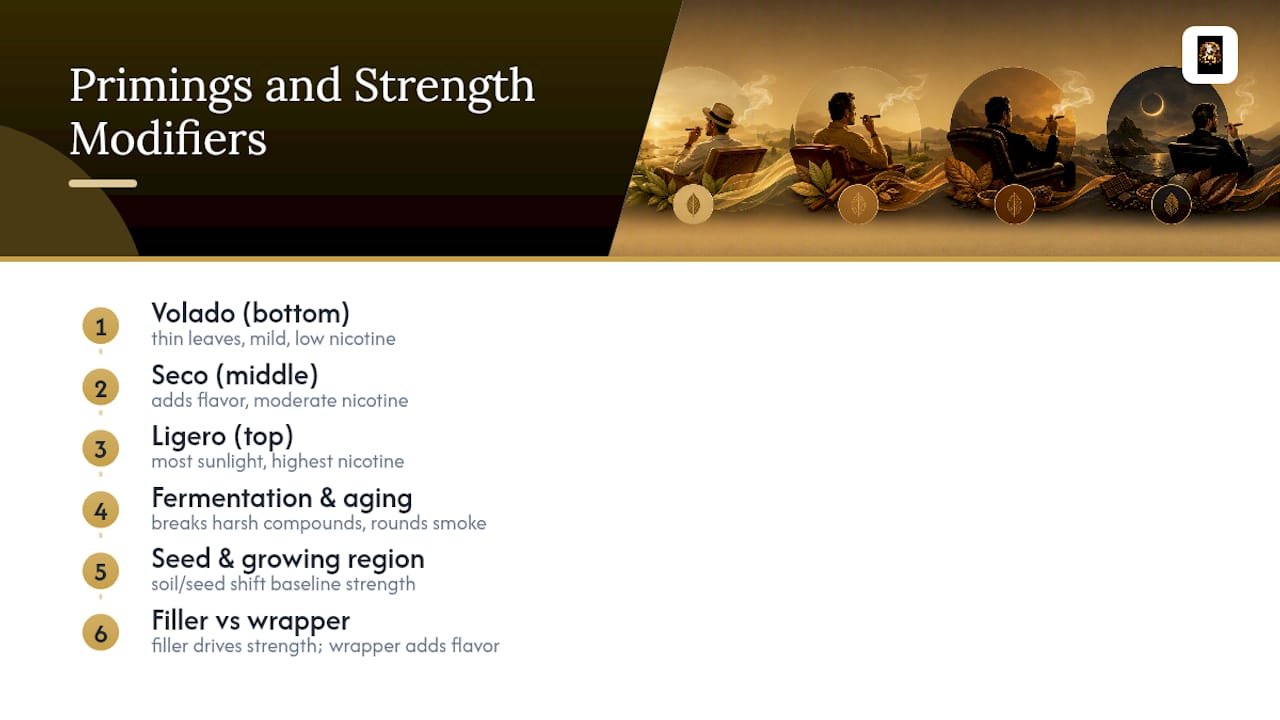
Filler drives strength; wrapper drives flavor. This trips up a lot of newer smokers. The wrapper leaf, the part you actually see and touch, contributes aroma and surface flavor, but it’s a thin layer wrapped around the bulk of the tobacco. The filler tobacco inside, where the ligero, seco, and volado get blended, is doing the heavy lifting on nicotine delivery.
Fermentation and aging soften the edges. Freshly cured tobacco is harsh and ammonia-heavy. Extended fermentation breaks down some of those harsher compounds, which can round out the smoking experience even when the underlying nicotine content hasn’t changed much. Seed variety and growing region also shift the baseline. Cuban-seed tobacco grown in Nicaragua, for instance, often smokes differently than the same seed grown in the Dominican Republic, because soil and climate change how the plant develops.
One illustrative scale used in trade writing bands cigars by wrapper nicotine percentage, from under 1.0% on the mild end up past 3.5% for strong blends, according to Cigar & Cocktail Magazine’s breakdown of strength, body, and flavor. That range is useful for orientation, but it’s a catalog convention rather than a universal lab standard, and different blenders apply it differently.
Cigars built around Havana-seed tobacco, like the filler in a Foundation The Tabernacle Havana Seed Toro, show how much seed and region shape the final experience even before fermentation enters the picture.
How Strength Gets Labeled and How You Can Test It Yourself
There’s no FDA-style lab number stamped on a cigar band that tells you exactly how much nicotine you’re about to smoke. Strength labels come from tasting panels inside the manufacturer, sometimes just a master blender’s palate and decades of comparison, and those panels don’t use a shared scale across brands. That’s the real reason a “medium” from one maker can smoke like a “medium-full” from another.
Retrohaling is the single most useful skill for judging strength yourself, and it’s simpler than it sounds. Draw smoke into your mouth, then exhale it gently through your nose instead of your mouth. The nasal passage picks up nicotine impact and flavor nuance that your tongue alone misses entirely, which is why experienced tasters lean on retrohaling to evaluate real strength rather than trusting mouth-feel alone.

Pro Tip: Before committing to a full cigar, smoke roughly a half-inch and retrohale slowly. If you feel lightheaded or your stomach tightens that early, you’ve got your answer, and you can set it down without wasting the rest of the stick.
A few variables change how strong the same cigar feels from one sitting to the next:
- Smoking pace. Puffing fast concentrates nicotine delivery and can make a medium cigar feel full.
- Food in your stomach. An empty stomach amplifies nicotine effects noticeably.
- Personal tolerance. Regular smokers build tolerance over time, so a cigar that floored you a year ago might feel medium today.
- Hydration and caffeine. Both can intensify the head rush that heavier cigars produce.
When in doubt, ask your tobacconist for the tasting notes and where the blend falls on their own scale, since staff who smoke the inventory regularly usually have a better read than the box copy.
Choosing Your Strength and Moving Up Safely
The safest path is boring but effective: start mild, spend real time there, then step to medium once mild stops giving you anything new. Treat medium-full and full as tiers you earn, not tiers you rush into on a Saturday because a friend recommended one.
A few habits make the climb smoother:
- Eat something substantial before smoking anything above medium strength.
- Smoke slowly. Rushing a full cigar is the fastest way to feel sick.
- Pair with water, not just coffee or alcohol, to keep nicotine effects manageable.
- Track your reactions after each cigar so you know your real tolerance instead of guessing.
Progressive sampler packs are recommended by many retailers as a low-risk way to discover your preferences before buying a full box. Working through a sampler that steps from mild to full lets you feel the difference directly, rather than trusting a label that may not match how your body actually reacts.
| Strength level | Best paired with | Watch for |
|---|---|---|
| Mild | Morning coffee, light conversation | Little to no nicotine effect |
| Medium | Afternoon or evening, casual settings | Noticeable but manageable buzz |
| Medium-full | After a light meal | Real weight in flavor and effect |
| Full | After a full meal, slower pace | Lightheadedness if rushed or smoked empty-stomach |
Thor’s Cigar Vault Guidance on Finding Your Strength
Thor’s Cigar Vault groups cigars by strength across its shop, so you can filter toward mild, medium, or full without guessing from box art alone. If a listing’s strength description feels vague, ask the staff directly. They can point to specific tasting notes and steer you toward blends that match what you actually want to feel, not just what the catalog copy implies.
For anyone still mapping their own tolerance, a progressive sampler is the low-risk move. The La Flor Dominicana Carbon Flower Sampler and the Foundation Elite Sampler both let you work through a spread of strength levels in one purchase, which beats buying a full box of something you’re not sure about. If ligero-heavy blends interest you after reading how priming works, the Artesano Del Tobacco El Pulpo Belicoso Grande is worth asking staff about directly.
Why This Guide Exists
Most strength charts treat mild, medium, and full as fixed categories, as if every “medium” cigar delivers an identical experience. It doesn’t. The label tells you almost nothing about how a specific blend will hit until you know what’s driving it, priming, filler ratio, fermentation time, and that’s the gap this guide is built to close.
The conventional advice (“just check the box”) undersells how much variation exists between brands using the same word. A medium from one house can outmuscle a medium-full from another. What actually works is learning to retrohale, asking pointed questions about ligero content, and using samplers instead of trusting marketing copy.
If you take one thing from this, prioritize learning your own physical tolerance before you trust anyone’s printed scale, including ours. Strength is personal. The chart is just a starting point.
— Kevin
Sources
The strength scale and beginner guidance in this piece draw on The Manual’s cigar strength chart, which lays out the mild-medium-full framework and the advice to progress slowly. The priming and retrohaling explanations come from Cigar Journal’s breakdown of what strength actually means, written from a master blender’s perspective on ligero and nicotine. The strength-versus-body distinction and the illustrative nicotine percentage bands are drawn from Cigar & Cocktail Magazine’s three-axis framework and Cigarista’s strength chart.
- Cigar Knowledge: What Is Meant By Strength? | Cigar Journal
- Mild, medium, or bold: Our cigar strength chart helps you choose to perfect smoke | The Manual
- Strength, Body, and Flavor: The Three Axes — Cigar & Cocktail Magazine
FAQ
Is smoking one cigar the same as smoking one cigarette?
No. A cigarette delivers nicotine fast through inhaled smoke, while a cigar’s nicotine gets absorbed more slowly through the mouth and nasal passages during retrohaling, so the effect and timeline differ even when total nicotine content is comparable.
What is the “1:35 rule” for cigars?
Definitions vary across sources, and there’s no single verified industry standard behind this figure, so it’s best treated as informal shorthand rather than an established rule.
Is smoking one or two cigars a week considered reasonable?
That frequency falls well within how most casual and moderate cigar smokers describe their own habits, though nicotine tolerance and health considerations vary by person, so pacing yourself and paying attention to how you feel matters more than hitting a specific number.
What’s the smoothest type of cigar to smoke?
Mild cigars built from lighter filler with minimal ligero, often wrapped in Connecticut-style leaf, tend to deliver the smoothest experience with the least nicotine impact, making them the standard recommendation for new smokers.