
Tight Cigar Draw? Check Airflow Before You Touch the Wrapper
Start with the least invasive fix first: gently massage the suspected tight spot along the cigar and run a dry draw to check airflow before you light up. If that doesn’t open things up, move to a precise draw tool or cut just behind the plugged section. Test after every small step, since a cigar that draws fine rarely needs more than a light touch.
TL;DR:
- Firmness alone does not prove a plug; an unlit draw tests airflow, while a squeeze can reveal excess moisture or a hard, localized obstruction.
- Overly humid cigars may loosen after a 6 to 12 hour rest in a dry box, while dry cigars need gradual rehumidification over several days.
- If massage and storage adjustments fail, insert a smooth draw tool no more than an inch, remove tiny amounts, and stop once airflow improves.
- Cut only when a blockage sits near the foot; a middle obstruction cannot be cleared this way, and deeper cuts change flavor and burn.
Table of Contents
- Quick checks and least-invasive fixes to try first
- How to safely use a draw tool or probe on a plugged section
- Humidity and storage fixes that affect draw
- When to cut behind the obstruction instead
- Tools and accessories worth considering
- Thor’s Cigar Vault tips and authority perspective
- Common causes of a tight or plugged draw
- Preventive tips to avoid tight draw issues in future cigars
- How to identify when tight draw is due to age or factory defects
- Choosing cigars with better construction to avoid draw problems
- Author perspective: when to walk away
- Where to find the right tools and a backup cigar
- FAQ
- Sources
Quick checks and least-invasive fixes to try first
Before you reach for any tool, run your fingers along the full length of the cigar. You’re feeling for soft spots, hard knots, or an uneven lump that suggests a bunched leaf or stem underneath the wrapper. Rotate the cigar slowly between your fingers and pinch gently at the suspected trouble spot, comparing how it feels against the rest of the stick.
A dry draw, pulling air through an unlit cigar, tells you more than squeezing ever will. According to tobacconist guidance on tight draws, firmness alone isn’t proof of a plug since many cigars feel dense but draw just fine. The real test is airflow, not touch.
If you do find resistance, try this sequence:
- Massage the tight section with light, rolling pressure using your thumb and fingers, working from the band toward the foot.
- Avoid pressing hard enough to crack or crease the wrapper, since that damage is permanent.
- Run a dry draw after each massage attempt rather than guessing whether it worked.
- If the cigar feels slightly spongy or over-humidified, set it in a dry box for 6 to 12 hours and retest.
- Stop probing or squeezing if you feel the wrapper start to give or stretch unevenly.
Pro Tip: Test the draw every 20 to 30 seconds during any correction attempt. Small, frequent checks catch improvement (or damage) before you’ve gone too far.
How to safely use a draw tool or probe on a plugged section
Only move to a tool once massage and the dry-box test have failed to improve airflow. Tobacconist University’s guidance on tight draws recommends starting with the least invasive correction and saving tools or cutting for cigars that still resist after a gentle massage.
- Insert the tool or a thin, smooth probe no more than an inch into the foot, moving slowly and never forcing it.
- Rotate the cigar, not just the tool, so you’re working around the filler evenly instead of carving one channel.
- Pull back and test the draw after every single pass. Stop as soon as airflow improves.
- Remove only tiny amounts of filler at a time. You can always take out more, but you can’t put it back.
- Watch the wrapper for stress, stretching, discoloration, or a seam lifting, and stop immediately if you see any of it.
A dedicated draw-adjustment instrument works better than an improvised probe because it’s built to remove small bits of tobacco exactly where needed, a precision that reduces the risk of tearing the wrapper or hollowing out the filler unevenly, as noted on the PerfecDraw product page. A paper clip or skewer can work in a pinch, but the margin for error is much higher.
- If the wrapper splits or the draw turns loose and hot, stop working on that section entirely.
- A loose, airy draw after over-correction usually means the cigar is done. Set it aside rather than keep digging.
Humidity and storage fixes that affect draw
Excess moisture swells the tobacco inside the wrapper, tightening the draw even when nothing is physically blocking it. A short dry-box stay of a few hours, as opposed to several days, often loosens a slightly over-humidified cigar without drying it out, per tobacconist advice on tight draws. Dryness can cause its own version of a constricted draw by making the filler brittle and unevenly packed.
- For an over-humidified cigar, try a 6 to 12 hour dry-box rest, then retest the draw.
- For a dry cigar, rehumidify slowly over several days using a gentle humidification pack rather than a fast moisture blast.
- One safe approach for rehydrating dry tobacco involves gradual exposure to moisture over time, detailed in this guide to re-moisturizing dry tobacco.
- Retest the draw after any humidity adjustment before assuming the fix worked.
Patience matters more than speed here. Rapid rehydration can crack a dry wrapper just as easily as aggressive probing can, so give the cigar time to adjust rather than forcing a fast result.
When to cut behind the obstruction instead
Cutting behind a plug makes sense when the blockage sits near the foot and massage or tool work hasn’t cleared it. This sacrifices length, but it can save the rest of the cigar.
- Locate the obstruction by feel, then identify how close it sits to the foot, since cutting only works when there’s enough usable cigar left behind it.
- Use a sharp, clean cutter rather than tearing or biting the end, which crushes the wrapper and filler.
- Remove only enough to clear the blockage, typically a small section rather than a large portion of the cigar.
- Retest the draw immediately after cutting.
Expect some change in flavor and burn once you cut deeper into the body, since you’re skipping part of the blend’s intended progression. If the obstruction runs through the middle of the cigar rather than near one end, cutting won’t help and the stick is likely not salvageable.
Tools and accessories worth considering
A dedicated draw-adjustment instrument, like the PerfecDraw, is a USA-patented tool built specifically to remove small bits of tobacco precisely, which is why it’s marketed as a precision option for tuning draw rather than a blunt workaround, according to its product listing. A straightened paper clip can work as a last resort, but only if it’s clean and used with far more caution than a purpose-built tool.
- A dedicated draw tool offers control that improvised probes can’t match, especially for repeated adjustments.
- Keep any makeshift probe sanitized and smooth with no rough edges that could snag the filler.
- A quality humidor with reliable humidity control prevents many draw problems before they start.
- When choosing an accessory, prioritize precision and build quality over price, and check the seller’s return policy before buying.
Thor’s Cigar Vault tips and authority perspective
We provide premium cigars and accessories, with attention to draw quality, and can guide you through troubleshooting a tight stick before you reach for a tool. Every cigar shipped gets a visual and feel check before leaving, and customers are pointed toward accessories built for precision rather than guesswork whenever draw issues come up.
Common causes of a tight or plugged draw
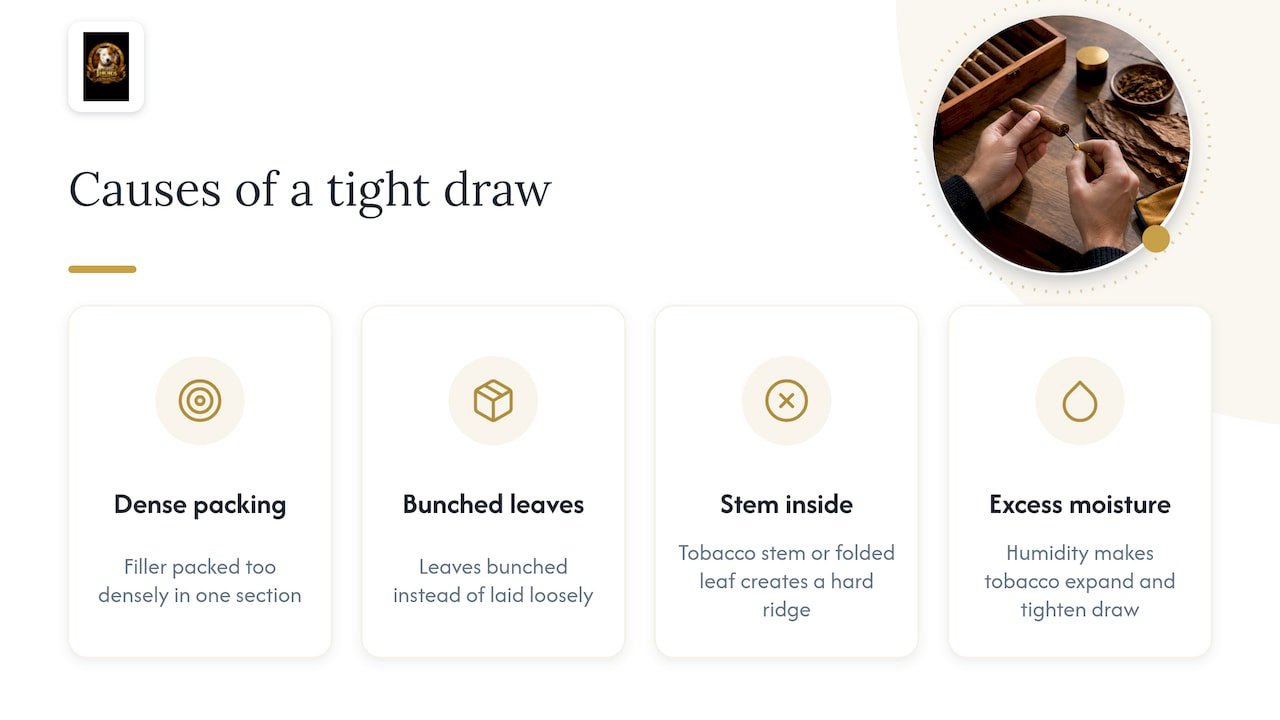
Most tight draws trace back to a handful of culprits, and knowing which one you’re dealing with changes how you fix it. Uneven rolling is a frequent cause: if the roller packed the filler too densely in one section, that spot resists airflow no matter how good the rest of the cigar is. Misplaced filler leaves, bunched together instead of laid loosely, create the same kind of localized resistance.
A stem or folded leaf left inside the filler is another common offender. Tobacco stems are stiff and don’t compress the way leaf does, so a stem running through the binder can choke airflow at that exact point. You’ll often feel this as a hard, narrow ridge rather than a soft lump.
Excess moisture is the fourth major cause, and it’s the easiest to miss because it doesn’t feel like a physical obstruction. When tobacco absorbs too much humidity, it expands, and that expansion alone can tighten a draw that would otherwise be fine, per tobacconist research on tight draws. This is why a dry draw and a quick squeeze test both matter: one catches airflow problems, the other catches moisture problems, and they don’t always point to the same fix.
Preventive tips to avoid tight draw issues in future cigars
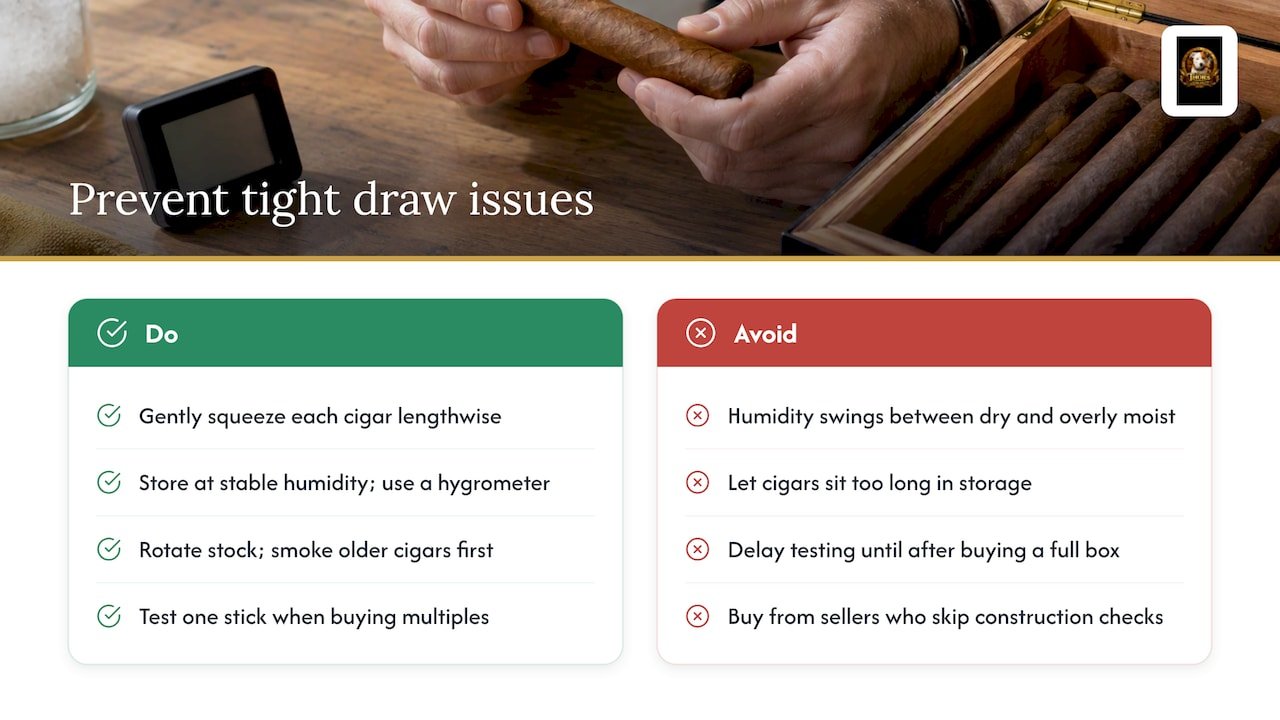
A little attention before you buy or store a cigar prevents most draw problems from happening in the first place. Squeeze each cigar gently along its length before purchase, checking for even give from head to foot rather than hard spots or soft pockets.
Store cigars at a stable humidity rather than letting them swing between dry and overly moist conditions, since repeated expansion and contraction stresses the wrapper and filler alike. A consistent range, checked with a reliable hygrometer, does more for draw quality over time than any single fix after the fact.
Rotate stock in your humidor so older cigars get smoked before they sit too long, since extended storage increases the odds of moisture migration and wrapper stress. When you buy multiples of the same blend, test one early rather than waiting until you’ve committed to a whole box, so you catch a rolling issue before it shows up in every stick. Buying from a retailer that checks construction before shipping also cuts down on the number of problem cigars that reach your humidor at all.
How to identify when tight draw is due to age or factory defects
Age and factory defects produce different signs, and telling them apart saves you from blaming the wrong cause. A cigar that’s simply too old and has been stored dry tends to feel brittle, with a wrapper that cracks easily and a draw that feels loose and hollow rather than tight, since dried-out filler loses structure.
A factory defect, on the other hand, usually shows up as a localized problem you can isolate with a pinch test: one section feels noticeably denser or contains a hard ridge while the rest of the cigar feels normal. This points to a rolling error, a stem, or a bunched leaf rather than age.
Freshness also matters. A recently rolled cigar that still needs rest time in a humidor can draw tight simply because the filler hasn’t settled yet, which resolves on its own with a few weeks of proper storage rather than any physical fix. If a cigar from a batch you’ve smoked before suddenly draws differently, that’s a stronger signal of a one-off rolling issue than a systemic problem with the blend itself.
Choosing cigars with better construction to avoid draw problems
The easiest way to avoid a tight draw is to catch construction issues before you ever light up. Look at the wrapper first: a smooth, evenly colored wrapper with no visible soft spots or lumps usually indicates consistent rolling underneath. Run your fingers from head to foot and compare the give across the entire length rather than just squeezing once in the middle.
Weight and density should feel consistent too. A cigar that feels noticeably heavier or denser in one section than another often has uneven filler packing, which is one of the more common causes of a restricted draw according to tobacconist guidance. Buying from brands and retailers known for quality control reduces how often you run into this at all, since consistent rolling standards cut down on plugged sticks reaching the shelf. Sampler packs are a practical way to test construction across several blends before committing to a full box of any one cigar.
Author perspective: when to walk away
If you’ve spent more than a few minutes working a tight draw without real improvement, it’s usually time to stop. Chasing a stubborn plug past that point risks a split wrapper or a hollowed-out draw that ruins the flavor anyway. Set it aside, smoke something else, and revisit it later with fresh patience rather than frustration.
— Kevin
Where to find the right tools and a backup cigar

We stock the humidors, cutters, and humidity accessories that make draw problems far less common in the first place, and browsing our accessories collection is a good next step if your current setup isn’t holding steady humidity.
- Check our humidors for consistent humidity control that prevents moisture-related draw issues.
- Browse our samplers if tonight’s stick turned out to be a lost cause and you want a reliable replacement.
- Reach out to our staff for guidance on construction quality before you buy your next box.
Visit Thor’s Cigar Vault to shop our current selection and get your first order sorted.
FAQ
Why are my cigars so hard?
A hard feel usually comes from dense filler packing or a stem running through the binder, not necessarily a plugged draw. Firmness alone doesn’t mean a cigar won’t draw well, so a dry-draw test is the better way to check before you assume there’s a problem.
How do I use a cigar draw enhancer tool?
Insert the tool a short distance into the foot, rotate the cigar rather than forcing the tool deeper, and test the draw after every pass. A precision instrument like the PerfecDraw is designed to remove only small amounts of tobacco at a time, which keeps the wrapper and filler intact.
Can a dry cigar be saved?
Yes, a dry cigar can often be rescued with slow rehumidification using a gentle humidification pack over several days rather than a fast moisture blast. Rushing the process risks cracking the wrapper, so patience matters more than speed.
What is the 135 rule for cigars?
Definitions of this rule vary across sources, and no tobacconist authority ties a specific standard to that name. If you’ve seen it referenced for storage or aging, treat it as informal guidance rather than an established benchmark.