3 Tasting Methods to Master Cigar and Whiskey Pairing for Beginners
The rule that matters more than any other in cigar and whiskey pairing is matching intensity: mild cigars want lighter spirits, full-bodied cigars can handle bigger, bolder pours. If you’re starting out, reach for a whiskey between 80 and 100 proof, since anything hotter tends to numb your palate before the cigar gets a chance to speak. A balanced bourbon or a Speyside scotch is the safest first move. Figure out whether your cigar is mild, medium, or full, then pick your whiskey family from there.
TL;DR:
- Matching cigar and whiskey intensity is crucial; mild cigars require lighter spirits around 80-100 proof to avoid overpowering flavors.
- Flavored bridges such as vanilla, caramel, and leather create harmonious pairings, while contrasting pairings should only be attempted after gaining palate confidence.
- Whiskey categories like bourbon, rye, Speyside scotch, and Islay scotch each bring distinct flavor profiles that suit specific cigar types and strengths.
- The cigar’s flavor profile—spicy, sweet, earthy, or creamy—guides the best whiskey family choice, emphasizing harmony rather than contrast.
- Proper storage of cigars and whiskey, small pours, and testing across different cigar bodies improve tasting outcomes and pairing success.
Table of Contents
- What Makes a Cigar and Whiskey Pairing Actually Work?
- Which Whiskey Category Fits Which Cigar?
- Best Cigars for Whiskey by Body and Wrapper
- How Do You Taste Cigars and Whiskey the Right Way?
- Five Sample Flights to Try Tonight
- Session Basics: Glassware, Pours, and Storage
- How Does a Cigar Change From Start to Finish?
- How Do Cigar Flavor Profiles Guide Whiskey Choice?
- Does Whiskey Aging and Barrel Type Change the Pairing?
- What Pairing Mistakes Should You Avoid?
- A Note From Thor’s Cigar Vault on Pairing by Feel
- Ready to Practice? Start With the Right Sampler
- Sources
- FAQ
What Makes a Cigar and Whiskey Pairing Actually Work?
Body matching is the first and most important rule. A delicate Connecticut shade cigar loses everything next to a cask-strength Islay scotch; the peat and alcohol heat flatten the tobacco’s subtlety before you get a single puff of flavor. Flip it around, and a full ligero cigar will steamroll a light Irish whiskey until all you taste is smoke. Matching intensity so neither element overpowers the other is the starting filter for every pairing decision you’ll make.
Once intensity lines up, look for flavor bridges, the shared notes that let a cigar and a whiskey talk to each other instead of past each other. Vanilla, caramel, leather, cocoa, and baking spice show up constantly in both tasting vocabularies. A cigar with cedar and cocoa notes tends to click with a bourbon that leans on toasted oak and brown sugar, because you’re not inventing a connection, you’re following one that’s already there.
Contrast is the more advanced move, and it’s where pairing gets genuinely fun. Instead of echoing flavors, you deliberately clash them. Pair a sweet, sherry-finished whiskey with a peppery, savory cigar and something unexpected happens: the sweetness and spice recombine into a flavor neither one has alone. Insiders call this the “Snickers bar effect,” where sweet, salty, and smoky notes collide to create an entirely new taste that wasn’t in either glass or wrapper to begin with.
- Match body first, always. It’s the guardrail that keeps a pairing from failing outright.
- Look for shared flavor notes (vanilla, cocoa, spice, leather) as your second filter.
- Save contrast pairings for after you’ve built some palate confidence.
- Stay in the 80 to 100 proof range until you know how a specific whiskey behaves with smoke.
Pro Tip: Read the whiskey’s own tasting notes before you buy the cigar. If a bottle advertises “baking spice and dried fruit,” you already know it wants a cigar with cedar or nutmeg in the profile, not one built entirely on pepper.
Which Whiskey Category Fits Which Cigar?
Every whiskey category brings its own flavor toolkit to the table, and knowing the toolkit saves you from guessing.
- Bourbon leans on vanilla, caramel, and toasted oak from its new charred-barrel aging, and it’s often called a “universal donor” because that sweetness plays nice with a wide range of cigars.
- Rye brings black pepper and baking spice up front, which makes it a strong partner for cigars with their own peppery kick.
- Speyside scotch tends toward honey, orchard fruit, and light malt, gentle enough for mild to medium cigars.
- Islay scotch carries peat, iodine, and medicinal smoke, built for full-bodied, high-nicotine cigars that can stand up to it.
- Irish whiskey is typically triple-distilled and smooth, a forgiving pick for beginners and mild cigars alike.
- Canadian whisky runs light-bodied with a soft rye edge, another low-risk starting point.
Cask finishing changes the math. A bourbon finished in sherry, rum, or port barrels picks up dried fruit and molasses notes that can either deepen a pairing or clash with it, so treat a finished whiskey as its own category rather than assuming it behaves like the base spirit. Bourbon’s caramel and barrel-driven sweetness makes it the safest default when you’re unsure, which is worth remembering before you reach for something more aggressive.
The most common mistake is reaching for a heavily peated Islay scotch with a delicate Connecticut wrapper cigar. The peat smoke annihilates the cigar’s cream and hay notes in one pour. Save the peat for a Maduro or ligero blend that can hold its own.
Best Cigars for Whiskey by Body and Wrapper
Cigar body and whiskey body should track each other almost one to one. Here’s how that plays out in practice.
- Mild, Connecticut shade wrappers pair best with lighter whiskies like Speyside scotch or Irish whiskey. These cigars run on cream, hay, and light wood, and anything stronger buries that subtlety in seconds.
- Medium-bodied cigars, often Habano or Ecuadorian wrappers, give you the most room to play. A wheated bourbon (softer, sweeter, less rye bite) or a balanced single malt both work, and the wrapper origin nudges the decision. Nicaraguan wrappers with cocoa notes lean bourbon; Cameroon wrappers with a nutty edge lean toward a lightly sherried scotch.
- Full-bodied Maduro and ligero cigars need whiskies with real weight behind them. Higher-proof bourbon, a peated scotch, or a rum-finished whiskey can all stand toe to toe with the tar, espresso, and pepper notes these cigars throw off. Watch the nicotine load here. Full cigars hit harder, so pace your pour and don’t rush the second half.
Ring gauge and length matter more than most beginners realize. A thick 60-ring-gauge cigar burns cooler and slower, stretching a session past an hour, which means your whiskey needs to hold its character over a long pour, not just at first light. A thinner Robusto or Corona burns hot and fast, better suited to a shorter pour you can nurse quickly. If you want a fuller cigar to test that theory, something like the Foundation The Tabernacle Havana Seed Toro gives you enough size and strength to see how proof and pacing interact over a full session.
How Do You Taste Cigars and Whiskey the Right Way?
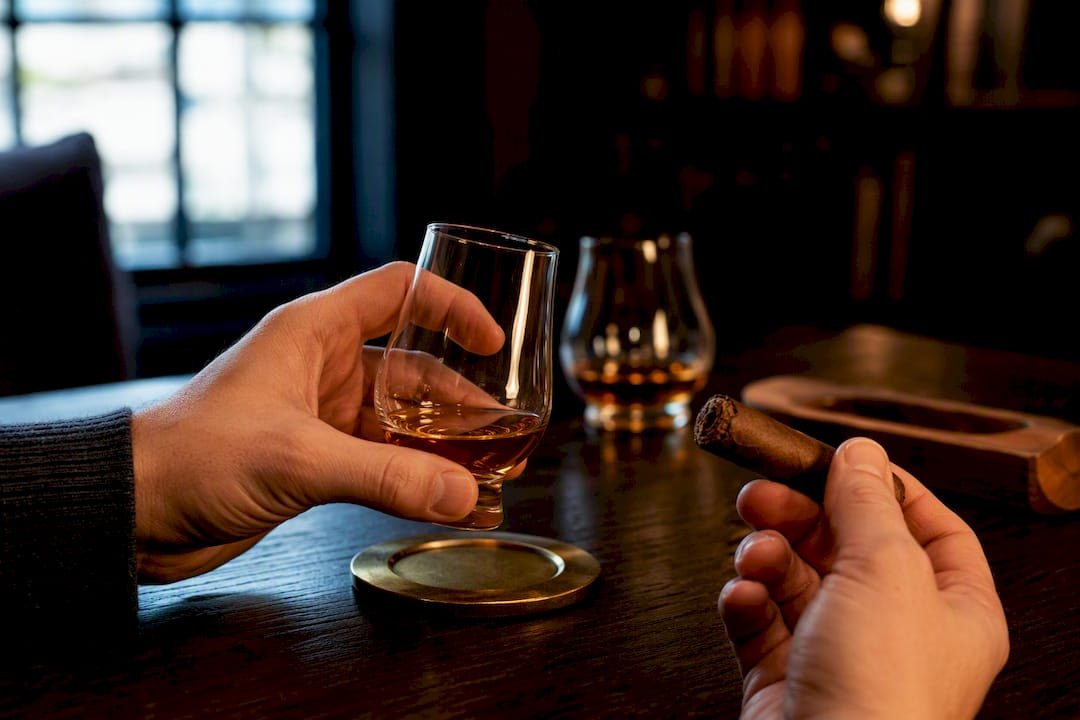
There are three directions worth trying, and each teaches you something different. Puff on the cigar first, then sip the whiskey, and you’ll notice how the smoke primes your palate for what follows. Sip the whiskey first, then draw on the cigar, and the reverse effect shows up, often bringing out sweetness in the smoke you missed the other way. The third method, sometimes called the poor man’s smoked drink, has you blow cigar smoke gently into an empty Glencairn glass before pouring the whiskey in, letting the aroma preview how the two will merge before you taste anything.
- Cigar to whiskey: shows how smoke changes your read on the pour.
- Whiskey to cigar: shows how the spirit reshapes the smoke.
- Smoked Glencairn: previews the combined aroma with zero commitment.
Keeping a tasting journal turns a fun evening into a repeatable skill. Log the cigar’s wrapper and body, the whiskey’s proof and family, your pour size, and what you tasted in each third.
Pro Tip: Pour small, roughly a half ounce at a time, and refresh the whiskey around the cigar’s second third. A pairing that sang at first light can go flat once the cigar’s flavors intensify.
Five Sample Flights to Try Tonight
- The mild starter: Connecticut shade cigar with Irish whiskey. Look for cream and toast in the cigar meeting honeyed grain in the glass. Sip slowly; this pairing rewards patience over intensity.
- The flexible medium: Habano-wrapped cigar with a wheated bourbon. Alternate a puff, then a sip, and track how the cigar’s cocoa notes pull sweetness out of the bourbon’s caramel.
- The full-bodied heavyweight: Maduro cigar with a higher-proof bourbon or lightly peated scotch. Pour smaller than usual here, around a half ounce, since alcohol heat and nicotine both climb faster in this pairing.
- The contrast play: a sherry-finished whiskey against a peppery, spice-forward cigar, chasing the Snickers bar effect where sweet and savory collide into something new.
- The exploratory flight: a sampler pack like the Sinistro Sampler gives you three or four bodies in one sitting, so you can run the same whiskey against each and feel the intensity rule in action.
A Glencairn glass concentrates aroma better than a rocks glass for any of these, and a half-ounce pour keeps the alcohol from drowning out what the cigar is doing.
Session Basics: Glassware, Pours, and Storage
A tulip-shaped Glencairn glass beats a wide rocks glass for pairing sessions because it funnels aroma toward your nose instead of letting it scatter, and that concentration matters when you’re trying to catch subtle notes next to cigar smoke.
- Pour half an ounce to an ounce at a time. Small pours let you refresh the drink as the cigar shifts through its thirds instead of nursing a warm, flat glass by the end.
- Keep water nearby, not to dilute the whiskey but to reset your palate between sips.
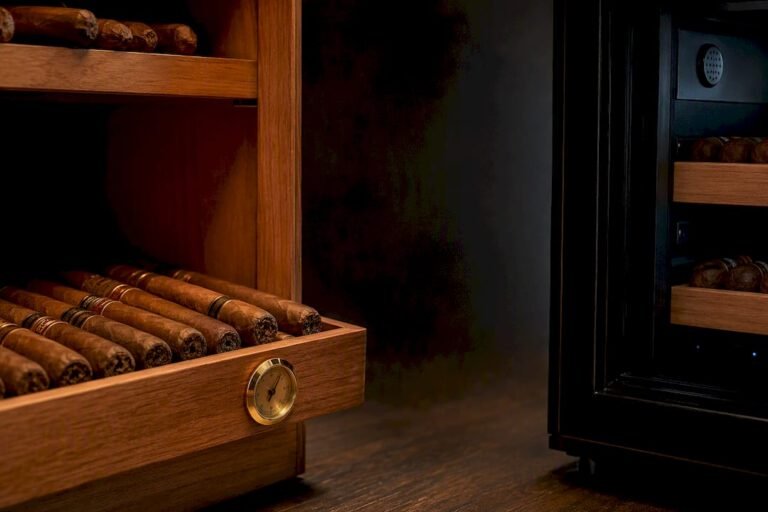
- Store cigars in a humidor holding roughly 65 to 70 percent relative humidity; a dried-out cigar burns hot and bitter no matter what you pour next to it.
- Store opened whiskey bottles upright, away from light and heat, to keep the flavor consistent from one tasting to the next.
- Never rush a full-bodied cigar. Let it rest between puffs so the nicotine and alcohol don’t compound too fast.
How Does a Cigar Change From Start to Finish?
A cigar isn’t one flavor experience, it’s three. The first third, right after light, tends to run milder and more one-dimensional, often dominated by whatever’s in the outer wrapper. By the second third, the filler tobaccos start asserting themselves, and flavors that were background notes at first light move to the front. The final third concentrates everything: more tar, more pepper, more heat, and often a noticeably fuller body than where you started.
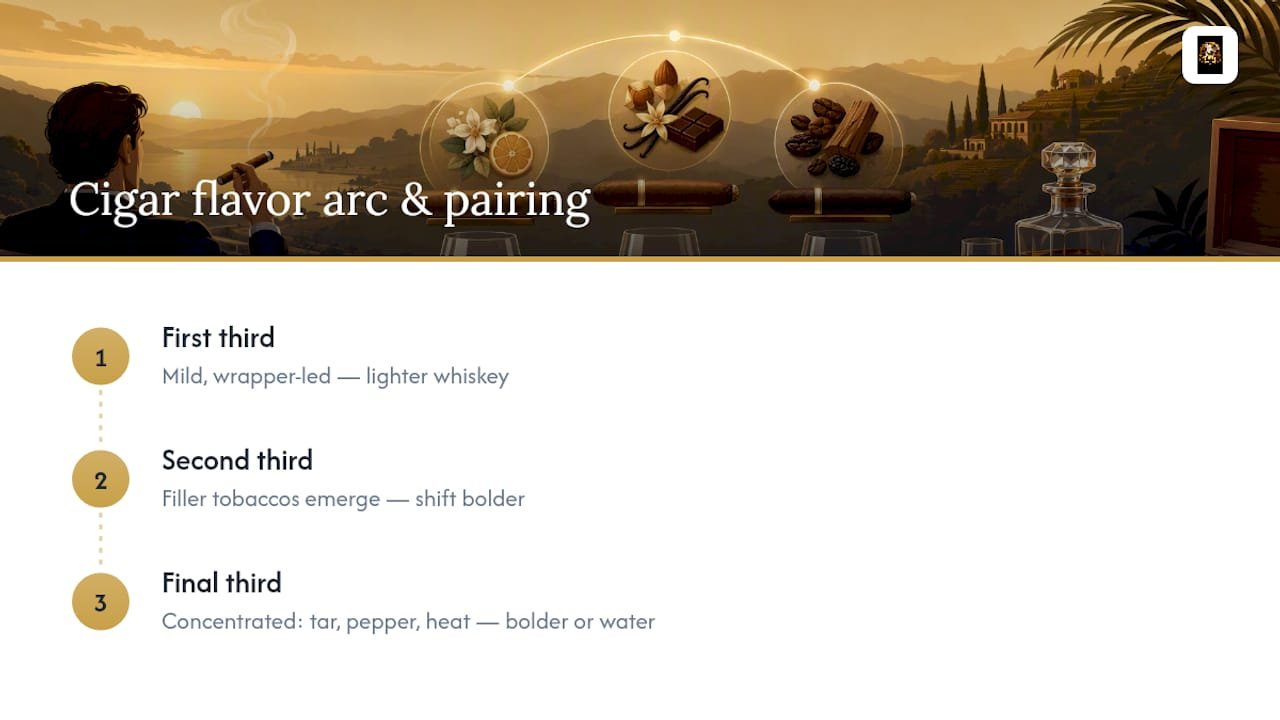
Pairings that felt perfectly balanced at first light can clash by the final third, which is exactly why serious tasters plan their pour around the cigar’s arc rather than pouring once and forgetting about it. A light Speyside scotch that matched beautifully with a mild first third might get steamrolled once that same cigar hits its punchier, more concentrated final third.
The practical fix is simple: treat your whiskey as a moving target, not a fixed one. Some tasters keep two pours going, a lighter one for the first third and a slightly bolder backup for the back half. Others adjust by adding a few drops of water partway through to open up sweeter notes as the cigar’s intensity climbs, which keeps the pairing from feeling like a fight by the last inch of the smoke. Either approach beats locking into one whiskey and hoping it survives the whole cigar unchanged.
How Do Cigar Flavor Profiles Guide Whiskey Choice?
Cigars aren’t just mild, medium, or full. They carry distinct flavor identities, and those identities point toward specific whiskey families more precisely than body alone.
A spicy cigar, heavy on black pepper and clove, usually pairs best with a rye whiskey that carries its own peppery backbone, doubling down on the spice rather than fighting it. A sweet cigar, one built on a Nicaraguan or Connecticut wrapper with cocoa or dried-fruit notes, tends to click with a bourbon or a sherry-finished scotch that mirrors that sweetness back. An earthy cigar, common in Maduro blends with notes of leather, coffee, and dark soil, often wants something with real barrel char behind it, a high-proof bourbon or a robust single malt that won’t get lost underneath.
Creamy cigars, the ones with a soft, almost buttery draw and notes of nuts or light spice, are trickier. Too bold a whiskey flattens that creaminess entirely, so a smoother Irish whiskey or a gentle Speyside tends to preserve it better than anything with heavy oak or peat.
None of these are locked rules. A spicy cigar can absolutely work with a sweet whiskey when you’re chasing contrast rather than harmony. But knowing which flavor family your cigar belongs to gives you a starting point that’s far more specific than just guessing at “medium bodied.”
Does Whiskey Aging and Barrel Type Change the Pairing?
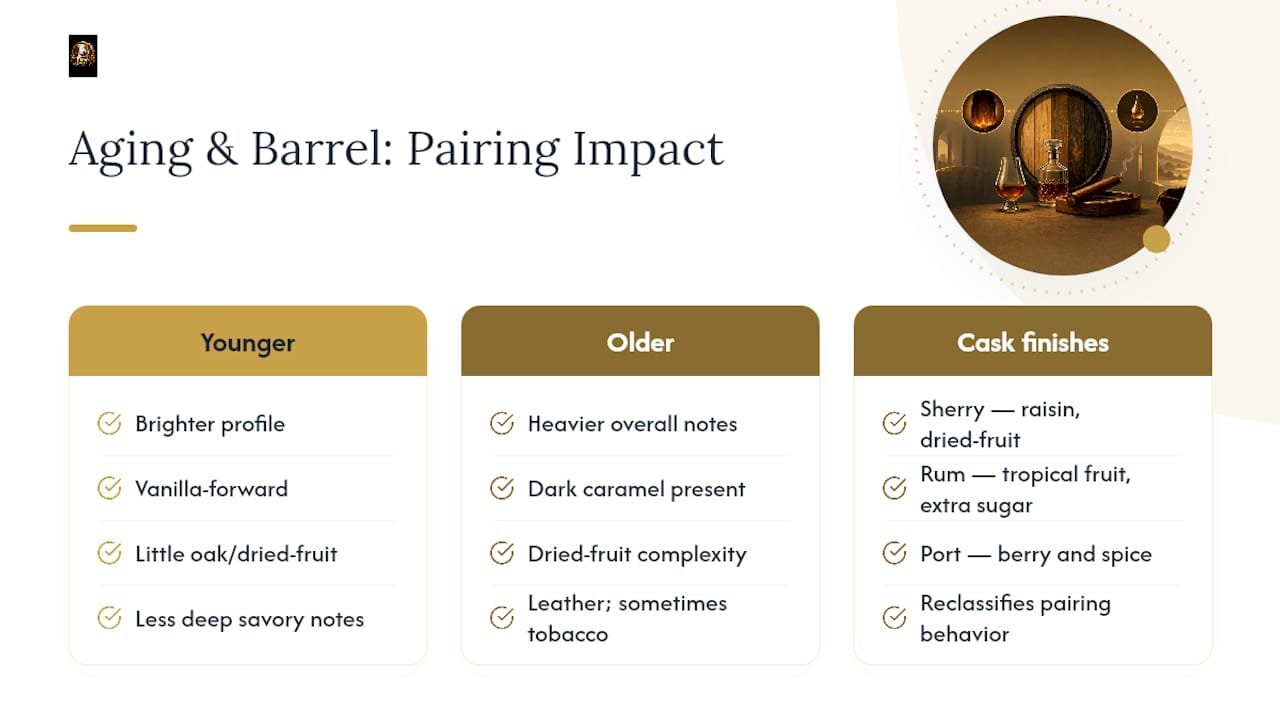
Age and barrel type shift a whiskey’s flavor as much as the grain recipe does, and that shift changes what it can pair with. A younger bourbon, aged just a handful of years, tends to run brighter and more vanilla forward, without much of the deep oak or dried-fruit complexity that comes later. An older bourbon or scotch, aged a decade or more, develops heavier notes: dark caramel, dried fruit, leather, sometimes a hint of tobacco itself, which can either complement a cigar’s own leather notes or compete with them for attention.
Cask finishing adds another variable entirely. A whiskey finished in a sherry cask picks up raisin and dried-fruit sweetness. A rum-cask finish brings tropical fruit and extra sugar. A port finish leans into berry and spice. Each of these finishes essentially reclassifies the whiskey for pairing purposes, since a sherry-finished bourbon behaves more like a dessert whiskey than a standard one, and pairs better with a sweeter or spicier cigar than the unfinished version would.
The lesson is straightforward: don’t judge a whiskey’s pairing potential purely by category name. A 12-year Speyside and an 18-year Speyside from the same distillery can call for genuinely different cigars, and a standard bourbon and its sherry-finished sibling from the same barrel program aren’t interchangeable partners either.
What Pairing Mistakes Should You Avoid?
The single most common mistake is ignoring the intensity rule entirely and picking whiskey based on personal preference rather than the cigar in hand. A favorite Islay scotch might be a poor Tuesday-night pairing if the cigar on hand is a delicate Connecticut wrapper.
The second mistake is pouring too generously. A full two-ounce pour of an 100-plus proof whiskey builds alcohol heat fast, and that heat numbs your palate well before the cigar’s second third even starts. Stick to half-ounce pours and refill as needed instead.
Third, plenty of beginners forget that a cigar changes as it burns and pour once, expecting that same glass to work for the whole session. As covered above, a cigar’s final third often needs a different pairing partner than its first light.
Fourth, storage gets overlooked constantly. A cigar pulled from a too-dry humidor burns hot and harsh no matter what’s in the glass, and that harshness gets blamed on the whiskey when the real problem started days earlier in poor storage conditions.
Finally, don’t assume a bigger name or higher price tag guarantees a better pairing. A well-matched mid-range bourbon with the right cigar beats an expensive scotch chosen at random every time.
A Note From Thor’s Cigar Vault on Pairing by Feel
We’ve spent plenty of evenings testing these pairings ourselves, working through sampler after sampler to figure out which whiskey families actually hold up against specific wrappers and which ones fall apart by the second third. That hands-on process shapes how we curate our sampler packs, built around bodies and wrapper types that make sense to test side by side. Grab a notebook, pour small, and track what actually works for your palate rather than what a guide says should.
— Kevin
Ready to Practice? Start With the Right Sampler
Reading about pairing principles only gets you so far. The fastest way to build real palate instincts is running the same whiskey against three or four different cigar bodies in one sitting, and that’s exactly what a curated sampler is built for.
Sampler packs specifically built around the body and wrapper contrasts this article covers can help you avoid guessing which sticks to buy separately to test mild against full. The Aganorsa Leaf sampler and the Artesano Del Tobacco El Pulpo Sampler both give you a spread of bodies to run against a single bottle, which is a faster education than buying singles blind. Beyond the samplers, the full cigar catalog covers everything from Connecticut shade to full ligero if you already know what wrapper you’re chasing, and the humidor selection keeps whatever you buy at the right humidity between tasting sessions.
Sources
- How to Pair Whisky (and Rum and Brandy) with Cigars — Whisky Advocate
- Best bourbons for beginners — VinePair
- A successful pairing — American Whiskey Magazine
- The perfect pairing — Whiskey Network
- Whiskey and Cigar Pairing For Beginners — Alcohol Professor
FAQ
Do Whiskey and Cigars Actually Go Together?
Yes. The tannins, sweetness, and smoke in both work together when the intensity levels match, which is why pairing guides consistently recommend matching body first. Mismatched intensity, a delicate cigar with a punishing high-proof pour, is what causes most disappointing pairings, not the concept itself.
What Cigars Pair Well With Whiskey for Beginners?
A medium-bodied Habano-wrapped cigar paired with a standard bourbon is the most forgiving combination to start with. From there, a mild Connecticut shade cigar with a Speyside scotch or Irish whiskey gives you a second easy comparison point to learn how body shifts the outcome.
What Is the 80 to 100 Rule for Cigar Pairings?
It refers to sticking with whiskeys in the 80 to 100 proof range while you’re still learning how alcohol strength interacts with cigar smoke. Higher-proof pours build heat fast enough to numb your palate before you’ve finished tasting the cigar’s first third.
What Liquor Pairs Best With a Cigar Overall?
Bourbon is the most commonly recommended starting spirit because its caramel and oak sweetness complements a wide range of cigar bodies without a specialist’s knowledge. That said, a rye works better with peppery cigars, and a peated scotch suits full-bodied Maduro blends more precisely than bourbon does.
How Should I Store Cigars and Whiskey Between Tastings?
Keep cigars in a humidor at roughly 65 to 70 percent relative humidity to prevent the harsh, hot burn that comes from dried-out tobacco. Store opened whiskey bottles upright and out of direct light, which keeps the flavor stable from one tasting session to the next.