Electric Humidor Setup for Collectors: The Low-Maintenance Guide
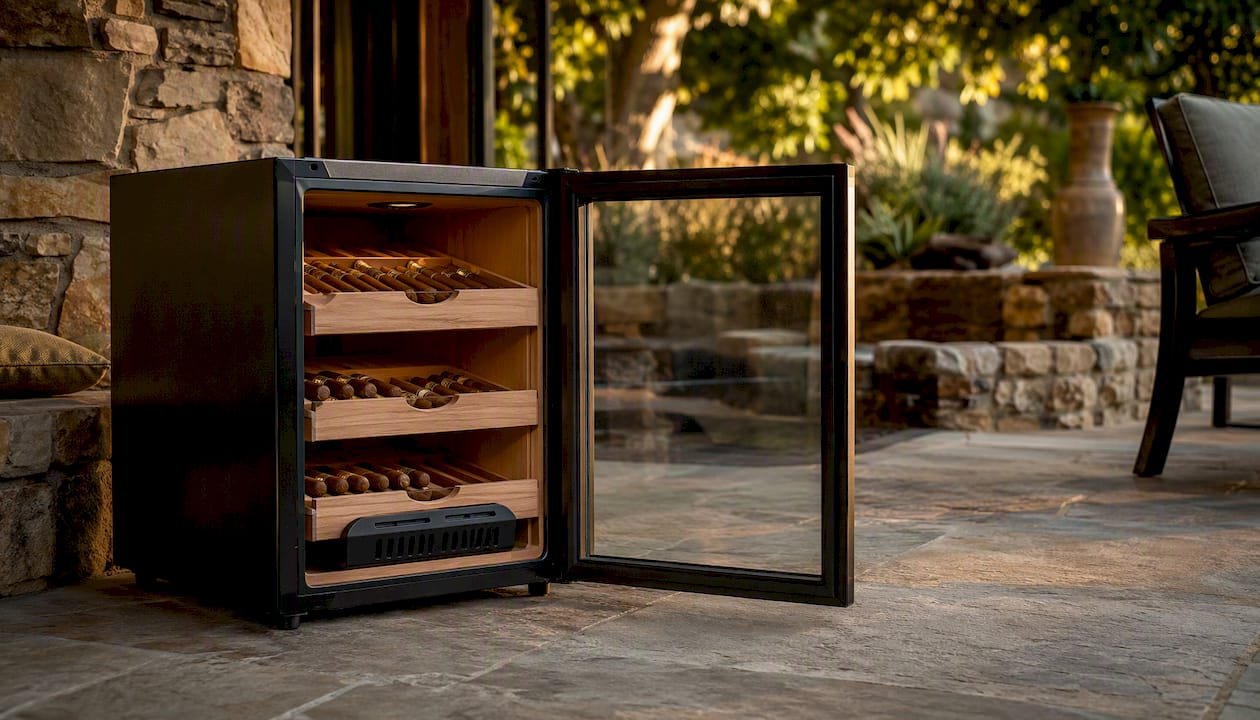
A properly built humidor delivers stable moderate temperatures suitable for cigar storage and relative humidity in the ideal range with almost no daily intervention. The single most important decision is this: use a thermoelectric wine cooler, load it with passive two-way humidification such as appropriate Boveda packs or Heartfelt beads, and place two calibrated digital hygrometers inside before putting in a single cigar.
Quick-start checklist before you buy anything:
- Thermoelectric humidor (single-zone, solid door seal, drain hole accessible)
- Boveda 320g packs or 1–2 lbs of Heartfelt humidity beads
- Two calibrated digital hygrometers
- Spanish cedar trays or custom cedar drawers
- Distilled water and baking soda for cleaning
- Aquarium-safe silicone or a temporary rubber plug for the drain hole
- Small 80mm computer fan and a mechanical outlet timer
- APC battery backup (optional but strongly recommended)
Four steps to start the build right now:
- Clean the interior and eliminate plastic odors before anything else touches the cooler.
- Seal or temporarily plug the drain hole.
- Place your humidification media and both hygrometers inside with the unit running but empty.
- Wait several days to about two weeks for RH to stabilize before loading boxes.
Staying at or below 70°F keeps tobacco beetles dormant. Those two numbers are the whole game.
Key Takeaways
| Point | Details |
|---|---|
| Choose thermoelectric | Thermoelectric coolers regulate temperature gradually; compressor units destabilize humidity and cause condensation swings. |
| Season before loading | Run the empty unit with media and hygrometers for 7–14 days before placing any cigars inside. |
| Target 62–65% RH | This range preserves wrappers, supports aging, and keeps tobacco beetles dormant at or below 70°F. |
| Monitor with two hygrometers | Place one at the top shelf and one at the bottom to catch humidity gradients in tall or dense units. |
| Thor’s Cigar Vault | Stocks calibrated hygrometers, Boveda 320g packs, and cedar-compatible accessories for a complete low-maintenance build. |
Table of Contents
- Which wine cooler should you use for a wineador setup?
- How to season and set up a wineador step by step
- Which humidification method works best in a wineador?
- How do you monitor RH and prevent humidity stratification?
- How should you arrange boxes and loose cigars in a wineador?
- Troubleshooting common wineador problems
- Thor’s Cigar Vault recommended starter kit for a low-maintenance build
- Thor’s Cigar Vault has everything you need to finish your build
- Sources
- FAQ
Which wine cooler should you use for a wineador setup?
The cooler you pick sets the ceiling on everything else. Get this wrong and no amount of Boveda packs will save you.
Thermoelectric vs. compressor: why it matters
Thermoelectric cooling is the right choice for cigar storage because it regulates temperature gradually rather than cycling hard on and off. Compressor units fluctuate aggressively, which destabilizes humidity and creates condensation swings that wreck wrappers over time. They’re also louder. For a sealed cabinet holding $500 worth of cigars, that volatility is a real problem.
Thermoelectric units do have a ceiling: they cool to a temperature below ambient room temperature by a moderate margin. If your storage room is very warm in summer, the cooler may struggle to maintain ideal conditions. Keep it in a climate-controlled space and you’ll never notice the limitation.
Models the community actually builds with
NewAir, Vinotemp, and Whynter are the three names that show up repeatedly in community builds. The NewAir AW-281E has its own dedicated forum thread with real-world build details, and the AW-280 series is one of the most documented wineador bases available. Vinotemp offers several single-zone thermoelectric models with interior heights that fit standard cedar drawer kits from makers like Wineadors.com. Whynter’s thermoelectric lineup is a solid alternative when NewAir or Vinotemp models are out of stock.
Many collectors buy cedar drawers from specialized makers like Wineadors.com for a clean fit inside these units, rather than improvising with wire racks.
What to look for when buying
- Single-zone temperature control (dual-zone units complicate RH management)
- Solid door seal with no visible gaps or warping
- Accessible drain hole for fan cable routing or sealing
- Interior height and slot spacing that fits your cedar tray dimensions
- Capacity matched to your collection: a 28-bottle unit holds roughly 25–40 boxes depending on tray configuration; a 46-bottle unit can hold 50+ boxes
Pro Tip: Before buying, measure the interior depth and width against the cedar drawer dimensions from Wineadors.com. A quarter-inch mismatch means shimming or returning the unit.
How to season and set up a wineador step by step
Conversion walkthroughs consistently show that collectors who skip seasoning and load boxes immediately end up chasing RH for weeks. Do the work upfront.
Step 1: Clean and remove plastic odors
New wine coolers smell like a plastic factory. That odor transfers to tobacco.
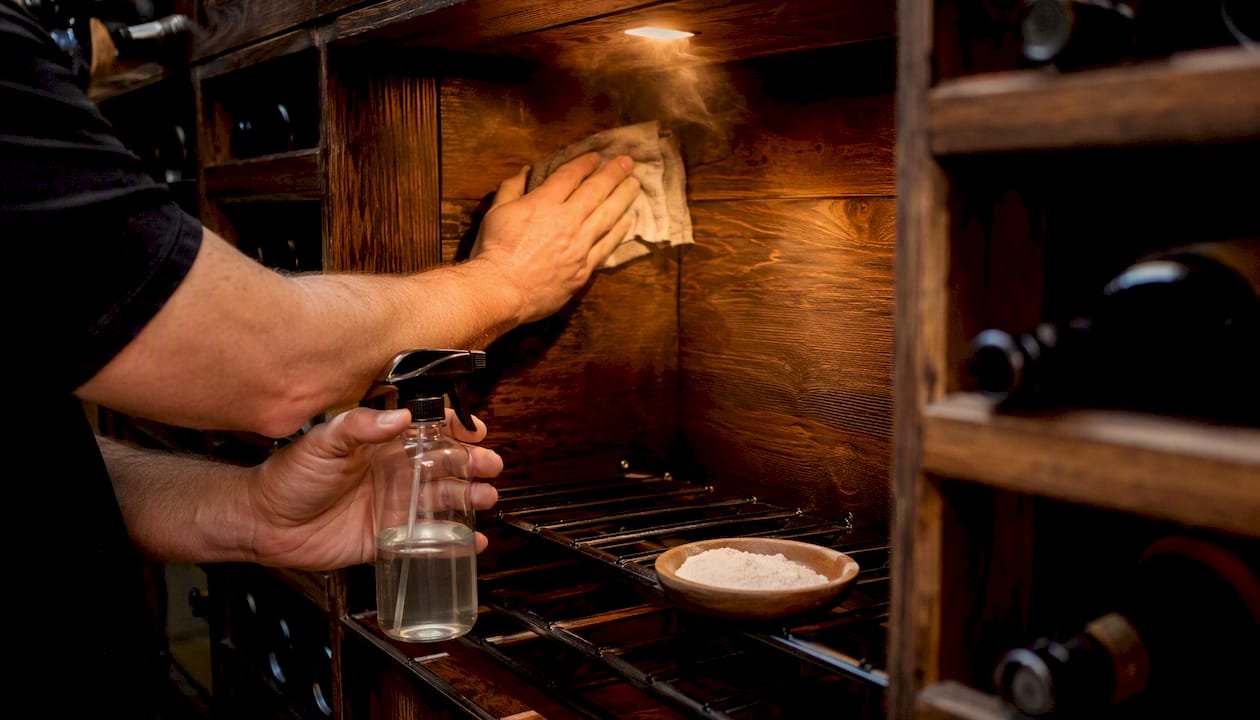
Wipe the entire interior with a solution of baking soda and water or diluted white vinegar, then let it air dry completely. Next, crumple several sheets of newspaper or pour a shallow dish of baking soda inside, close the door, and run the unit for 2–4 days. Check the smell. If it’s still sharp, repeat. Only move forward when the interior smells neutral.
Step 2: Handle the drain hole
The drain hole is a slow leak waiting to happen. Community builders(https://simplystogies.com/wino/) almost universally seal it, either temporarily with a rubber plug or permanently with aquarium-safe silicone once the build is proven. The decision depends on your fan setup: if you’re routing a fan cable through the drain hole, leave it open until the cable is in place, then seal around the cable with silicone. If you’re not using a fan, plug it now.
Temporary plugs work fine during seasoning. Permanent silicone sealing is the right call once you’re satisfied with the build and don’t need the hole for cable routing.
Step 3: Install cedar trays or drawers
Remove the original wire wine racks. Slide in your Spanish cedar trays or custom drawers. Cedar absorbs and releases moisture slowly, which buffers RH swings and adds a mild cedar character over time. Plastic bins work for loose sticks but don’t contribute to RH buffering the way cedar does.
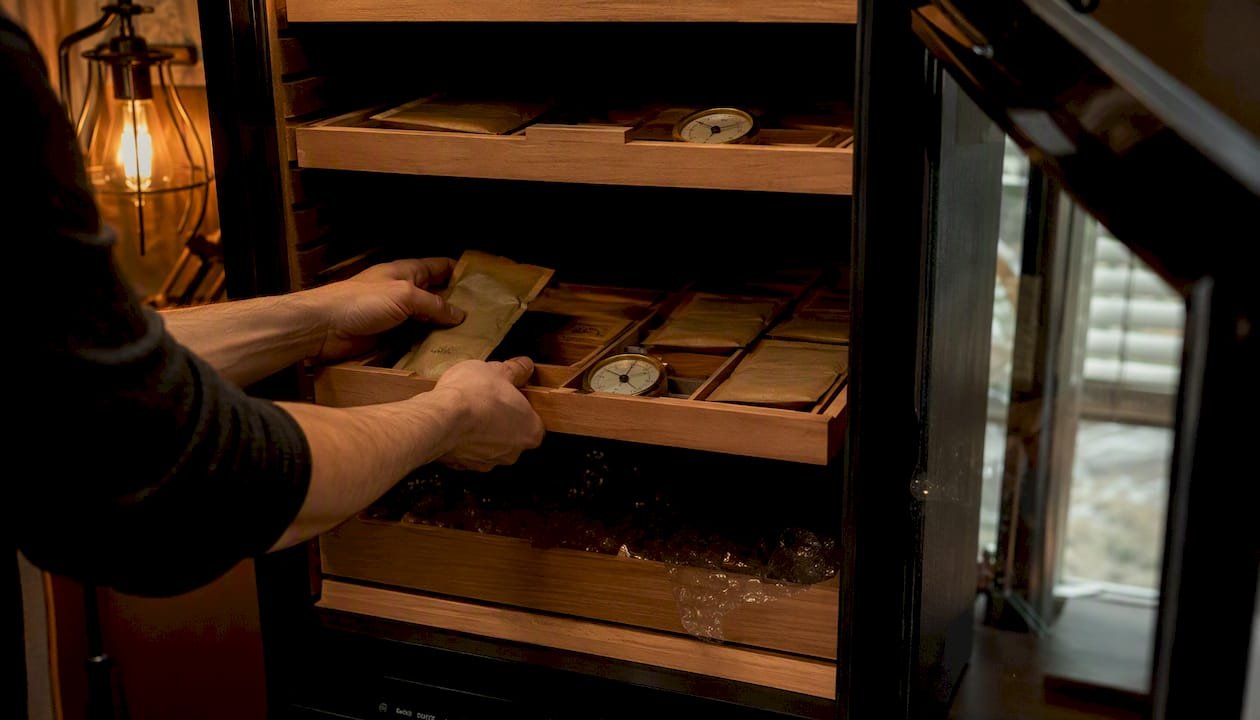
Step 4: Place humidification media and hygrometers
Set your Boveda packs or Heartfelt beads on the shelves before any cigars go in. Place one calibrated hygrometer near the top shelf and one near the bottom. Close the door and let the unit run.
Step 5: Wait for stabilization
| Stage | Timeline | What to watch |
|---|---|---|
| Initial RH climb | Hours 1–24 | RH rising from ambient toward target |
| Active stabilization | Days 2–7 | RH settling; top/bottom readings converging |
| Confirmed stable | Days 7–14 | Both hygrometers reading within 2–3% of each other |
| Ready to load | Day 14+ | Consistent readings across two full days |
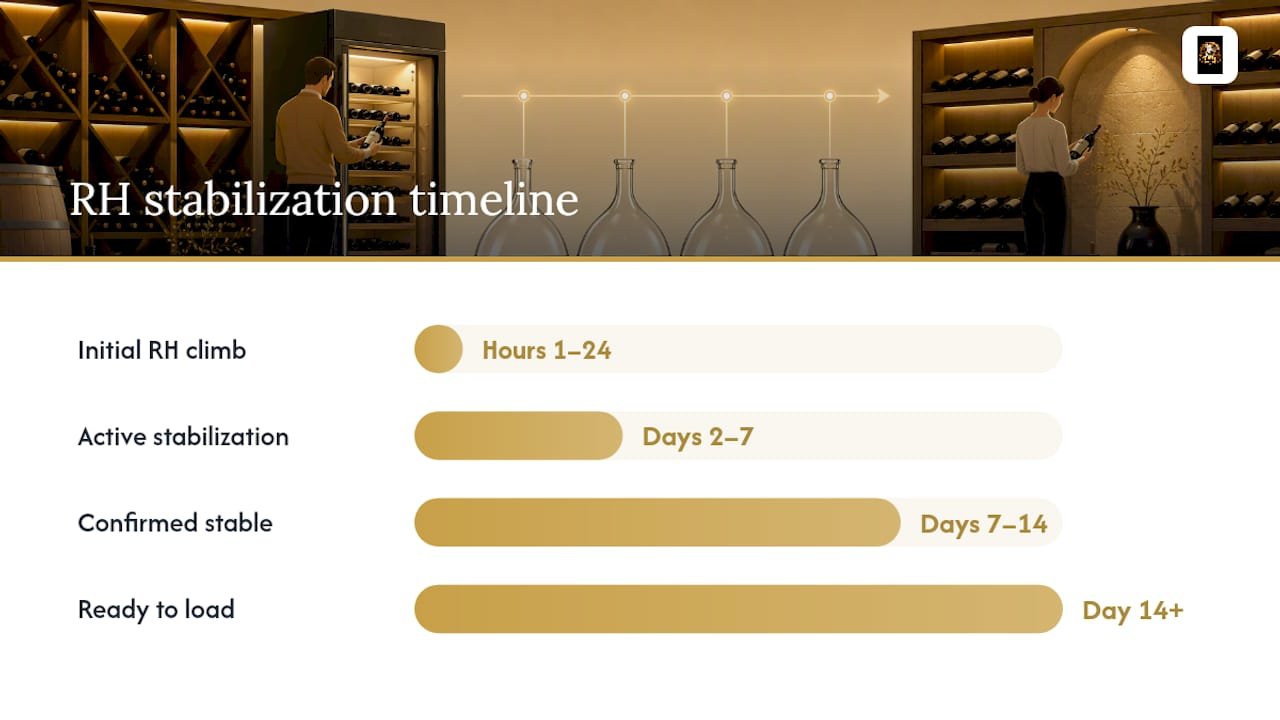
Most builders report reliable RH behavior after about a week, though some units with larger interiors or drier starting conditions may take longer.
Pro Tip: Record your hygrometer readings every morning for the first two weeks. A simple notes app entry takes 10 seconds and gives you a clear picture of whether RH is trending or stable.
Which humidification method works best in a wineador?
The short answer: passive two-way systems (Boveda packs or Heartfelt beads) for almost every build. Active humidifiers are a last resort.
Boveda two-way packs
Boveda packs are the lowest-maintenance option available. They absorb excess moisture when RH climbs and release it when RH drops, maintaining a fixed set point without any intervention. For box storage in a wineador, the 320g size is the right format. Smaller packs dry out faster and require more frequent replacement.
Community experience confirms that multiple 320g packs keep RH stable in larger wineadors without active systems. A rough starting point: a general guideline is to use one 320g pack per a moderate number of cigars, with adjustments as needed based on recovery after door openings. Boveda packs are safe in direct contact with cigars and don’t require distilled water top-ups.
Replacement frequency depends on ambient conditions, but packs are replaced every few months in a well-sealed unit. The pack feels hard and crinkly when it’s spent.
Heartfelt humidity beads
Heartfelt beads offer a fixed RH set point and handle larger capacities efficiently. They’re popular for wineadors because a pound or two covers a lot of cubic space and recharging is straightforward: add distilled water when the beads shrink noticeably and RH starts drifting low. Start with 1–2 lbs for a standard 28-bottle unit and increase if recovery time after door openings is slow.
The advantage over Boveda is cost per cubic foot at scale. The tradeoff is slightly more hands-on maintenance: you need to monitor bead volume and recharge before they fully deplete.
Active humidifiers (Cigar Oasis and similar)
Active humidifiers can work in a wineador, but they carry real risk in a sealed cabinet. Forum members consistently warn against Oasis-style devices in fully sealed wineadors without a way to vent excess moisture. Over-humidification and mold are the common outcomes when an active device runs unchecked in a tight space.
Comparison: humidification methods at a glance
How do you monitor RH and prevent humidity stratification?
Monitoring is where most first-time builds cut corners, and it’s where most problems start.
Use at least two hygrometers
Expert collectors place at least two calibrated digital hygrometers inside — one near the top shelf and one near the bottom. Humid air can rise slightly, so the top of a tall wineador often reads higher than the bottom. Without two sensors, you’re flying blind on half your collection.
Placing sensors at both ends also tells you whether your fan is doing its job. If the gradient shrinks after you add circulation, the fan is working. If it stays wide, you need more airflow or a different fan placement.
Calibrate before you trust any reading
Apply that offset to every reading going forward.
Check calibration every 6 months or after any power interruption.
Add a small circulation fan
Computer fans on timers are the standard fix for RH stratification. An 80mm CPU fan running on a timer with regular intervals moves enough air to even out humidity without excessively drying out the media. Route the cable through the drain hole before sealing, or use a thin cable pass-through if the drain is already sealed.
Pro Tip: Pair the fan timer with an APC battery backup. Power interruptions reset mechanical timers and leave fans offline. The backup keeps everything running through short outages and gives you time to respond to longer ones.
- Mount the fan on a lower shelf bracket pointing upward, or on the back wall pointing toward the door.
- Set the timer to 15 minutes on, 45 minutes off as a starting point.
- Check the top/bottom hygrometer gradient after 48 hours. If it’s still more than 3%, increase the on-cycle to 20 minutes.
- Recheck weekly for the first month.
How should you arrange boxes and loose cigars in a wineador?
Organization affects airflow, which affects RH consistency. A tightly packed wineador with no gaps creates humidity pockets.
Box storage rules:
- Stack boxes with small gaps between them for air circulation.
- Keep boxes a modest distance from the back wall and cooling element. The back wall is the coldest surface; cigars pressed against it can develop condensation on the wrapper.
- Rotate box positions every 2–3 months so boxes near the cooling element and boxes near the door age at similar rates.
- Store boxes with the lid side up so you can open them without disturbing the stack.
Loose sticks:
Cedar trays work well for loose cigars. If you’re mixing loose sticks with boxed cigars, consider a small tupperdore (an airtight plastic container with its own Boveda pack) placed inside the wineador. This gives loose sticks a more stable micro-environment and keeps them from absorbing flavors from neighboring boxes.
Layout by position:
- Top shelves: slightly higher RH, good for cigars you want to age with a touch more moisture.
- Bottom shelves: slightly lower RH and closer to the cooling element; better for cigars you plan to smoke sooner.
- Middle shelves: the most stable zone for long-term storage.
Avoid stacking boxes so high that you can’t easily read the labels. You’ll open the door more often when you’re hunting for a specific stick, and every door opening costs you RH recovery time.
Troubleshooting common wineador problems
Most issues trace back to three causes: the drain hole, the humidification media, or the ambient room temperature. Work through them in that order.
Condensation on the interior walls or boxes
Condensation usually means the cooler is set too cold relative to the room’s dew point, or the drain hole is letting in warm humid air that hits the cold walls.
- Raise the temperature setpoint by 2–3°F and wait 24 hours.
- Check the drain hole plug. If it’s loose or missing, reseal it.
- If condensation persists, check whether the door seal is making full contact around the perimeter.
RH too high
- Remove one or two Boveda packs and wait 48 hours before reassessing.
- If using an active humidifier, lower its output setting or switch to passive media entirely.
- Run the fan for longer cycles to accelerate evaporation.
- Check for pooling water near the drain or from a leaking humidifier reservoir.
RH too low
- Add Boveda packs or recharge Heartfelt beads with distilled water.
- Check the door seal for gaps. A warped seal is a slow but constant leak.
- Confirm the drain hole is fully sealed.
Mold
Inspect new acquisitions before they go in.
Beetle prevention
Tobacco beetles become active above 72–74°F. Keep your temperature setpoint at or below 70°F. Freeze new acquisitions before introducing them to an established collection: 72 hours at 0°F, then a gradual return to storage temperature over 24 hours to prevent wrapper cracking.
Power loss
An APC battery backup keeps the cooler and fan timer running through short outages. For longer outages, move boxes to a sealed tupperdore with fresh Boveda packs. Check RH with both hygrometers when power returns and give the unit 24 hours to restabilize before trusting the readings.
If your cooler stops cooling or the thermoelectric module fails, contact the manufacturer’s support line. For accessory questions or replacement humidification media, the team at Thor’s Cigar Vault can point you to the right replacement.
Thor’s Cigar Vault recommended starter kit for a low-maintenance build
This is the kit that covers every variable in a single purchase list, with no redundant parts and no guesswork about compatibility.
Recommended components:
- Thermoelectric wine cooler (NewAir AW-281/280 series, Vinotemp single-zone, or Whynter thermoelectric): the foundation; choose based on your target box count and available space.
- Spanish cedar trays or custom cedar drawers (Wineadors.com or equivalent): cedar buffers RH and adds mild flavor development over time.
- Boveda 320g packs (62% or 65%): the lowest-maintenance passive media for box storage; replace every 2–4 months.
- Heartfelt beads (1–2 lbs): an alternative or supplement to Boveda for larger units; recharge with distilled water as needed.
- Two calibrated digital hygrometers: place one at the top shelf and one at the bottom; calibrate before first use.
- 80mm computer fan on a mechanical outlet timer: set to 15 minutes on, 45 minutes off; routes through the drain hole.
- APC battery backup: keeps the cooler and timer running through power interruptions.
- Aquarium-safe silicone: for permanent drain hole sealing once the build is proven.
Every item on this list earns its place through reliability and low upkeep. The Boveda packs require no distilled water, no reservoir checks, and no daily monitoring. The fan timer runs automatically. The APC backup removes the single biggest risk to a stable build: an unnoticed power interruption that lets RH drift for hours.
Thor’s Cigar Vault carries a curated selection of accessories to complete this kit, including hygrometers, humidification media, and cedar-compatible storage options. Browse the full accessory selection or reach out to the team directly for build-specific recommendations.
What actually matters most when converting a wine cooler
The collectors who get this right the first time share one habit: they season the unit completely before loading a single cigar. Not a day or two. A full week, with both hygrometers running and daily readings logged.
The other thing most guides understate is the drain hole. It looks like a minor detail. It isn’t. A slow leak through an unsealed drain can drop RH by 5–8 points over a week in a dry climate, and you’ll spend days adding media before you find the actual cause. Seal it early, seal it properly, and you eliminate one of the most common failure points in the entire build.
Thor’s Cigar Vault has everything you need to finish your build
The accessories that make or break a wineador build — calibrated hygrometers, Boveda 320g packs, Heartfelt beads, cedar trays — are exactly what Thor’s Cigar Vault stocks for collectors who want a clean, low-maintenance setup without sourcing parts from five different vendors.

Thor’s Cigar Vault brings together premium humidification media, storage accessories, and a curated selection of cigars worth protecting. The team is available to answer build-specific questions, help you match media to your cooler’s capacity, and point you toward the right accessories for your collection size.
Shop the full accessory collection at Thor’s Cigar Vault, or browse the premium cigar selection to stock the wineador you just built.
Sources
The builds and troubleshooting flows in this guide draw from community consensus across multiple forum threads and how-to walkthroughs. These are the most practically useful:
Setup and conversion:
- Wineador – what’s all involved in set up | Cigar Forums
- What is a Wineador and How to Build One? – Cigar Inspector
- New wineador set-up help? – Humidors
- How to Build A Wineador – Stage V
- Cigarscore
- Wineador 101 – Simply Stogies – A Cigar Podcast
Model-specific builds:
Humidification and monitoring:
A note on using forums: prioritize threads with multiple replies and consistent advice from experienced members over single-post anecdotes. A tip that appears in five separate threads from different builders carries far more weight than one person’s experience with one unit.
FAQ
What is a wineador?
A wineador is a wine cooler converted into a cigar humidor, typically using a thermoelectric unit with cedar shelving and passive humidification media to maintain stable temperature and relative humidity for cigar storage.
What should you set your wineador humidity to?
This range preserves wrapper integrity, supports aging, and keeps tobacco beetles dormant when temperature stays at or below 70°F.
How long does it take for a wineador to stabilize?
Most builds stabilize within 7–14 days when seasoned empty with humidification media and two calibrated hygrometers in place.
What is the 70°F rule for cigar storage?
Keeping temperature at or below 70°F prevents tobacco beetle eggs from hatching. Beetles become active above roughly 72–74°F, so the 70°F ceiling is the standard safety threshold for any long-term storage setup.
Do you need to season a wineador before adding cigars?
Yes. Running the unit empty with humidification media and hygrometers for at least a week lets the interior wood and surfaces absorb moisture and reach equilibrium, which produces far more stable RH once cigars are loaded.