Which Humidor Protects 150 Cigars Best: Electric or Wood
Choose an electric humidor if you’re protecting a large or valuable collection and want precise, hands-off climate control. Choose a wood humidor if you have a smaller rotation, care about the ritual and look of Spanish cedar, and don’t mind checking a hygrometer every week or two. Both keep cigars smokable; they just ask different things of you in exchange.
TL;DR:
- Electric humidors provide ±1 to 2 percent RH precision and active temperature control, making them ideal for large or high-value collections.
- Wood humidors with Spanish cedar buffer humidity swings but require regular seasoning, hygrometer checks, and don’t include active temperature regulation.
- The actual capacity of electric humidors is often 10 to 15 percent lower than rated, especially in desktop models, due to internal hardware taking up space.
- Electric units typically need power and can fail suddenly, whereas wood humidors last decades but require physical maintenance and are non-electric.
- Proper initial setup, including seasoning and calibrating hygrometers, is crucial for both types to prevent damage and ensure optimal cigar aging conditions.
Table of Contents
- Electric Humidor vs Wood Humidor: The Quick Comparison
- How Do Humidity and Temperature Control Actually Differ?
- What Maintenance Does Each Option Really Require?
- Does a Wood Humidor Really Age Cigars Better?
- Which Humidor Size and Price Fits Your Collection?
- How Do You Set Up and Maintain a New Humidor Correctly?
- Are Electric Humidors Noisy Enough to Notice?
- How Long Do Electric and Wood Humidors Actually Last?
- Do Electric Humidors Hold Fewer Cigars Than They Advertise?
- What’s the Environmental Cost of Running an Electric Humidor?
- The Tradition vs Precision Debate Isn’t Really About Humidors
- Ready to Choose Your Next Humidor?
- Sources
- FAQ
Electric Humidor vs Wood Humidor: The Quick Comparison
The two approaches solve the same problem (stable humidity and temperature) with opposite philosophies. One uses sensors and fans to hold a number. The other uses wood, water, and your attention.
Here’s how they stack up on the factors that actually change your buying decision:
- Humidity precision: Electric units hold roughly ±1 to 2 percent RH using active sensors; wood humidors rely on Spanish cedar buffering and passive humidifiers, which can drift several points with weather swings.
- Temperature control: Electric cabinets often include active heating or cooling; wood boxes have none, which matters most in summer heat when tobacco beetle eggs can activate.
- Maintenance load: Wood needs seasoning before first use and regular hygrometer checks; electric units need less routine attention but depend on power and internal components staying functional.
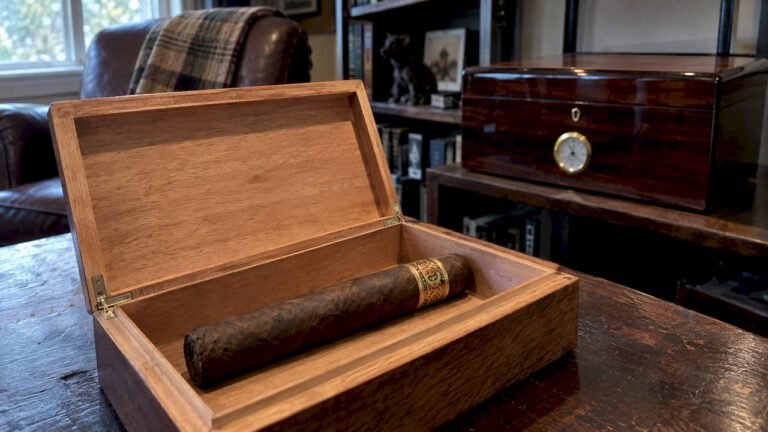
- Aesthetics and aging character: Wood, especially Spanish cedar, contributes a mild aromatic influence and the tactile experience collectors associate with cigar culture; electric cabinets are more clinical.
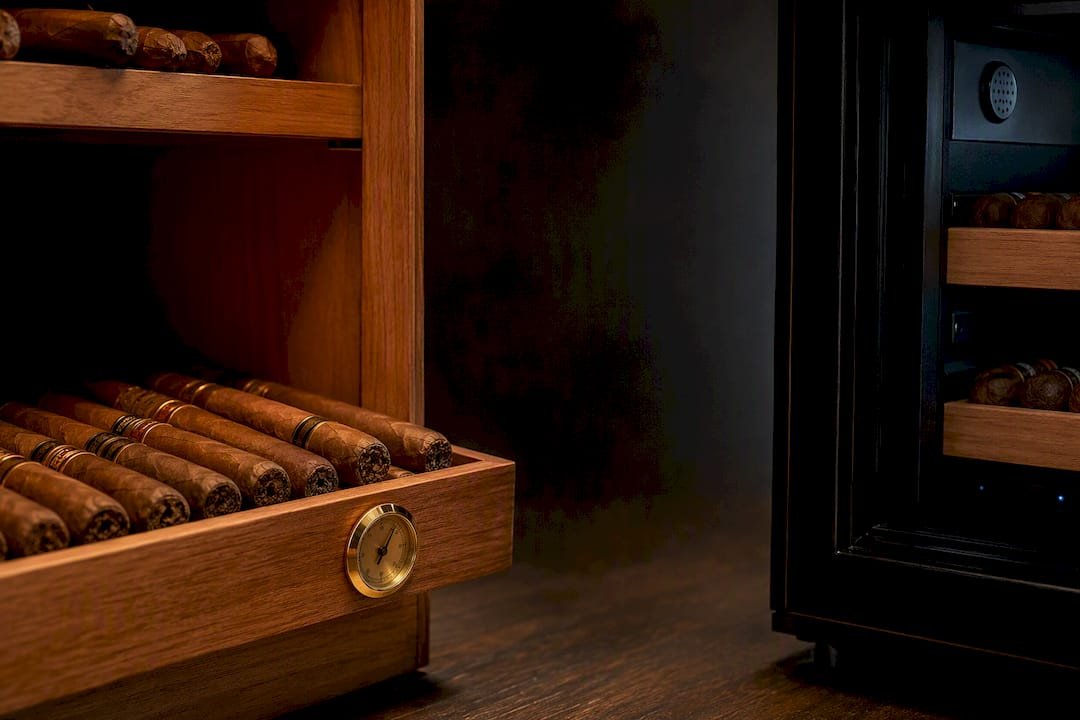
- Price and capacity: Wood desktop boxes start cheap and scale up slowly; electric units carry a higher entry price but often make more sense per cigar once you’re storing 150 or more sticks.
Neither wins outright. The comparison exists because your collection size, climate, and patience for maintenance point you toward one or the other.
How Do Humidity and Temperature Control Actually Differ?
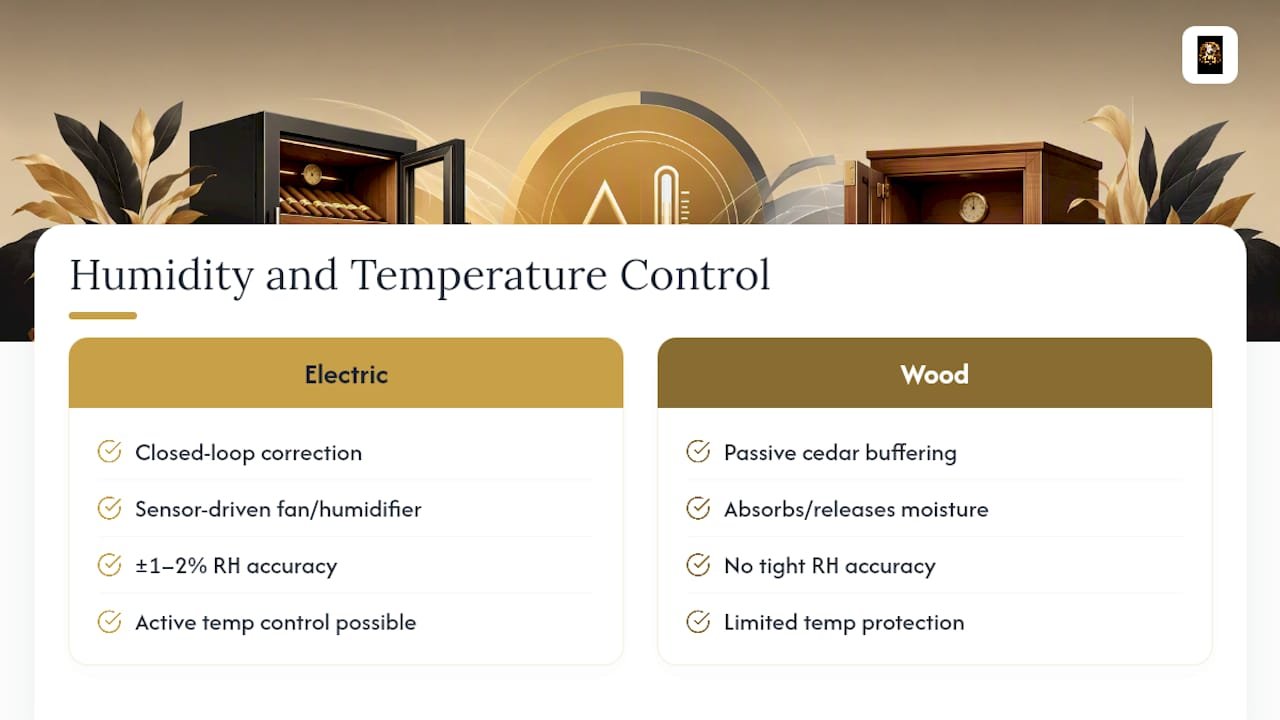
Electric humidors run a closed-loop system. A sensor reads the internal air, compares it to your target, and triggers a fan, a humidifying element, or in higher-end cabinets a small heating or cooling unit to correct the drift. That’s why manufacturers can advertise ±1 to 2 percent RH accuracy: the system is actively hunting for a set point rather than waiting for equilibrium.
Wood humidors work by buffering, not correcting. Spanish cedar absorbs excess moisture when the air is humid and releases it back when the air dries out, smoothing swings rather than eliminating them. That’s also why cedar helps deter tobacco beetles, whose eggs can hatch when temperatures climb into the mid-70s Fahrenheit and beyond, a risk wood alone doesn’t fully neutralize the way active temperature control does.
Both systems are chasing the same numbers. Cigar Aficionado’s storage guidance puts the target zone at roughly 68 to 72 percent RH and 68 to 70°F. Below that, cigars dry out and burn hot. Above it, you risk mold and beetle activity. A well-seasoned wood humidor in a stable room can sit inside that band for weeks. The same box in a house with swinging seasonal humidity might wander outside it every few days, which is exactly the scenario where electric control earns its price tag.
For a 300-count cabinet holding four-figure inventory, a one-point RH swing barely registers. For that same swing in a 25-count travel case, it can mean the difference between supple wrappers and cracked ones by the time you notice.
What Maintenance Does Each Option Really Require?
Wood humidors ask for a relationship, not a purchase. New units need seasoning, wiping the interior with distilled water or a humidification solution over several days until the cedar itself holds moisture, before you load any cigars. Skip this step and dry cedar will pull humidity straight out of your inventory instead of holding it steady.

Electric humidors mostly need less babysitting. Once the humidification element is filled and the sensor calibrated, many electric or acrylic-lined units require little to no seasoning at all. That convenience comes with a different risk profile: mechanical or power failure instead of slow humidity drift.
A practical maintenance routine looks like this regardless of type:
- Check the hygrometer weekly for the first month, then every two to three weeks once readings stabilize.
- Press on seals and gaskets monthly. A weak seal defeats both wood and electric systems equally.
- Refill or replace your humidification source, water, gel, or Boveda pack, on the schedule the product specifies rather than waiting for a low reading.
- If RH drifts more than three points from target for over 48 hours, inspect the seal before assuming the humidifier has failed.
Boveda packs deserve a specific mention here. They regulate to a fixed RH point and largely eliminate the overshooting that plagues sponge-style passive humidifiers, making them a smart hybrid fix for either humidor type.
Pro Tip: Keep a spare hygrometer in a sealed bag with a fresh 75 percent salt solution. When your primary reading looks off, you’ll have a known reference on hand instead of guessing whether the humidor or the gauge is lying to you.
Does a Wood Humidor Really Age Cigars Better?
Not dramatically, and not quickly. Spanish cedar’s contribution to aging is mostly indirect: it moderates humidity swings and adds a faint aromatic note to the wrapper over time, rather than actively transforming flavor the way barrel aging changes whiskey. Any meaningful aging effect, mellower smoke, integrated flavors, needs months at minimum and usually years, regardless of which humidor holds the cigars during that stretch.
Where wood humidors genuinely shine is the experience. Opening a cedar-lined box, catching that faint cedar note before you even pull a cigar, is part of why plenty of enthusiasts keep a wood display box even after buying an electric cabinet for the bulk of their collection.
Electric cabinets pull ahead when the stakes are financial rather than sentimental. If you’re holding a five-figure collection of limited releases, the ±1 to 2 percent precision and active temperature control reduce the odds of a humidity collapse wiping out months of aging in a single bad week. The most sensible setup for serious collectors is often both: a small wood desktop box for what you’re smoking soon, and an electric cabinet doing the heavy lifting on long-term storage.
Which Humidor Size and Price Fits Your Collection?
Capacity, not brand, is the first real filter. Industry sizing generally breaks into three tiers, and matching your actual cigar count to the right tier prevents both overspending and outgrowing a box in six months.
- Travel humidors hold roughly 5 to 25 cigars, built for portability rather than long-term storage, and are almost always passive wood or a hard-shell case with a small humidifier.
- Desktop humidors run 25 to 150 cigars and are where the electric-versus-wood decision matters most, since both formats compete directly at this size.
- Cabinet humidors start around 150 cigars and climb into the thousands; at this scale, active electronic systems become almost necessary to keep RH consistent across that much internal air volume.
Price follows a similar curve. Entry-level wood desktop boxes are inexpensive; electric desktop units and cabinets carry a real premium for the sensors, fans, and sometimes Peltier cooling inside. Retail buying guides generally recommend electric for collections over 200 cigars or in climates with heavy seasonal swings, while a well-sealed wood or acrylic box handles a casual smoker’s 30 to 50 count without issue.
A rough buyer breakdown: casual smokers with under 50 cigars are usually fine with a quality wood desktop box. Mid-range collectors in the 50 to 150 range should weigh climate stability before deciding. Serious collectors past 150, especially with rare or limited releases, are the group where electric earns back its cost.
How Do You Set Up and Maintain a New Humidor Correctly?
Getting a new humidor right in the first month prevents most of the horror stories you hear about ruined cigars. The process differs slightly by type, but both start with the hygrometer.
- Season a wood humidor first. Wipe the interior cedar with distilled water (never tap water, which leaves mineral deposits) daily for three to five days, or use a seasoning solution, until the wood stops absorbing moisture instantly.
- Calibrate your hygrometer before trusting any reading. The 75 percent salt test remains the simplest reliable method: seal a bottle cap of table salt with a few drops of water inside a sealed bag with your hygrometer for eight to twelve hours. A properly calibrated unit reads 75 percent; adjust or replace if it’s off by more than a couple of points.
- Size your humidification source to capacity. A single 60 gram Boveda pack typically covers a small desktop box; larger cabinets need multiple packs or a dedicated electronic reservoir sized to the interior volume.
- Plan for power loss on electric units. Keep a couple of Boveda packs on hand as backup humidification, and know that most cabinets hold stable conditions for a day or two on a well-sealed door alone during a short outage.
The 75 percent salt test isn’t optional theater, it’s the only way to know whether the number on your hygrometer reflects reality or a cheap sensor drifting by five or six points without telling you.
Are Electric Humidors Noisy Enough to Notice?
Most electric humidors run quiet enough to sit in a home office or bedroom without becoming a distraction, but “quiet” isn’t “silent.” The fan that circulates air past the humidification element produces a low hum, similar in character to a small refrigerator, and it cycles on and off rather than running continuously.
Cabinet-sized units with active cooling are the ones worth checking before you buy. A Peltier-based cooling system, the kind used to actively lower internal temperature, draws more current and tends to produce a more persistent hum than a simple humidity-only fan system. If you’re placing a unit in a quiet study or near a sleeping area, that constant low drone is worth testing in person or checking reviews for specifically.
Desktop electric humidors are generally the quietest option since they’re only managing humidity, not temperature, and cycle briefly rather than running continuously. Wood humidors, by contrast, produce zero operational noise since nothing inside them runs on power. For collectors who keep a humidor in a bedroom or a small apartment, that silence is a legitimate point in wood’s favor that rarely comes up in spec sheets but matters daily.
If noise is a concern, ask about decibel ratings before buying an electric cabinet, place it away from seating areas, or opt for a desktop electric model over a full cabinet, since smaller units generally run smaller, quieter fans.
How Long Do Electric and Wood Humidors Actually Last?
Wood humidors, cared for properly, can last decades. Solid, well-built cedar boxes have no motors, sensors, or electronics to fail, so the primary threats to longevity are physical: warped seals, cracked hinges, or wood that dries out and splits from years of neglect. A quality wood humidor that gets its hinges oiled occasionally and its seals checked can genuinely outlive the person who bought it.
Electric humidors have a shorter practical lifespan because they contain components that wear out. Fans, sensors, and humidification pumps are mechanical parts with a service life, typically several years of reliable operation before something needs replacing or the unit needs to be swapped out entirely. Higher-end cabinets with better components tend to outlast budget units, but no electric humidor is built to run maintenance-free forever the way a solid wood box can.
That doesn’t make electric a poor long-term bet. For a collector actively adding and rotating stock over five or ten years, replacing a $150 humidification module partway through that span is a minor cost against the protection it provided. The durability question really comes down to what fails and how visible the failure is: a wood humidor fails slowly and gives you warning signs (a hygrometer drifting, a seal feeling loose), while an electric unit can fail suddenly if a fan or sensor dies without notice. That’s one more argument for checking your hygrometer regularly no matter which type you own, since it’s often the earliest sign something in either system needs attention.
Do Electric Humidors Hold Fewer Cigars Than They Advertise?
Yes, and this catches a lot of first-time buyers off guard. An electric humidor’s advertised capacity is usually measured before accounting for the internal hardware, sensors, humidification trays, fans, and sometimes cooling coils, that takes up real interior space. A cabinet rated for 300 cigars might comfortably hold closer to 250 once you account for the equipment bolted to the back panel or floor.
Wood humidors don’t have this problem in the same way. Aside from dividers or trays, nearly the entire interior volume is usable space for cigars, since there’s no electronic hardware competing for room.
The gap matters most at the desktop size, where internal components take up a proportionally larger share of a smaller box. A 100 count electric desktop unit might realistically fit 80 to 85 cigars once you leave room around the humidification element for airflow. Cabinet-sized electric units lose a smaller percentage of capacity to hardware simply because the internal volume is larger relative to the equipment.
If you’re buying based on a specific target count, whether that’s 150 cigars or 300, ask the retailer or check reviews for real-world capacity rather than trusting the number on the box alone. Padding your target by 10 to 15 percent over what you actually plan to store is a reasonable rule of thumb when shopping electric units specifically.
What’s the Environmental Cost of Running an Electric Humidor?
Electric humidors draw continuous, low-level power to run their fans and humidification systems, and cabinet models with active cooling draw meaningfully more than desktop humidity-only units. None of this approaches the energy use of a household refrigerator, but it’s not zero, either, and it’s a legitimate consideration for anyone tracking home energy use or choosing between two similarly capable units.
Wood humidors have no operational energy cost at all. Their environmental footprint is entirely upfront, tied to the wood harvesting and manufacturing, and Spanish cedar is a renewable hardwood commonly grown for exactly this kind of use. Once built, a wood humidor consumes nothing to keep running for its entire lifespan.
The tradeoff isn’t clean-cut, though. An electric humidor that reliably prevents a humidity failure protects a physical investment, cigars, that took real agricultural resources to produce and that would otherwise go to waste if ruined by neglect or a lucky guess with a passive system. Looked at that way, the modest power draw of a well-functioning electric cabinet can be the more resource-efficient choice for a large, valuable collection, even if the wood box wins on raw energy use for a smaller one. If minimizing power draw specifically matters to you, a desktop electric unit without active cooling is a reasonable middle ground between a full cabinet’s energy use and a wood box’s zero draw.
The Tradition vs Precision Debate Isn’t Really About Humidors
Here’s the thing most buying guides get wrong: they frame electric versus wood as a technology argument, when it’s really a personality question. Some collectors get genuine satisfaction from checking a hygrometer, adjusting a Boveda pack, and knowing the exact moisture level by feel and smell rather than a digital readout. That’s not inefficiency, it’s the hobby working as intended for them.
Other collectors want the ritual to be smoking the cigar, not maintaining the box it came from. For that person, an electric cabinet holding a steady 70 percent RH without a single check-in for two weeks isn’t a compromise, it’s the whole point. Neither instinct is wrong, and pretending one is objectively superior misses why people get into cigars in the first place.
Where I’d push back on conventional advice is the idea that beginners should default to wood because it’s “traditional” and cheaper. That logic ignores climate. A new collector in a humid Gulf Coast summer or a dry Rocky Mountain winter is fighting their environment with a passive buffer that was never designed to correct for 20-point swings. Sometimes the more traditional choice is also the harder one to execute well, and a modest electric desktop unit saves that same beginner from ruining their first real purchases while they learn.
— Kevin
Ready to Choose Your Next Humidor?
Whichever direction you land on, precision cabinet or cedar-lined classic, some retailers stock both approaches with real capacity and price differences explained up front, not buried in a spec sheet you have to decode yourself.

Our humidor category covers desktop, travel, and cabinet options across both electric and wood construction, so you can compare capacity and price side by side instead of guessing from a single product listing. If you’re setting up a new box, our accessories selection includes Boveda packs and hygrometers sized for everything from a 25 count travel case to a 300 count cabinet. And once your storage is sorted, it’s worth filling it with something worth aging. Browse our cigars for the rare and limited blends that make a well-maintained humidor worth the effort in the first place. Not sure which size or type fits your collection? Reach out through the site and our team will walk through your climate, budget, and collection size before you commit to either one.
Sources
- Amber Ash — Desktop vs Travel vs Cabinet humidor guide
- Wood Database — Spanish cedar
- Cigar Aficionado — Storing cigars
- Luxury Wine Appliances — Electric vs Traditional Cigar Humidor
FAQ
What Is the 135 Rule for Cigars?
Ideal storage conditions are roughly 68 to 72 percent relative humidity and 68 to 70°F, with a small margin of error on either side. This range is the expert recommendation for humidor conditions, as detailed in 68 to 72 percent RH and 68 to 70°F.
What Is the Best Type of Humidor?
There’s no single best type. A wood humidor lined with Spanish cedar suits smaller collections, display, and lower upfront cost, while an electric humidor suits large or valuable collections that need ±1 to 2 percent RH precision and less manual upkeep. Thor’s Cigar Vault carries both formats across desktop, travel, and cabinet sizes so you can match the type to your actual collection.
Do Electric Humidors Need to Be Seasoned?
Most electric or acrylic-lined units need little to no seasoning compared to raw wood, since there’s no dry cedar pulling moisture from the air. Always check the manufacturer’s instructions, since some electric cabinets still use cedar interior panels that benefit from a light seasoning pass.
Do Electric Cigar Humidors Need Water?
Yes, most electric humidors still need a water or humidification solution reservoir to generate moisture, the electronics just automate distribution and monitoring rather than replacing the need for water entirely. A few advanced models use gel cartridges or Boveda-style packs instead of a manual reservoir, but some form of humidification source is still required.
How Do I Calibrate My Hygrometer?
Use the 75 percent salt test: seal your hygrometer in a bag with a bottle cap of table salt moistened with a few drops of water for eight to twelve hours. A correctly calibrated hygrometer should read 75 percent; if it’s off by more than a couple of points, adjust it or plan to replace it.