
Cigar Ash Etiquette: One Inch, Gentle Taps, Safer Lounges
The single most important rule of cigar ash etiquette is patience: let the ash build to about about a short length, or until a seam or crack forms, then remove it with a gentle tap or roll rather than a flick. This preserves flavor and avoids a frustrating relight, and it signals to anyone nearby, whether at Thor’s Cigar Vault or a crowded lounge, that you know what you’re doing.
TL;DR:
- A tapered porcelain tray gives you an edge for rolling stubborn ash off, while deep metal or glass trays work better with a gentle tap.
- A dim ember or gray, cool foot needs a quick relight; if the cigar still glows orange, let it rest for a minute instead.
- Cool ash overnight, then place it in a covered metal container outdoors, at least 10 feet from buildings; embers can reignite for 72 hours.
- Keep bands and wrappers out of communal trays, leave cigar stubs there unless venue staff says otherwise, and avoid tapping during a host’s tasting notes.
Table of Contents
- How do you properly ash a cigar?
- What your cigar’s ash reveals about its construction
- Ashtray etiquette when you’re sharing a space
- Keeping ash and embers from becoming a fire hazard
- The ashing mistakes that give you away as a beginner
- Gear that supports better ash habits
- Ashing etiquette when there’s no ashtray nearby
- Casual hangouts versus formal cigar events
- Managing ash during tastings and group sessions
- Why ashing well is really about respect
- Gear up for better ashing habits
- FAQ
- Sources
How do you properly ash a cigar?
Timing matters more than motion. Wait until the ash reaches roughly one inch, or until you notice a natural seam or crack forming near the foot, according to Cigar Aficionado’s ashing guide. Well-constructed, long-filler cigars often hold ash well past that mark, so treat an inch as a guideline rather than a deadline.
Once the ash is ready to go, follow this sequence:
- Hold the cigar level over the ashtray so loose ash falls straight down instead of scattering.
- Tap the cigar lightly against the rim, letting gravity do the work rather than your wrist.
- If the ash clings, roll the tip gently against the ashtray’s edge to shear it off cleanly.
- Check the foot; if the burn looks uneven, let it sit a moment before puffing again.
The ashtray itself changes your technique slightly. A tapered porcelain tray gives you a sharp edge for rolling the tip, which works well for shearing off a stubborn cap of ash. A deep metal or glass tray, common in lounges, favors a soft tap against the inner wall since there’s less of a defined lip to roll against.
Relighting is a judgment call. If the ember looks dim or the foot has gone gray and cool after ashing, a quick relight keeps the burn even. If the cigar is still glowing orange underneath, resist the urge to fuss with it and let it breathe for a minute instead.
Pro Tip: Rotate the cigar a quarter turn before you ash it. This evens out any one-sided burn before it becomes a problem.
What your cigar’s ash reveals about its construction
Ash isn’t just leftover tobacco. It acts as insulation around the ember, helping the burn stay even and the flavor stay consistent from the first third to the last, as Cigar Aficionado’s glossary on ash explains. Knock it off too early and you expose the coal to drafts that can cause tunneling or an uneven burn.
Color and texture tell you something, too. A firm, light gray to white ash usually points to well-fermented, high-quality tobacco and careful rolling. Flaky, dark, or crumbly ash tends to show up more often in short-filler cigars, where the loosely packed leaf can’t hold its shape as well.
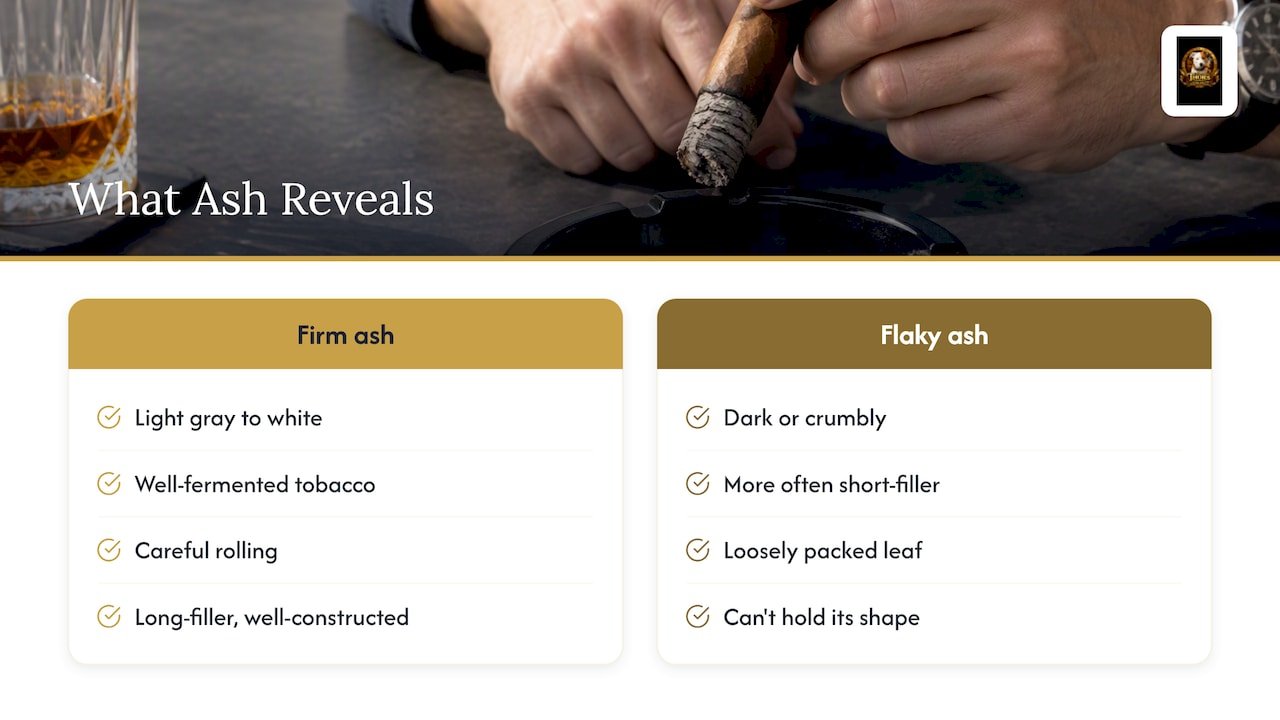
That’s also why a long, unbroken ash is something smokers take pride in. Holding an inch or more without collapsing generally means the cigar is long-filler and well-constructed, a small but real marker of craftsmanship worth noticing before you tap it away.
Ashtray etiquette when you’re sharing a space
Shared ashtrays come with unwritten rules, and breaking them is one of the fastest ways to mark yourself as new to the lounge. According to guidance on fall fire safety and ember handling, seasoned patrons treat non-tobacco trash in a shared ashtray as both a mess and a potential fire hazard.
Keep these habits in mind:
- Never drop cigar bands, cellophane, food wrappers, or other trash into a shared ashtray.
- If you remove a band mid-smoke, pocket it or carry it to a trash bin instead of setting it in the tray.
- Keep your section of a communal ashtray tidy rather than letting ash and stubs pile up around your seat.
- If a shared tray is getting full, it’s fine to quietly flag it to staff or a server rather than letting it overflow.
When your cigar is finished, leave the stub in the ashtray rather than carrying it to a separate trash can unless a venue specifically asks you to. A cold, spent stub left neatly in the tray is a normal, expected sight; a smoldering one left unattended is not.
Pro Tip: If you’re unsure whether an ashtray is shared or assigned to your seat, ask a server rather than assume.
Keeping ash and embers from becoming a fire hazard
Cigar ash and the embers underneath stay dangerous far longer than most people expect. Hot embers can remain capable of reignition for up to 72 hours, even when the surface ash feels cool to the touch, according to fire-safety guidance on ember handling.
That single fact should shape how you dispose of ash at home or after an event:
- Let the ash cool completely before moving it anywhere, ideally overnight.
- Transfer it to a covered metal container, never plastic or cardboard, which can melt or ignite.
- Place that container outdoors, at least 10 feet from your home or any other structure.
- Skip the vacuum. Loose ash and lingering heat can damage a vacuum or spark inside it.
For a larger gathering or event, apply the same logic at scale: designate a metal collection container away from tents, decorations, or dry vegetation, and don’t let anyone dump a tray into a regular trash bag before it’s fully cooled.
The ashing mistakes that give you away as a beginner
A few habits mark an inexperienced smoker instantly, and they’re easy to fix.
- Flicking the ash sharply can crack the wrapper or knock the ember loose, hurting both flavor and burn.
- Over-tapping breaks down the ash structure before it’s ready, exposing the coal too early.
- Dumping bands or wrappers into a shared ashtray creates mess and, per ember-handling guidance, a small fire risk.
- If your ash breaks unevenly, simply roll the tip gently against the tray rather than drawing attention to it. A quiet correction is always better than a visible fuss.
Gear that supports better ash habits
The right accessories make good technique easier. We recommend a tapered ceramic ashtray for precise rolling, a sharp cutter for a clean draw that burns evenly, and a quality humidor to keep cigars at the humidity that produces that firm, long-holding ash smokers admire. Our humidors and accessories are chosen with exactly that kind of consistency in mind.
Ashing etiquette when there’s no ashtray nearby
Not every setting hands you a tray, especially outdoors or at a casual gathering. The fix is the same patience rule, applied more carefully.
If you’re at a cigar-friendly patio or event without a tray in reach, a portable cigar stand works well since it holds the cigar level and gives you a stable edge to tap against. In a pinch, a metal cup, an empty can, or any non-flammable container can substitute, as long as it won’t tip and won’t melt.
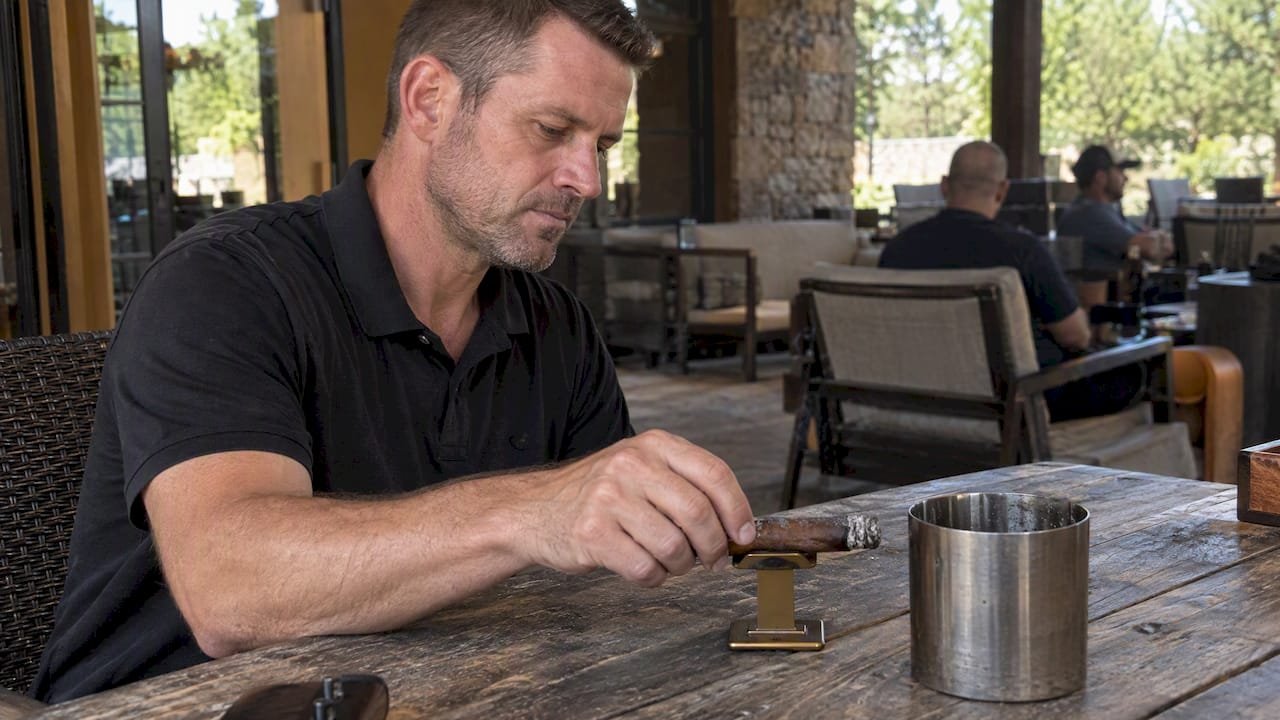
What you should never do is flick ash onto grass, gravel, or a sidewalk and walk away. Even small embers carry the same reignition risk as a full ashtray’s worth, so treat stray ash the same way you’d treat a dropped match: contained, not scattered.
If absolutely nothing is available, hold the ash longer than you normally would rather than dropping it on the ground. A cigar with good construction can often carry an extra half inch before it needs tending, buying you time to find a proper spot. When you finally do ash, do it over bare dirt, stone, or another clearly non-combustible surface, never near dry leaves or mulch.
Casual hangouts versus formal cigar events
The core rule doesn’t change between settings, but the margin for sloppiness does. At a backyard gathering or a casual smoke with friends, a slightly early tap or an imperfect roll barters won’t draw much notice.
Formal settings raise the bar. At a cigar dinner, a brand launch, or a lounge with a dress code, your ashing habits get watched the same way your posture or conversation does. Flicking, over-tapping, or leaving a messy tray reads as careless in a room full of people paying close attention to craft.
The safest approach at any formal event is to slow down everything: wait a beat longer before ashing, tap more gently than feels necessary, and keep your tray immaculate throughout the night. Hosts and fellow guests notice the difference, even if no one says anything.
Managing ash during tastings and group sessions
Group settings add a layer most solo smoking doesn’t: everyone’s ash becomes part of the shared visual and social experience.
During a formal tasting, try to pace your ashing with the group rather than constantly tapping ahead of or behind everyone else. If the host or lead smoker is narrating flavor notes or burn characteristics, hold off on ashing mid-sentence since the motion and tap can be distracting in a quiet room.
In a more relaxed group session, it’s fine to ash on your own schedule, but keep noise to a minimum and avoid reaching across someone else’s space to use a shared tray. If multiple trays are available, use the one nearest you consistently rather than switching around, which keeps the group’s shared surfaces cleaner and easier to manage as the session runs long.
Why ashing well is really about respect
Good ashing technique isn’t a performance for other people, though it often reads as one. It’s a small, repeated act of patience toward something that took months of fermenting and rolling to become what’s in your hand.
Rushing the ash, flicking instead of tapping, or ignoring the tray in front of you treats the cigar as disposable rather than crafted. Slowing down is the easiest form of respect available, both for the cigar and for whoever is sitting across from you.
— Kevin
Gear up for better ashing habits
Good technique is easier with the right tools on hand. Accessories from our shop, including tapered ashtrays, precision cutters, and reliable lighters, are built to support the steady, even burn that makes proper ashing simple.

If you’re putting together a group tasting or just want to practice on a few different profiles, our samplers give you a curated range without committing to a full box. Browse our cigars when you’re ready to stock up.
FAQ
Can you do anything with cigarette ash?
Cigarette and cigar ash don’t have practical household uses beyond occasional, informal gardening tricks that lack solid backing. The safest approach is simply cooling it fully and disposing of it in a covered metal container, since ember-handling guidance notes embers can stay hot for up to 72 hours.
Is there a correct way to smoke a cigar?
Yes: let the ash build to about an inch or until a seam forms, ash it gently rather than flicking it, and avoid deep inhalation since cigars still deliver nicotine through the oral mucosa, per the National Cancer Institute. Pace and patience matter more than any single technique.
Can you smoke in a cigar lounge?
Most dedicated cigar lounges are set up specifically for on-site smoking, though rules vary by venue and local ordinance. Always follow the lounge’s own posted policies and shared-ashtray etiquette rather than assuming any location allows it.
Do cigars give you a buzz without inhaling?
Yes, cigars can deliver a nicotine effect without deep inhalation because nicotine absorbs through the oral mucosa, according to NCI research on cigar pharmacology. Cigar smoke also contains toxic compounds similar to cigarette smoke, so it carries real health risks despite the different smoking style, per the CDC.
What does a long ash actually mean?
A long, stable ash usually indicates long-filler construction and careful rolling, and if you’re interested in quality options, consider browsing slow burning cigarettes in Canada for similar burn characteristics, according to Cigar Aficionado’s glossary. It’s a reasonable sign of quality, though burn time and flavor still depend on storage and how the cigar is smoked.
Sources
- How To Ash A Cigar — Cigar Aficionado
- Fall fire safety: embers — St. Charles (IL) news
- Cigars | Smoking and Tobacco Use | CDC