Light a Cigar in Wind with a Torch and a 10–15 Second Toast
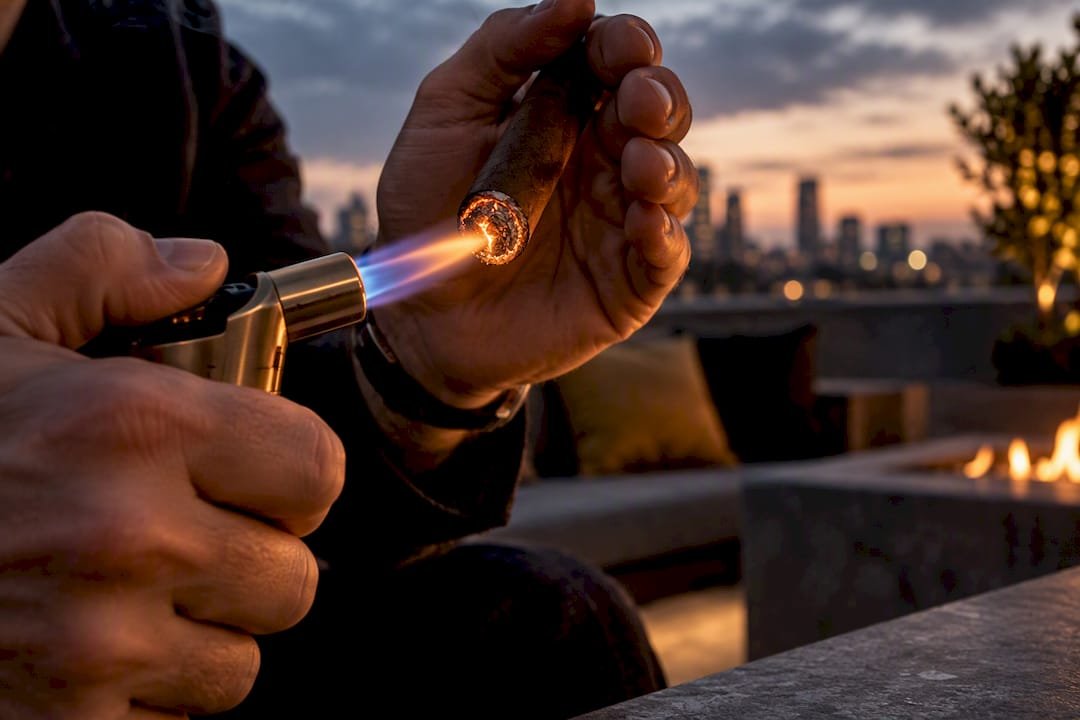
Use a butane torch and a quick toast of the foot while sheltering the ember, then rotate after each puff. That routine, backed by cigar authorities like Cigar Journal and retailers like Thor’s Cigar Vault, holds an even burn even when a breeze keeps interrupting your flame. Skip the toast step and wind will carve a canoe into your cigar before you finish the first third.
TL;DR:
- Using a torch lighter with high-quality butane provides a stable, wind-resistant flame ideal for outdoor cigar lighting.
- Properly toasting the foot with continuous rotation creates an ember that withstands gusts better than quick lighting methods.
- Angling the cigar and shielding the ember with your hand or a body part helps maintain the flame in gusty conditions.
- Thicker ring gauges and oilier wrappers burn more slowly and are less prone to uneven burning outdoors.
- Giving ample time to toast and correct uneven burn early prevents canoeing, tunneling, and relighting issues in windy environments.
Table of Contents
- Tools that actually work in wind
- The pre-light routine: cutting, toasting, and the first draw
- Holding, positioning, and rotating the cigar outdoors
- Choosing cigars that tolerate wind better
- Fixing an uneven burn once it starts
- Safety and etiquette for outdoor sessions
- Publisher perspective: what Thor’s Cigar Vault recommends
- When to light up: timing and weather matter
- Matching your technique to wind strength
- Using natural windbreaks effectively
- What outdoor smoking actually teaches you about patience
- Shop for wind-friendly cigars and accessories
- Sources
- FAQ
Tools that actually work in wind
A soft flame from a disposable lighter bends and scatters the moment a gust hits it. A butane torch or multi-flame torch lighter throws a concentrated, high-temperature jet that holds its shape, which is why Cigar Aficionado recommends torch-style butane lighters as the practical default for outdoor sessions. Refill with high-quality butane and purge the lighter after filling so trapped air does not sputter the flame later.
Petrol-fueled lighters, including classic Zippos, work in wind but leave a chemical taste on the wrapper that ruins the smoke. Long wooden matches or cedar spills are a solid backup: let the match head burn down fully before touching it to the cigar so sulfur does not transfer into the draw.
- A torch lighter’s jet flame resists gusts that would snuff a soft flame instantly.
- Cedar spills carry a clean flame from a candle or another lit cigar without adding fuel odor.
- Wooden matches need a few seconds to burn past the sulfur tip before use.
- Petrol lighters should stay in the drawer for cigars no matter how strong the wind gets.
Pro Tip: Carry two lighters on windy outings. A dead or empty torch with no backup means an unlit cigar for the rest of the walk.
The pre-light routine: cutting, toasting, and the first draw
Cut cleanly above the cap’s shoulder, then strip off any cellophane or loose cedar sleeve completely. Loose material near the foot catches wind and flame unevenly, which sets up a bad burn before you even light it.
- Hold the flame slightly off the foot rather than touching it directly, as Tobacconist University advises.
- Rotate the cigar slowly and continuously while toasting until the entire foot glows an even orange.
- Bring the cigar to your mouth and take short, repeated puffs while the flame stays near, not on, the foot.
- Check the burn line after three or four puffs and touch up any dark spot before it spreads.
Cigar Journal calls this toast a decisive step in wind: a well-toasted foot forms an ember that tolerates gusts far better than a quick light-and-draw attempt. Rushing this stage is the single biggest cause of canoeing outdoors.
Pro Tip: If the foot looks patchy after toasting, spin it back through the flame for another five seconds before your first puff instead of hoping it evens out on its own.
Holding, positioning, and rotating the cigar outdoors
Facing directly into a stiff wind blows the flame away from the foot and makes toasting nearly impossible, so angle your body so the wind crosses rather than hits the cigar head-on. A slight leeward lean gives the flame a stable pocket to work in without cutting off airflow completely.
Rotating the cigar is not optional outdoors. A shifting breeze burns whatever side faces it fastest, and rotation spreads that heat evenly around the foot instead of letting one side race ahead.
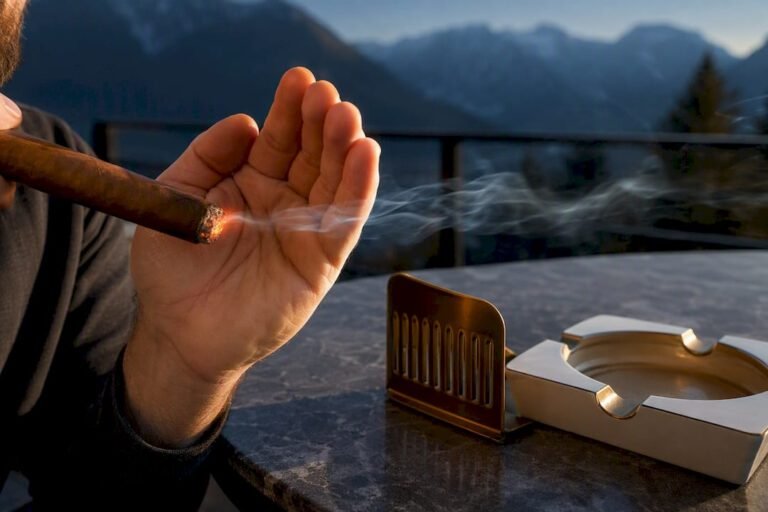
- Cup your free hand around the ember between puffs to block sudden gusts.
- A jacket collar, hat brim, or your own shoulder can serve as a quick windbreak.
- Space draws out rather than puffing rapidly, since overheating the foot causes its own uneven burn.
- Watch for a gust right as you exhale and pause your next puff until it passes.
Experienced smokers often let the ash itself act as a partial wind buffer, only knocking it off once it starts to look loose or long.
Choosing cigars that tolerate wind better
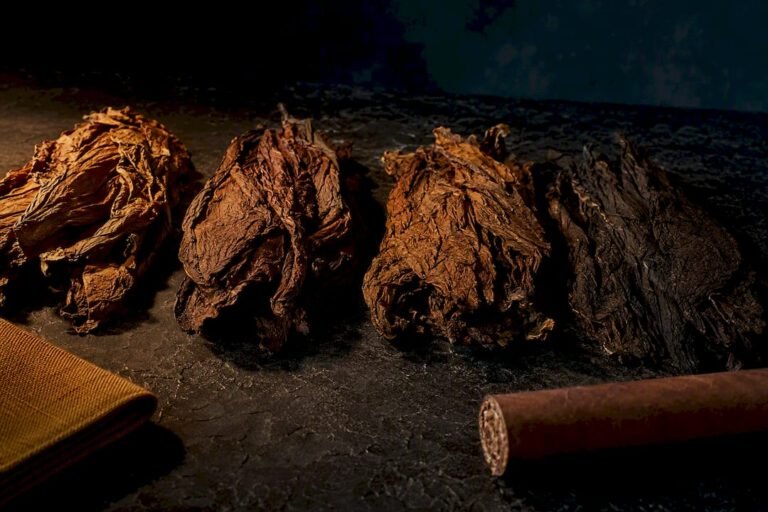
A thicker ring gauge and a heavier, oilier wrapper burn more slowly and resist the uneven heating that causes tunneling and canoeing. Robusto and toro vitolas with sturdy construction give you more margin for error than a thin lancero or panetela when the wind picks up.
Thinner or lighter-bodied cigars can still work outdoors, but they need shorter puffs and more frequent rotation to keep the burn line even. A delicate wrapper simply has less material to absorb an uneven blast of air.
- Thicker vitolas like a toro or robusto forgive wind-driven mistakes better than thin ones.
- Sampler packs are a low-commitment way to test which sizes hold up in your usual outdoor spot.
- Oilier, darker wrappers tend to burn slower and steadier than delicate lighter leaves.
Fixing an uneven burn once it starts
A canoe looks like one side of the cigar burning faster in a straight line, while tunneling shows the filler burning ahead of the wrapper in the center. Both are fixable if you catch them early.
- Rotate the faster-burning side away from the wind and let the slower side catch up naturally for a puff or two.
- If the gap persists, apply the torch directly to the slow side only, holding the flame there for a few seconds while rotating gently.
- Take two or three controlled draws to pull the correction through the burn line.
- If more than half the foot has gone out, relight the entire foot fully rather than patching a small section repeatedly.
Pro Tip: Repeated small touch-ups without a full relight usually make canoeing worse, not better, since you keep adding heat unevenly.
Safety and etiquette for outdoor sessions
Keep your ember and any dropped ash away from dry grass, mulch, or brush, and always extinguish a cigar completely rather than leaving it smoldering. Stick to butane or the wooden matches and cedar spills mentioned above, never improvised fuels.
Point smoke away from other people and check local rules before lighting up in a public outdoor space. If a cigar just will not draw right, run through the basics first: check the humidity it was stored at, inspect the construction for soft spots, and confirm the lighter’s fuel is fresh.
Publisher perspective: what Thor’s Cigar Vault recommends
A torch-style butane lighter paired with a sturdier vitola is recommended for anyone smoking outdoors regularly. Curated selections often include cigars with thicker ring gauges that hold up to a breeze better than delicate sizes, and knowledgeable tobacconists can point new and experienced smokers toward the right pick. Browse our samplers to try a few outdoor-friendly options before committing to a full box.
When to light up: timing and weather matter
Early evening and overnight tend to bring calmer air than midday, when heat differentials kick up gustier, less predictable wind. If you have flexibility, checking a local wind forecast before heading out saves you the frustration of fighting a relight every few minutes.
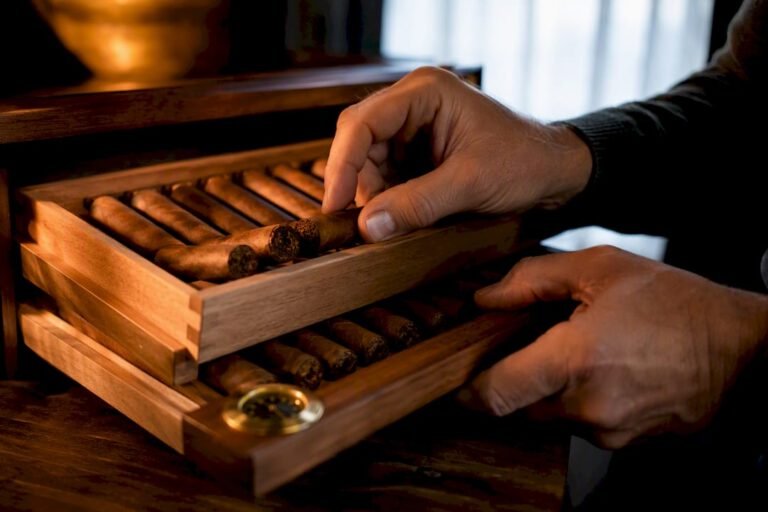
Humidity plays a role too. A cigar that has been stored properly lights more evenly than one that is too dry or too damp, since moisture content affects how the leaf burns under a flame. Thor’s Cigar Vault covers this in more detail in a guide to hygrometer calibration for anyone storing cigars at home.
Overcast, mild days with steady rather than gusty wind are often easier to light in than a bright, hot afternoon with unpredictable swirling air. Wind that blows steadily from one direction is far more manageable than wind that keeps shifting, since you can angle your body once and hold that position. A porch, patio, or any spot with a consistent breeze pattern beats an open field where gusts come from different directions every few seconds.
Matching your technique to wind strength
A light breeze barely changes your routine: toast normally, rotate as you go, and cup your hand around the ember only when a stronger gust passes through. Moderate wind calls for a more deliberate toast, holding the flame in place a beat longer on each side as you rotate, and using your body or a nearby object to break the airflow before you strike the torch.
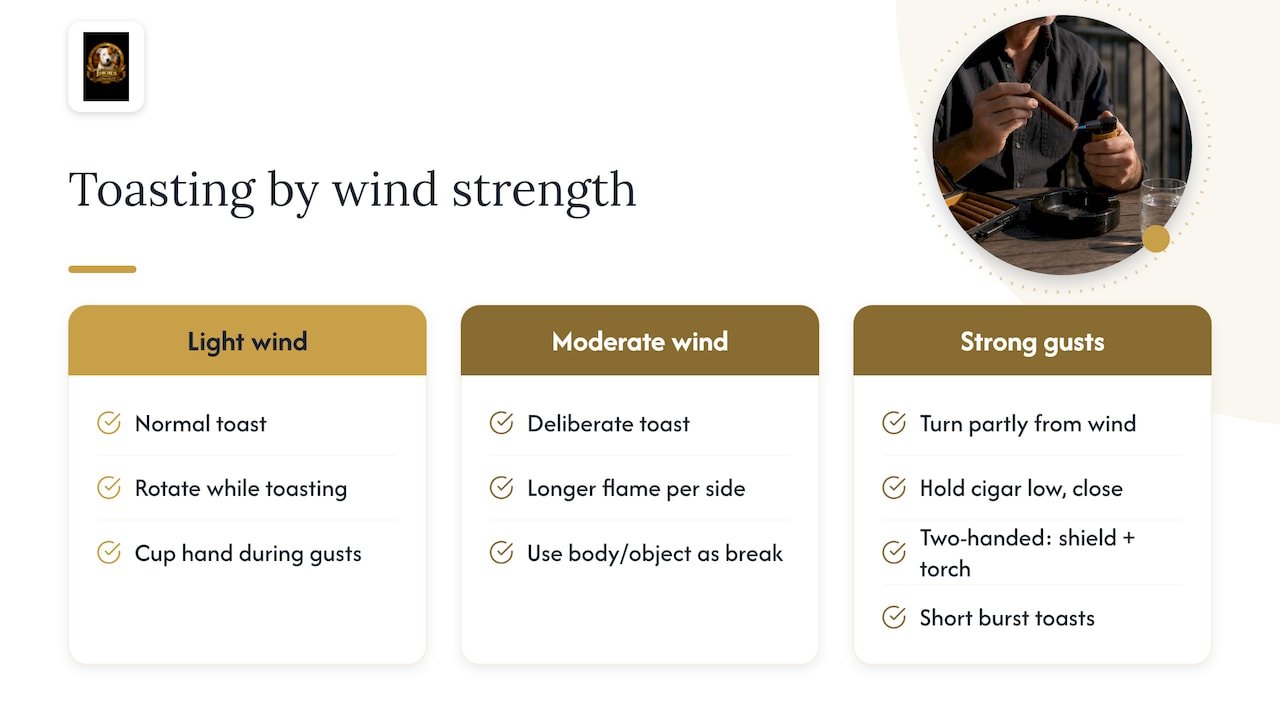
Strong, gusty wind requires the most defensive approach. Turn your back partly to the wind, hold the cigar low and close to your body, and use both hands, one to shield and one to hold the torch, while toasting in short bursts rather than one continuous pass. Take your draws immediately after each burst rather than waiting, since the ember cools fast in heavy wind.
In genuinely difficult conditions, stepping fully into any available shelter, even briefly, to get the foot properly lit before returning to the open air saves you from a string of failed relights. Once the ember is established and glowing evenly, it holds up to far more wind than an ember still in the toasting stage.
Using natural windbreaks effectively
A tree trunk, a parked car, a building corner, or even a low wall can cut wind speed enough to make lighting straightforward again. Position yourself so the object sits between you and the wind’s direction, not just nearby, since a windbreak only helps when it actually blocks the airflow reaching your hands.
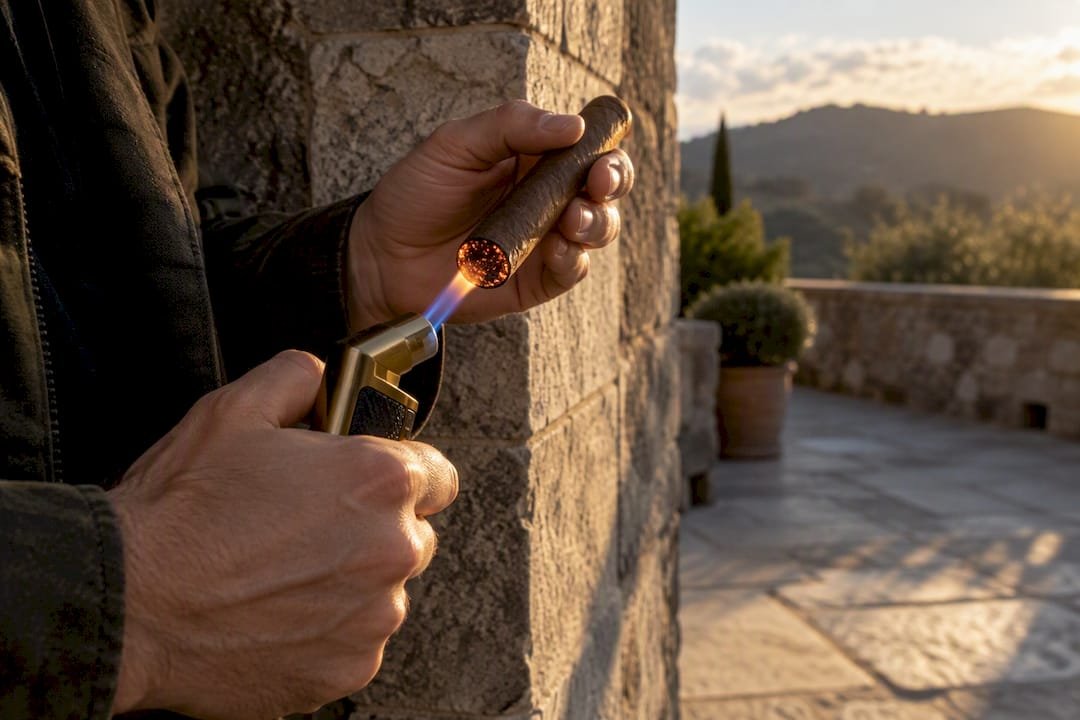
Standing close to the windbreak matters more than standing near it in a general sense. A few feet of distance from a wall or trunk can put you right back in turbulent air that curls around the edges of the shelter.
When no fixed object is available, another person can serve as a temporary windbreak by standing with their back to the wind while you light in the pocket of calmer air behind them. Your own hands cupped tightly around the foot work as a last resort windbreak when nothing else is nearby, though a torch flame still needs a small gap to breathe properly.
What outdoor smoking actually teaches you about patience
The gear matters less than most smokers assume. A good torch and a sturdy cigar cut your odds of trouble, but the real skill in windy conditions is slowing down at the exact moment your instinct says to hurry. Most canoeing and tunneling problems trace back to a rushed toast, not a weak lighter.
Conventional advice tends to focus heavily on equipment, as if the right torch solves everything. It helps, but a cheap lighter used patiently beats an expensive one used carelessly. If you take one thing from this guide, make it the toast: give the foot the full ten or fifteen seconds it needs to glow evenly before your first puff, regardless of how many people are waiting on you to light up.
Readers should also stop treating a touch-up as a failure. Even experienced smokers relight and correct outdoors. The difference is catching an uneven burn early rather than smoking through it and blaming the cigar afterward.
— Kevin
Shop for wind-friendly cigars and accessories
A sturdy vitola and a reliable torch make outdoor sessions far less frustrating, and Thor’s Cigar Vault carries both. Our samplers let you test a few thicker ring gauges before buying a full box, and our accessories page covers torch lighters and cutters built for exactly this kind of session.

- Browse Samplers for a low-commitment way to find your next outdoor-friendly cigar.
- Check Accessories for a torch lighter that holds up once the wind picks up.
- Reach out to our team if you want a vitola recommendation for a specific climate or setting.
Visit the Thor’s Cigar Vault shop to get started.
Sources
This guide draws on the National Cancer Institute, Cigar Journal, Cigar Aficionado, and Tobacconist University.
- Cigar Journal — Lighting up a cigar: Nothing to it
- Cigar Aficionado — How to light a cigar
- Tobacconist University — Cigar lighting FAQ
FAQ
Is Tom Cruise a cigarette smoker?
This is not something Thor’s Cigar Vault can speak to, since it falls outside cigar retail and technique. We recommend checking a dedicated entertainment or news source for accurate, current information on any public figure’s habits.
What is the 135 rule for cigars?
The 135 rule is a cigar storage guideline suggesting the sum of temperature in Fahrenheit and relative humidity percentage should land around 135, with a target range of roughly 133 to 137. Straying outside that range for extended periods raises the risk of mold or tobacco beetle activity, according to the CDC’s broader tobacco health resources.
What is a light cigar called?
There is no single standardized industry term for a “light” cigar the way there is for light cigarettes, since strength depends on wrapper, filler blend, and fermentation rather than a fixed labeling category. Terms like mild, medium, or full-bodied are commonly used descriptors instead of a specific product name.
Is 1 or 2 cigars a week ok?
The National Cancer Institute notes there is no safe level of tobacco smoke exposure, and cigar smoking carries cancer and cardiovascular risks regardless of frequency. Research also indicates that as many as 75% of cigar smokers are occasional users, which is associated with lower disease risk compared to daily cigarette smoking, though the National Cancer Institute stresses this is not risk-free.