Stop Hot Cigar Smoke Now: Slow Your Puffs, Purge, and Fix Your Humidor
A hot cigar almost always comes down to three things: you’re puffing too fast, the tobacco is too dry, or the roll has a construction flaw. Slow down, take a gentle purge, and check your humidor’s hygrometer before you blame the cigar itself. Hot cigar smoke tastes bitter and harsh, and it exposes you to more combustion byproducts than a properly paced smoke, so treat the burn as a signal to change something, not something to push through.
TL;DR:
- Puff slowly, aiming for about one draw every 45 to 60 seconds, to effectively lower combustion temperature and prevent overheating.
- Maintaining an optimal humidity level of 65% to 70% with a calibrated hygrometer is key to avoiding dry, overly dry, or overly moist tobacco that burns hotter.
- Properly lighting and re-topping the cigar with even toasting helps establish a consistent burn and reduces hot spots that accelerate heat buildup.
- Outdoor conditions like wind and dry climate can significantly increase burn temperature, requiring slower paces and wind protection to keep heat in check.
- High-quality, construction-focused cigars and moderate ring gauges naturally resist heat spikes better, especially when stored and smoked with discipline.
Table of Contents
- What Causes Hot Cigar Smoke?
- How Can You Tell a Cigar Is Burning Hot?
- What Should You Do Right Now to Cool It Down?
- How Do You Store Cigars to Prevent Hot Smoke Before It Starts?
- Why Does Cigar Combustion Get So Hot in the First Place?
- Do Different Blends and Wrappers Burn Hotter or Cooler?
- Can Weather and Wind Make Your Cigar Smoke Hotter?
- Does How You Light a Cigar Affect How Hot It Smokes?
- Is Hot Cigar Smoke Dangerous to Inhale?
- Thor’s Cigar Vault’s Take on Preventing Hot Smoke
- Gear That Actually Stops Hot Smoke Before It Starts
- Sources
- FAQ
What Causes Hot Cigar Smoke?
Combustion temperature isn’t fixed. It moves with how you smoke, how the tobacco was stored, and how the cigar was rolled. Four factors do most of the damage.
- Puffing too often or too hard. Every draw pulls oxygen into the coal and spikes its temperature. Puff every 30 to 45 seconds and the cigar cools between draws. Puff every 10 seconds and the coal never gets the chance, which pushes heat and tar toward the head faster than you can enjoy it.
- Tobacco moisture that’s off target. Dry leaf burns faster and hotter because there’s less moisture to slow the reaction. Over-humidified tobacco causes its own trouble: it burns unevenly, goes out, and forces harder relights that spike temperature right when you’re trying to save the stick.
- Construction flaws. A cigar rolled too tight starves the burn of airflow and creates hot spots. One rolled too loose burns fast and hot with a harsh, ashy taste. Testing on packing density and airflow ties both problems directly to combustion rate and flavor.
- Size and remaining length. Thinner ring gauges concentrate heat in a smaller combustion zone, and any cigar runs hotter in its last third as the burning cone gets closer to your hand and oils accumulate. Larger cigars generally show lower peak axial temperatures at the same puff volume than thin ones.
How Can You Tell a Cigar Is Burning Hot?
Your mouth and eyes will tell you before your brain fully registers it. Here’s the sequence to watch for:
- Heat on contact. The foot or the band area feels noticeably warmer than it did ten minutes earlier, and that heat lingers in your mouth after each draw instead of fading.
- Flavor collapse. Sweetness and complexity disappear, replaced by bitterness, ash, or a scorched taste that wasn’t there in the first third.
- A changing burn line. Fast, crumbling ash, a coning or “running” burn on one side, or visible tunneling down the center all point to a hot, uneven coal.
- Timing tells you the cause. Hotness that shows up early usually means a packing or construction problem. Hotness that creeps in during the final third is more often pace, tar buildup, or simple proximity to your fingers.
What Should You Do Right Now to Cool It Down?
Fixing a hot cigar mid-smoke is mostly about slowing down and clearing the smoke path, in that order.
- Slow your rhythm. Stretch your draws to roughly one every 45 to 60 seconds and take shallower puffs. This alone solves the problem for most smokers before anything else is needed.
- Purge, don’t just puff. Give the cigar a gentle, steady exhale through the head, without inhaling first, to push out the hot, tar-laden gas that’s built up near the coal. Do this every few draws, not only once things go wrong.
- Relight carefully if it goes out. Toast the foot evenly before drawing again rather than jamming a flame straight into it, which just adds another spike of heat on top of the one you’re trying to fix.
- Skip the aggressive habits. Tapping the ash hard, inhaling deeply, and rapid-fire puffing all make a hot cigar worse, not better.
- Know when to stop. If the taste stays acrid after slowing down and purging twice, the tobacco or the roll is compromised. Let it go instead of forcing the last third.
Pro Tip: Purge before you think you need to. A cigar that gets a light purge every five or six draws almost never builds up enough tar to turn bitter in the first place.
How Do You Store Cigars to Prevent Hot Smoke Before It Starts?
Most hot-smoke complaints trace back to a humidor that’s running dry, and the fix starts with your hygrometer, not your cigars.
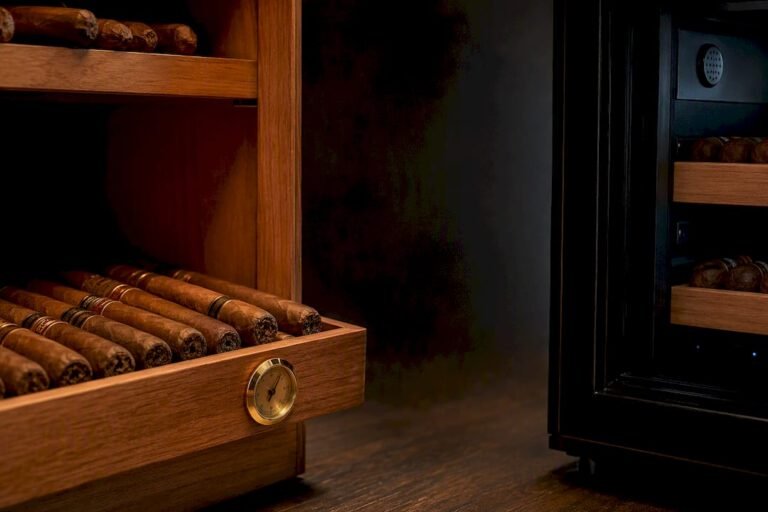
- Aim for 65% to 70% relative humidity for most standard profiles. Even a 1 to 2 percent swing changes burn rate and taste enough to notice, which is exactly why hygrometer accuracy matters more than most smokers assume.
- Calibrate before you trust the reading. A salt test takes about eight hours and tells you whether your hygrometer is lying to you. Run it every few months, and check placement, since a spot too close to a vent or wall reads differently than the rest of the box.
- Season a new humidor properly before loading it with cigars, and consider Boveda packs or a similar two-way system to hold humidity steady without daily attention. Electronic humidifiers make sense once a collection grows past a hundred or so cigars, since they hold a set point with less manual upkeep.
- Recondition dry cigars slowly. Raise humidity gradually over one to two weeks rather than dumping a bone-dry stick into a swampy box overnight, which risks cracked wrappers or mold instead of a fix. Watch for white, dusty mold versus the shine of plume, which is harmless.
- For travel, a zip bag with a small humidification packet works for a day or two, but check it daily. Overdo it and you’ll soften the wrapper before you ever light up.
Why Does Cigar Combustion Get So Hot in the First Place?
Cigar combustion isn’t one steady flame. It’s a moving front where oxygen meets tobacco, and how much oxygen gets there decides the temperature.
Thermocouple studies place pipe tobacco combustion around 380 to 620°C and cigarette burn temperatures averaging higher still, while cigar axial temperatures can run comparably high or beyond, depending heavily on size and how the smoker draws on it.
That range comes from direct temperature measurements taken inside burning tobacco, and later comparative work found cigar axial temperatures exceeding 900°C in small cigars, according to CORESTA combustion research. Every hard puff pulls fresh oxygen into that zone and pushes the number higher. A modeling analysis of cigar combustion shows why geometry matters so much: a narrower ring gauge concentrates the same heat into a smaller cross section, which is the mechanical reason thin cigars and final thirds run hotter than a fat robusto’s first inch.
Do Different Blends and Wrappers Burn Hotter or Cooler?
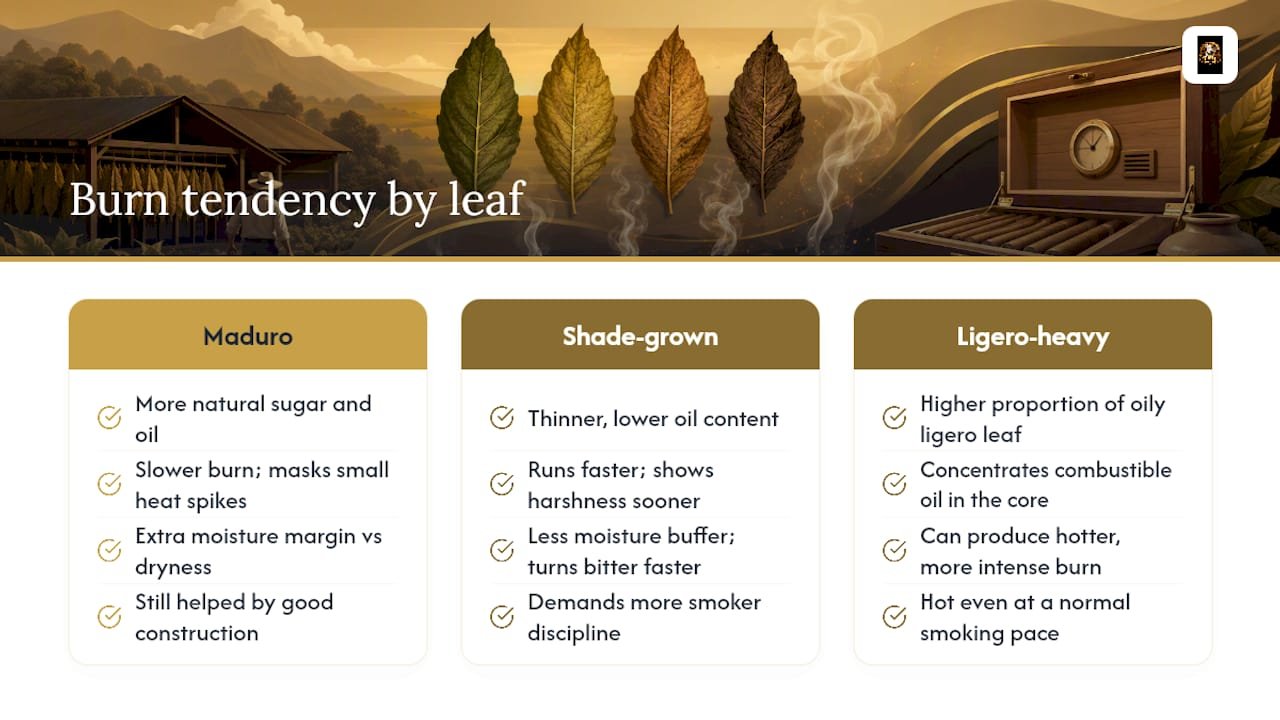
Not every leaf burns the same way, and blend choice shapes how forgiving a cigar is when your pace slips. Denser, oilier ligero leaf, common in fuller-bodied blends, tends to burn slower and can mask minor heat spikes better than thinner seco leaf, which combusts faster and shows harshness sooner when you rush it. Maduro wrappers, aged longer and fermented more heavily, generally carry more natural sugar and oil, and that extra moisture buys you a small margin against dryness related heat.
Shade-grown wrappers, thinner and lower in oil, tend to run less forgiving. A slightly under-humidified Connecticut shade wrapper turns bitter faster than a maduro would under the same conditions, simply because there’s less moisture buffer to begin with. Filler blend matters just as much as wrapper. A cigar built with a higher proportion of ligero in the filler concentrates more combustible oil in the core, which can produce a hotter, more intense burn even at a normal pace.
None of this means one wrapper type is inherently better. It means the margin for error changes. A well-constructed cigar like the Foundation The Tabernacle Havana Seed Toro or the Artesano Del Tobacco The Squid gives you more room to relax your pace before heat becomes an issue, while a delicate wrapper on a thin ring gauge demands more discipline from the smoker holding it.
Can Weather and Wind Make Your Cigar Smoke Hotter?
Ambient conditions push combustion around more than most smokers realize. Wind is the biggest offender: even a light breeze feeds extra oxygen into the coal continuously, not just when you draw, which drives the burn rate and temperature up whether you’re puffing or not. Smoking on an open patio on a breezy day, you’ll often notice the cigar burning visibly faster than it would indoors, with a harsher taste to match.
Cold air has a similar, if smaller, effect. It can make you draw harder without noticing, since a colder cigar seems to need more coaxing to keep the coal lit, and that extra draw strength is exactly the puffing behavior that overheats a cigar in the first place. Hot, humid air works the other direction. It can slow combustion slightly, but it also raises the moisture content of the tobacco during a long outdoor session, which changes burn behavior in its own way.
If you regularly smoke outside, shield the foot from direct wind with your hand or a windbreak, and expect to slow your pace further than you would indoors to compensate for the extra oxygen the air is already supplying. Altitude and dry climates compound the dryness problem discussed earlier: a cigar that reads fine on a humidity level indoors can still burn hotter outdoors in thin, dry mountain air simply because ambient moisture is lower.
Does How You Light a Cigar Affect How Hot It Smokes?
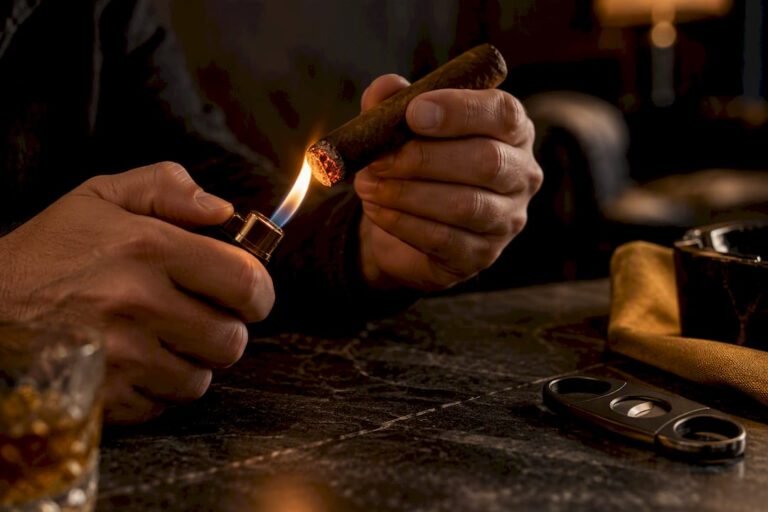
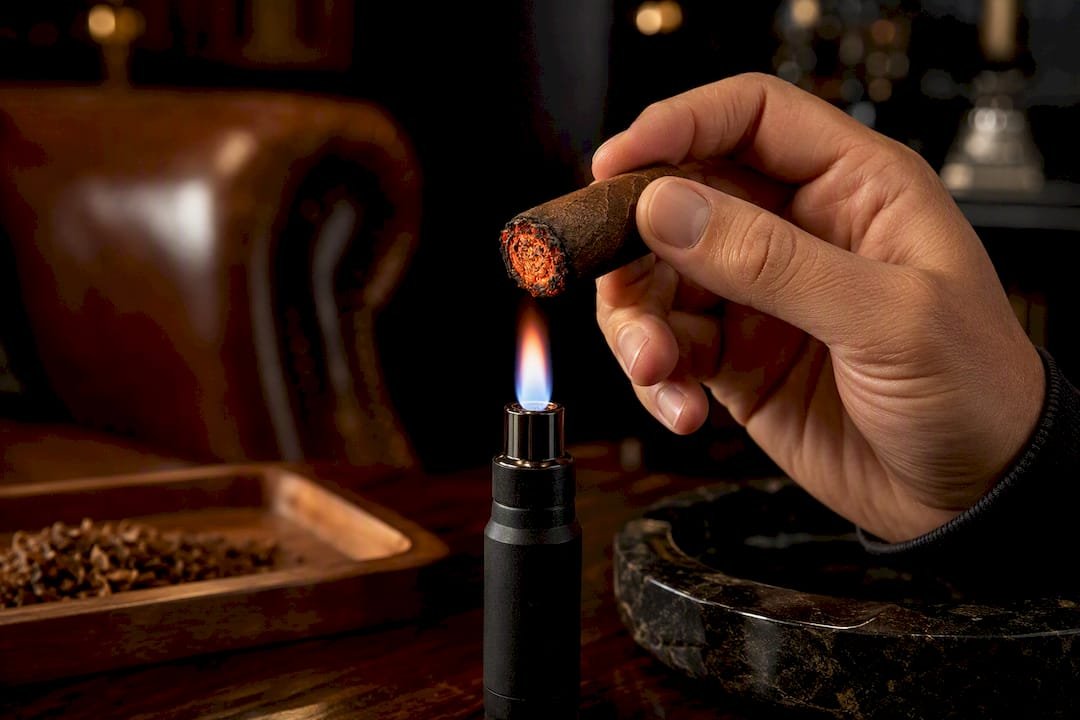
A rushed light sets up a hot smoke before you’ve taken your first real draw. Toasting the foot evenly, rotating the cigar over the flame without letting it touch, creates a level, complete ember across the entire circumference. Skip that step and jam a flame straight into the foot, and you get an uneven light with one side catching before the other, which forces the burn to correct itself later through tunneling or a fast, hot runner on the underlit side.
Butane torch lighters work well because they burn clean and hot enough to light evenly in a few seconds, but that same intensity means you should keep the flame a half inch away rather than pressing it into the tobacco. Matches and cedar spills, the traditional choice among many longtime smokers, give a gentler, more forgiving light, though they take a bit more patience to get an even burn across a wide ring gauge.
Whichever method you use, check the foot after the first few draws. An uneven glow, brighter on one side, is your cue to touch it up immediately with a light re-toast rather than waiting for the imbalance to turn into a canoe or a hot runner later in the smoke. A clean, even light is the cheapest insurance against hot smoke that exists, and it costs you nothing but 20 extra seconds.
Is Hot Cigar Smoke Dangerous to Inhale?
Hot smoke isn’t just unpleasant, it changes what you’re actually taking in. Regular cigar smoking is linked to cancers of the mouth, throat, larynx, and esophagus, along with coronary heart disease and COPD, and the nicotine in cigar smoke is addictive regardless of how it’s smoked. Roughly 9,000 premature deaths a year in the United States are attributed to regular cigar smoking, according to the same CDC data.
Cigars aren’t meant to be inhaled the way cigarettes are, and that distinction matters for how you handle heat. Cigar smokers typically draw smoke into the mouth and exhale without pulling it into the lungs, which limits some of the deeper respiratory exposure associated with cigarette smoking. But hot, harsh smoke still contacts the mouth, throat, and sinuses directly, and a scorching draw increases your exposure to irritating combustion compounds right at the tissue that first takes the hit.
If a cigar is burning hot enough to hurt, that’s a signal worth respecting, not a sensation to smoke through. Broader research on tobacco use, including work on how smoking affects long-term health outside the lungs, reinforces that combustion byproducts carry risk beyond the immediate discomfort. Slowing your pace protects your palate and reduces how much irritant-laden smoke you’re pulling across sensitive tissue in a single session.
Thor’s Cigar Vault’s Take on Preventing Hot Smoke
The habit that fixes most hot cigars isn’t a gadget, it’s pace. Slow draws, a purge every few puffs, and a hygrometer you’ve actually calibrated solve the problem before it starts. If you want the step-by-step version, our hygrometer calibration guide walks through the salt test in detail.
— Kevin
Gear That Actually Stops Hot Smoke Before It Starts
Most hot-smoke complaints trace back to storage, not the cigar itself, which is why the fix usually lives in your humidor, not your technique. A quality humidor holds relative humidity steady without the daily babysitting a cheap box demands, and Thor’s Cigar Vault’s humidors are built to keep that 65% to 70% range consistent instead of drifting every time someone opens the lid.

Pair one with a calibrated hygrometer and a reliable cutter from our accessories collection, and you’ve removed the two biggest variables behind harsh, hot draws: bad moisture and a bad cut that starves airflow. If you’re ready to try a cigar built to reward a slower pace, the Cigars collection is stocked with construction-forward options, and new customers get 10% off their first order when they sign up for updates. Start with the humidor, get your RH dialed in, and the hot, bitter draws stop being a mystery.
This article is general information, not a substitute for advice from a qualified doctor. Consult a qualified healthcare professional about your own circumstances before acting on anything here.
Sources
- Cigars | CDC
- On the burning temperatures of tobacco. (Jørgen Lam, Acta Pathologica Microbiologica Scandinavica, 1955)
- Combustion temperature — CORESTA abstract
- Cigar-review
FAQ
How Hot Is Cigar Smoke?
Cigar combustion temperatures can run comparably high or higher than cigarette smoke depending on size and puffing behavior, with thermocouple studies and comparative combustion research recording axial temperatures exceeding 900°C in small cigars under fast puffing.
Is Cigar Smoke Worse Than Cigarette Smoke?
Cigars carry serious health risks of their own, including links to cancers of the mouth, throat, and esophagus, heart disease, and COPD, even though most cigar smokers don’t inhale as deeply into the lungs as cigarette smokers typically do.
What Are the Health Effects of Inhaling Cigar Smoke?
Regular cigar smoking is associated with cancers of the mouth, throat, larynx, and esophagus, plus coronary heart disease and COPD, and the CDC attributes roughly 9,000 premature deaths a year to the habit.
Does Cigar Smoking Get You High?
Cigars contain nicotine, which is addictive and produces a mild stimulant or relaxant effect depending on dose and tolerance, but this isn’t the same as intoxication, and the CDC classifies that nicotine dependence as a genuine health risk rather than a recreational benefit.