Cigar MSRP Explained: What the Suggested Price Means
MSRP is the manufacturer’s suggested retail price: the number a cigar brand recommends a shop charge for one cigar or one box. It is a guide, not a rule. The price you pay at checkout depends on what the shop paid, the taxes in its state, and how that shop chooses to price. Below we explain where the number comes from, why a cigar can sell above or below it, and how to read a price tag without guessing.
TL;DR
- MSRP is the brand’s suggestion. Under U.S. practice, manufacturers cannot legally control the final price a store charges, so each shop sets its own.
- Sales tax is added on top of the shelf price, and state cigar taxes are usually built on the wholesale price, so the same cigar costs different amounts in different places.
- Limited and hard-to-find releases often sell near or above MSRP because demand is higher than supply.
- To judge a deal, divide the box price by the number of cigars and compare it with the single-cigar price. Do not lean on a crossed-out number.
- We ship across the U.S. to adults 21+ only, with free shipping on orders over $125.
Table of Contents
- What MSRP means on a cigar listing
- Who sets a cigar’s MSRP
- MSRP, street price and sale price
- Why the same cigar costs different amounts in different states
- What the typical markup on cigars looks like
- Why limited releases sell above or below MSRP
- How to tell a normal price gap from a red flag
- Perspective
- Shop with the numbers in hand
- FAQ
- Sources
What MSRP means on a cigar listing
MSRP stands for manufacturer’s suggested retail price. A retail help article describes it as the price a manufacturer recommends so that products sell at a standard margin, and it shows up as a reference point for retailers choosing their own price.
On a cigar, you will see it in three places:
- On a brand’s press release or price sheet when a new line is announced.
- On a retailer’s product page, sometimes crossed out beside a lower price.
- In reviews, where writers quote the MSRP so readers can compare cigars at the same level.
The word “suggested” is doing real work. Even large online marketplaces note that a list price may not reflect the prevailing market price of a product. Cigars follow the same logic.
Who sets a cigar’s MSRP
The brand sets it. A factory or brand owner looks at its costs, its reputation, the blend, the packaging and what similar cigars sell for, then publishes a number. Nothing in the law forces a shop to match it.
The Cigar Action Coalition, an industry advocacy group, puts it plainly: each store sets its own price based on its taxes, rent, customer base and other operating factors. A brand can, however, set policies such as a minimum advertised price. A minimum advertised price limits how low a retailer may advertise a product, and fixing resale prices outright goes further than suggesting them and is illegal in many places.
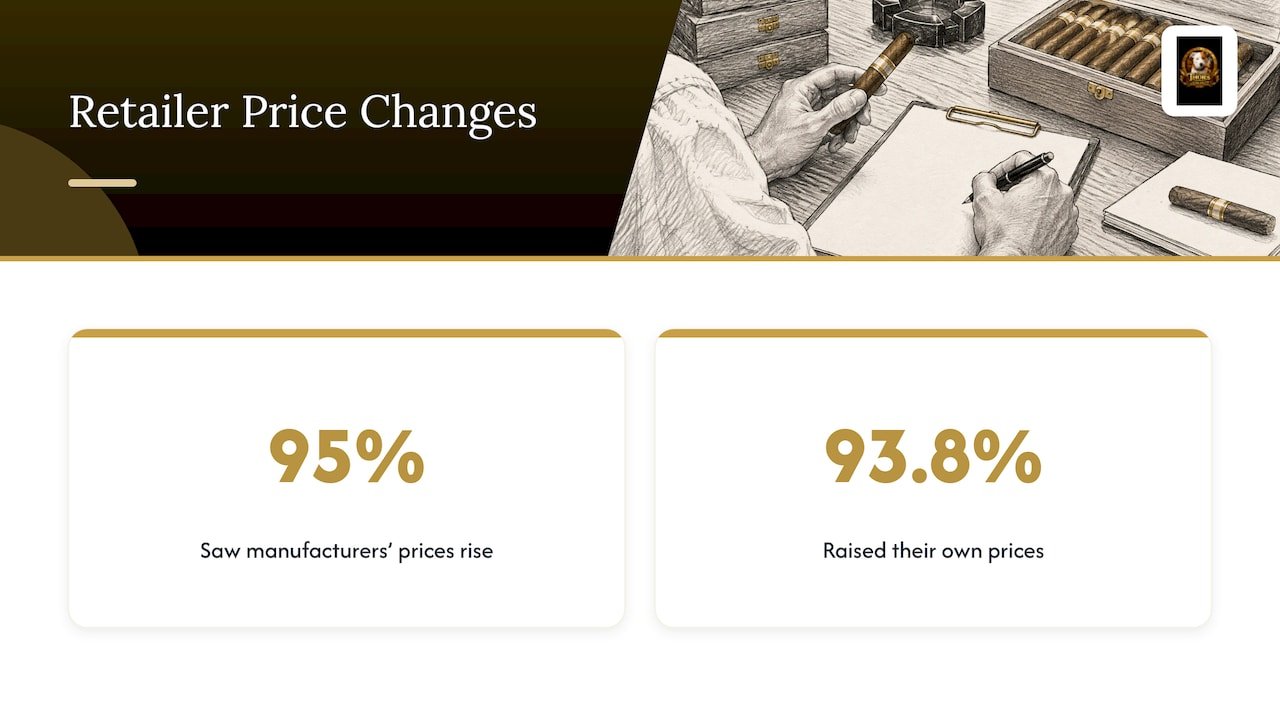
Pricing pressure on the brand side is real. Cigar Aficionado’s 2023 retailer survey found that 95 percent of U.S. tobacconists polled saw manufacturers’ suggested prices rise that year, and 93.8 percent said they had to raise their own prices too.
MSRP, street price and sale price
A useful way to read any cigar listing is to separate three numbers:
| Price | What it is | Who controls it |
|---|---|---|
| MSRP | The brand’s suggested price | The brand, with no legal enforcement |
| Street price | What one cigar normally costs from an ordinary online shop on an ordinary day | The retailer |
| Sale price | A temporary price cut | The retailer, sometimes with brand support |
On many lines, MSRP and street price sit close together. On others, the MSRP is set high so that a standing discount has something to be a discount from. If a cigar is 30 percent off every day of the year, the “regular” price was never really the price. The street price is the real one.
That is why we suggest you compare the final price you will pay, not the strike-through number beside it.
Why the same cigar costs different amounts in different states
Taxes are the biggest reason a cigar’s final price drifts away from MSRP. There are two layers.
Federal tax. The federal excise tax on premium cigars is 52.75 percent of the sale price, capped at 40.26 cents per cigar. Because of the cap, a modest cigar and an expensive one pay nearly the same federal amount.
State and local tax. Most states add a tax based on the wholesale price. Halfwheel’s state-by-state table uses a cigar with a $9.50 MSRP and a $4.75 wholesale price as its example. Retailers may price cigars however they like, and sales tax is calculated on the retail price at the register.
Many states also cap the per-cigar tax, and a few are generous to premium buyers: one bookkeeping guide notes that Pennsylvania has long exempted premium cigars from other-tobacco-product excise tax, while some cities and counties add their own.
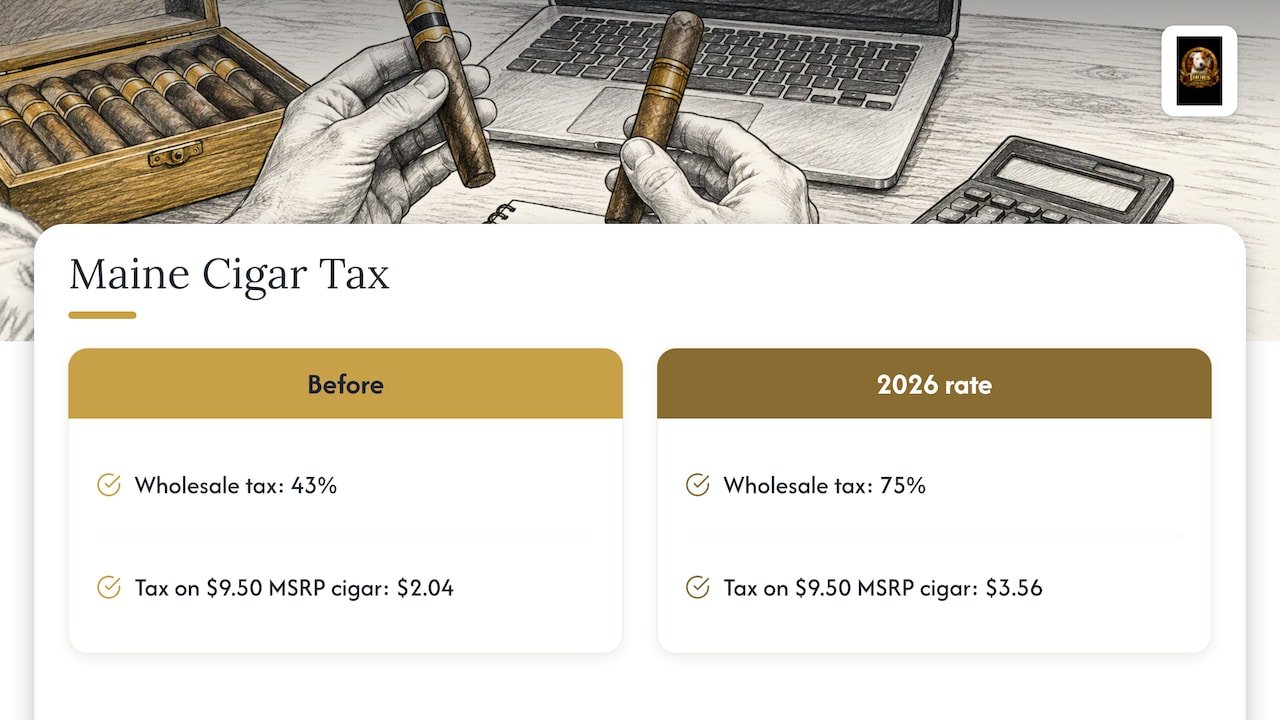
A recent change shows how fast this moves. Maine raised its cigar tax from 43 to 75 percent of wholesale price starting January 5, 2026. Using halfwheel’s figures, a cigar with a $9.50 MSRP would see its tax rise from $2.04 to $3.56. Check your own state’s current rate before you compare prices across shops.
If you want a broader look at how taxes shape tobacco prices online, this guide on how taxes shape tobacco prices walks through the idea in plain terms.
A worked example
Take halfwheel’s example cigar: $9.50 MSRP, $4.75 wholesale. The wholesale price is about half the MSRP, which matches the way many shops price. In a state taxing 43 percent of wholesale, that is roughly $2.04 in state tax built into the shop’s cost. The same cigar after a 75 percent rate carries about $3.56. Same cigar, same MSRP, a different real cost for the shop, and that shows up in what you pay.
What the typical markup on cigars looks like
People often ask about the typical markup on cigars. Retail pricing in this trade usually starts with a simple rule: double the wholesale price, often called keystone pricing. Cigar Public gives an example where a $5 wholesale cigar becomes $10 on the shelf, before local taxes are layered on.
This is a common starting point, not a universal formula. Shops adjust for rarity, demand and overhead. A cigar that is easy to get and heavily stocked may have a thinner margin. A scarce release may carry more.
The same Halfwheel example, a $9.50 MSRP against a $4.75 wholesale price, fits that doubling pattern neatly. Expect most mainstream premium cigars to land somewhere near this relationship between wholesale cost and suggested price, then move up or down by shop.
Why limited releases sell above or below MSRP
Limited releases are where MSRP gets the most interesting, because supply is fixed and demand is not.
Cigar Aficionado reported that when the Fuente OpusX Society cigars launched, they had a suggested retail price of $90 each, or $1,800 per 20-count box, but the company left pricing to individual retailers. Some stores charged up to $130 per cigar, so a three-pack could cost anywhere from $270 to $390, depending on the shop.
Halfwheel’s report on the Fuente y Padron Legends gives another view: each humidor holds 40 cigars, 20 of each blend, with an MSRP of $7,115 before taxes. That works out to about $178 per cigar, though the per-cigar price can vary with how a retailer handles the humidor.
A few things push a limited release above MSRP:
- Small production and allocation, so a shop gets only a few boxes.
- Collector demand once reviews appear.
- Rising costs, including tariffs. When Foundation announced a June 2025 increase, halfwheel explained that tariffs are built into the wholesale price, so shoppers often end up paying at least, and often more than double, the increase.
And a few things keep a price at or below MSRP: steady supply, a brand that wants wide distribution, or a shop choosing to price closer to cost to build loyalty.
If you collect, our post on whether cigars appreciate in value goes deeper. You can also browse our current limited releases to see how each one is listed.
How to tell a normal price gap from a red flag
Most price differences are ordinary. Different shops, different tax situations, different margins. A few habits keep you honest:
- Do the per-cigar math. Divide the box price by the count and compare it with the single price. On some lines the box saves real money. On others, a five-pack lands within pennies of the box.
- Ignore the strike-through. Look at the final price against what the same cigar usually costs.
- Include tax and shipping. A lower sticker price can lose its edge once both are added. Free shipping thresholds matter here. Ours is free shipping on orders over $125.
- Be careful with prices that seem impossible. The Manual notes that a price too good to be true usually is, because real cigars carry costs for making, aging and brand reputation. Buy from a shop you trust and that sells cigars by name.
An illustrative example: a box of 20 listed at $200 is $10 per cigar. If the single is $12, the box saves you $2 per stick, $40 over the box. If the single is $10.25, the box barely matters and you might prefer to buy only what you will smoke.
Perspective
I look at MSRP the way I look at a map legend: helpful, but you still have to walk the ground. When someone asks me about a cigar, I do not start with the suggested price. I ask what they like to smoke, how much they want to spend, and whether they are buying one cigar for tonight or something to put away.
That is why I hand-build every sampler in my store. A good sampler lets you try several cigars without committing to a box, and it takes the guesswork out of whether a price is fair, because you are paying for the cigars you will actually taste. I also mark the cigars I recommend most with my Thor’s Favorites emblem, so a newer smoker has a place to begin.
For limited releases, I tell collectors the same thing: know the suggested price, know the tax in your state, and decide what the cigar is worth to you. Then buy it from someone who will answer your questions in plain English, or in Spanish if you prefer.
Kevin
Shop with the numbers in hand
Once you know how MSRP works, shopping gets easier. If you are new and want to try before buying boxes, our hand-built cigar samplers are a low-risk way to learn which cigars suit you. Our guide on samplers versus boxes shows how to compare the two.

We sell individual cigars, samplers, mystery packs, limited and hard-to-find releases, Raching humidors and accessories, and we ship across the U.S. to adults 21+ only. Orders over $125 ship free. Prices on each product page are the ones to trust, and our exclusive discounts page lists current subscriber offers.
FAQ
Is MSRP the price I have to pay for a cigar?
No. MSRP is a suggestion from the brand. Each store sets its own price based on its costs, taxes and customers, and manufacturers cannot legally control the final price. Some brands use minimum advertised price policies, which limit how low a shop may advertise, but that is different from a required price.
What is the typical markup on cigars?
A common starting point is doubling the wholesale price, which is called keystone pricing. A $5 wholesale cigar would then sell for $10 before local taxes. Shops adjust up or down depending on rarity, demand and overhead, so treat it as a rule of thumb, not a fixed rate.
Do taxes change a cigar’s final price?
Yes. Federal excise tax is 52.75 percent of the sale price, capped at 40.26 cents per cigar. States add their own taxes, usually built on wholesale price, and sales tax is applied at checkout. That is why the same cigar can cost different amounts in different states.
Why are limited releases often priced above MSRP?
Supply is small and demand is high. Retailers set their own prices, so one shop may sell a release at the suggested price while another charges more. Collector interest and rising costs can both push the number up.
How do I know if a box deal is real?
Divide the box price by the count and compare it with the single price. If the savings per cigar are meaningful, the deal is real. If the “savings” are measured against a crossed-out MSRP that nobody charges, look at the actual per-cigar price instead.
Sources
- Manufacturer’s Suggested Retail Price (MSRP), help center
- Strike-through pricing and savings, Amazon Customer Service
- List price, Wikipedia
- Core arguments against a price point definition, Cigar Action Coalition
- 2023 Cigar Insider Retailer Survey, Cigar Aficionado
- Cigar Taxes by State, halfwheel
- Cigar lounge and retail tobacco shop bookkeeping, Beancount.io
- Maine Jacks cigarette, cigar taxes for 2026, Tobacco Reporter
- Why online tobacco costs less, Cigarette Central
- Fuente OpusX Society cigars now come in packs of three, Cigar Aficionado
- Fuente y Padron Legends, halfwheel
- Foundation increasing prices in June, halfwheel
- The hidden dangers of fake cigars, The Manual
Ready to compare real prices? Start with our samplers and check each product page for the current price.