Storing Tubos in a Humidor: Cap Off, Cap On or Out
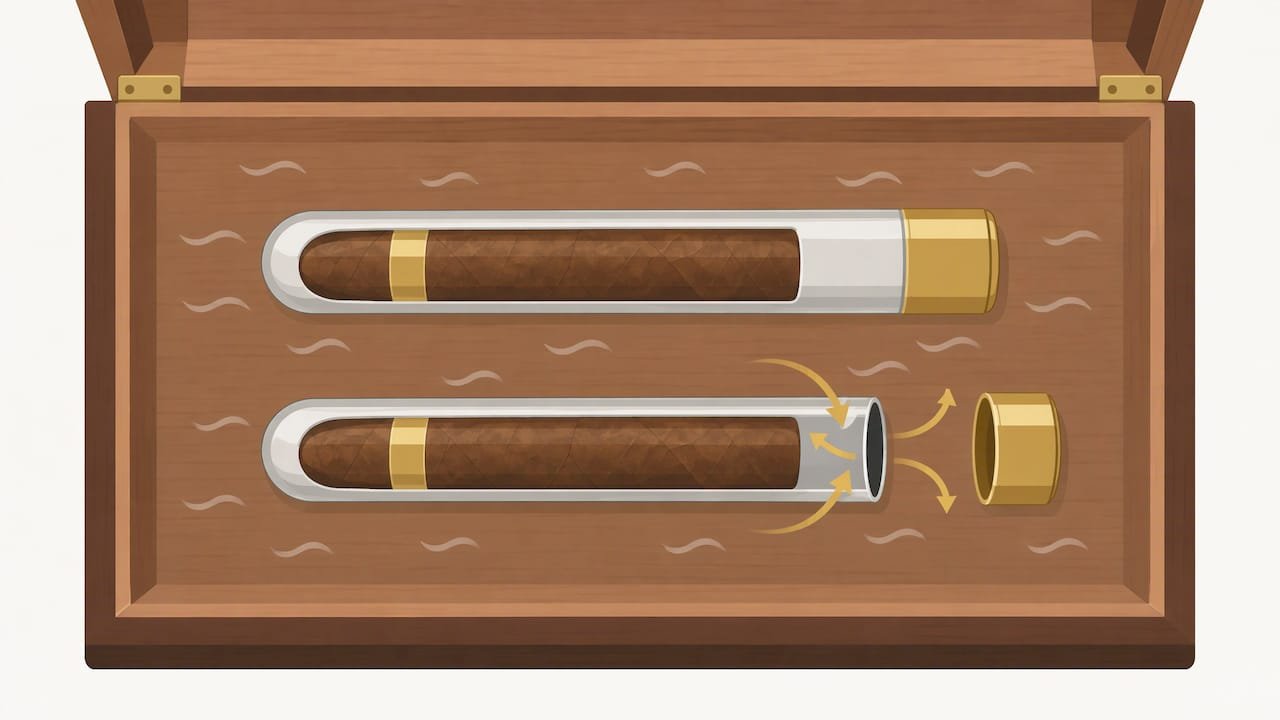
Yes, tubed cigars belong in your humidor, and the simplest rule is to unscrew the cap before you put them in. A tubo protects a cigar from knocks, but it is not a humidor, and a closed tube can keep humidified air from reaching the leaf. Cigar Aficionado advises unscrewing the end so humidified air can circulate around a tubed cigar. Below we cover when to leave the cap on, how tubos differ from cellophane, and what to watch for once the cigar is in the box.
TL;DR
- Put tubed cigars in the humidor, not in a drawer. Loosen or remove the cap so air can move around the cigar.
- A tube is built for physical protection. Whether it protects humidity depends on its material and closure, so don’t treat it as long-term storage on its own.
- Cellophane breathes and can stay on in a properly maintained humidor. Tubos are better for travel, gifts and short stays.
- Aim for about 68 to 70 percent humidity at about 68 to 70°F, and check tubed cigars now and then for mold.
- Keep tubes and cellophane cigars away from the humidifier itself, where condensation can form.
Table of Contents
- Why tubos behave differently from other cigars
- The short answer: cap off, cigar in the tube
- How long can a tubo keep a cigar fresh without a humidor?
- Tubos vs. cellophane: what each one does in the humidor
- Humidity and temperature for a box with tubos in it
- Condensation and mold: what to look for
- When keeping the tube closed makes sense
- What about a humidor that’s very full?
- Perspective
- Build your humidor stock the easy way
- Quick reference: what to do with each type
- FAQ
- Sources
Why tubos behave differently from other cigars
Most cigars reach you in one of three ways: bare, in cellophane, or in a tube (a tubo, in cigar-shop shorthand). Each one changes how fast the cigar swaps moisture with the air around it.
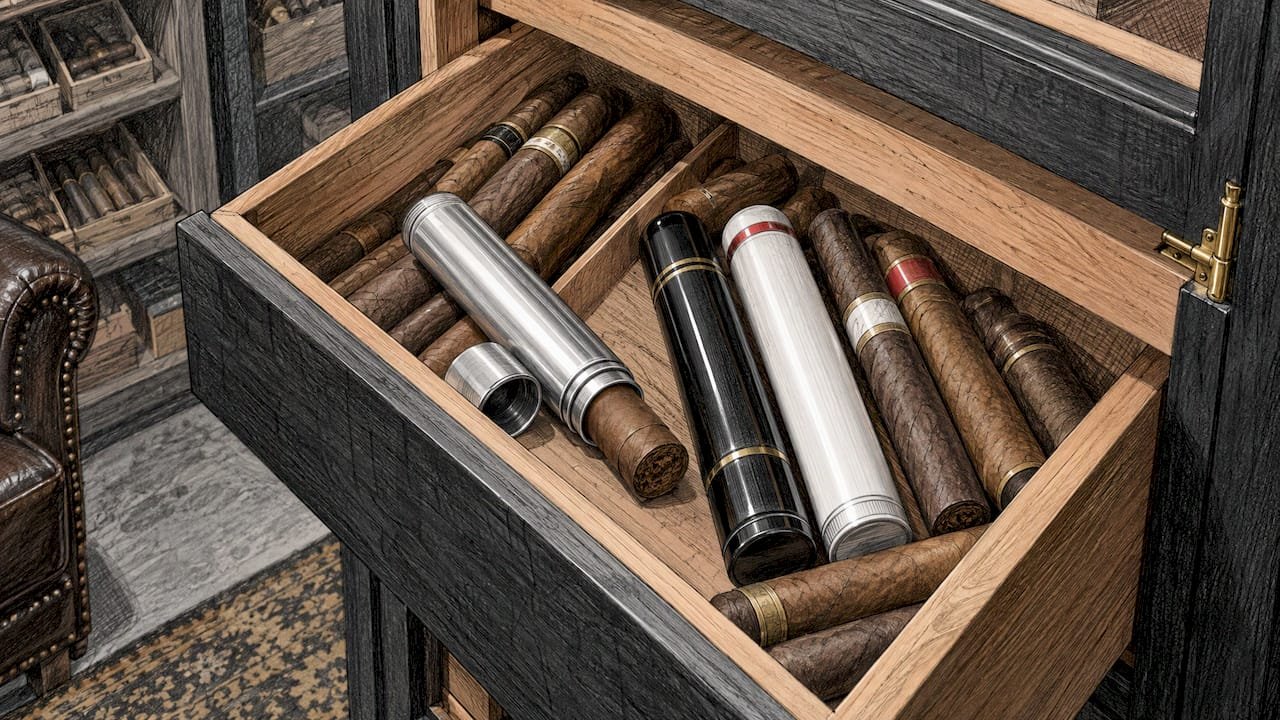
A tubo is a miniature case. It shields the cigar from crushed feet, cracked wrappers and the bumps of a pocket or a travel bag. Tobacconist University puts it plainly: a cigar tube gives excellent physical protection, but protection from the environment depends on the tube’s material, construction and closure. A tightly closing, nonporous tube can slow the exchange of moisture with the surroundings a great deal. A loose or permeable tube offers much less. Wooden tubes absorb and release moisture, while metal and other nonporous materials behave differently.
That is the whole reason tubos confuse people. The same feature that keeps a cigar safe in your jacket can keep your humidor’s moisture out. Inside a humidor, you want the cigar to settle into the same humidity as everything around it, and a sealed tube slows that down.

The short answer: cap off, cigar in the tube
For most cigars you plan to smoke in the coming weeks or months, here is the routine we recommend:
- Check the cigar first. Look at the wrapper and give the tube a sniff at the open end. Anything musty is worth a closer look before it goes near your other cigars.
- Unscrew the cap, or slide the cigar partway out. Aluminum tubos usually twist open. Glass tubes have a stopper or cap. Wooden or cedar-lined tubes can be left with the lid loose.
- Put the open tubo on a shelf or tray away from the humidifier. You want steady humidified air, not a spot right next to the wet element.
- Leave it for a few days, then check. The cigar should feel supple, not crunchy and not spongy.
- Decide whether to keep it in the tube. Many collectors keep the cigar in the open tube because it still guards against dings. Others slide the cigar out and stack it with the rest.
There is some disagreement among experts on closed versus open, and it is worth knowing why. Cigar Journal recommends that for aluminum tubos you unscrew the cap and place the cigar in the open tubo in the humidor if you want to keep the aging process going. The author would store a cigar in a completely closed tubo only if a single cigar is meant to rest for a very long time, eight years or more, because aging slows to a crawl in a closed tube. Leaving it closed is a deliberate choice for a specific purpose, not a default.
There is also a freshness angle. The same piece notes that off-flavors are more likely the fresher the cigars were when they were packed into aluminum tubos. If a fresh cigar still has a clearly noticeable ammonia note, the author would leave the tubo open for a few months. So an open tube also helps a young cigar settle.
How long can a tubo keep a cigar fresh without a humidor?
People search for this because a single tubed cigar feels self-contained. It is, for a short while. Tobacconist University adds that even a well-sealed tube does not protect a cigar indefinitely unless it includes a humidification element. How well a tube works depends on how tightly it limits moisture exchange, the condition of the cigar when it was enclosed, the room around it and how long the cigar stays inside.
The practical read: a tubo is fine for a day trip, a weekend, a gift on its way to someone’s desk, or the walk to the patio. For a cigar you want to smoke at its best a month from now, put it in a humidor. That is the same advice in our guide to storing cigars at home, which covers humidor setup and the common mistakes people make.
Tubos vs. cellophane: what each one does in the humidor
Cellophane is the other wrapper you will meet most often, and it works in an opposite way. Tobacconist University explains that cellophane is made from regenerated cellulose and is permeable to water vapor, so moisture passes through it slowly. A cigar can stay in its cellophane in a properly maintained humidor. It gets the benefit of the surrounding environment and also gets protection from handling and from contact with neighboring cigars.
| Tubo | Cellophane | |
|---|---|---|
| Main job | Protects against physical damage | Light protection; lets moisture pass slowly |
| Moisture exchange | Depends on material and closure; a sealed tube can slow it sharply | Gradual, since the material is permeable to water vapor |
| In a humidor | Loosen or remove the cap | Can usually stay on |
| Best use | Travel, gifts, short-term carrying | Everyday humidor storage |
| Watch for | Trapped moisture and mold if kept closed after coming from a humid space | Condensation if placed right beside the humidifier |
What about aging? Cigar Journal’s author separates the two by humidor size. In a large cabinet or walk-in humidor, he leaves cellophane on, because the large volume of air causes tobacco flavors to release gradually. In original-box storage, where the air volume is small and cigars age better close together, he takes it off. So the answer to “cellophane on or off” depends on your box.
Cellophane also tells a story over time. Tobacconist University notes that clear cellophane may turn yellow, golden, amber or even brown as a cigar ages, because compounds from the tobacco migrate into the wrap. Darker, oilier wrappers often stain it more noticeably. If your cellophane has gone amber, that is typically a sign of age, not a problem.
Humidity and temperature for a box with tubos in it
Tubed cigars don’t need a different climate from the rest. They need the same stable one, with a bit more attention to airflow.
Cigar Aficionado says 68 to 70 percent humidity at 68 to 70 degrees Fahrenheit keeps cigars in excellent condition. If the room around your humidor is more humid than that, the same article suggests taking the humidity regulator out for a day or more to let the excess escape.
Some collectors who age cigars prefer to run a little lower. The 70/70 rule is a reference point, not a law, and aging collectors may sit on the lower side of the common band to reduce mold risk. For a tube that has just been opened, a steady 68 to 70 percent is a sound place to start.
A few practical habits help:
- Use a reliable hygrometer and check it weekly.
- Keep the humidor out of direct sun and away from heat vents. Temperature swings move moisture around and can cause condensation.
- Don’t crowd the humidifier. Leave a gap so air flows through the box.
- Rotate tubed cigars the same way you rotate the rest of your stock, so none sits forgotten in a corner.
If your cigars have already dried out from sitting in a closed tube too long, our 3-stage rehydration plan walks through bringing them back slowly instead of rushing it.
Condensation and mold: what to look for
Tubos are sealed spaces. If a cigar was packed in a very humid room and the tube stays closed in a humid humidor, moisture has nowhere to go. That is the case for opening the cap and letting the tube equilibrate.
Tobacconist University recommends inspecting manufacturer-tubed cigars occasionally for signs of mold. Make it a routine: when you do your weekly hygrometer check, open one or two tubes and look.
Here is what to look at:
- Wrapper surface: fuzzy or cottony growth, or spots that look blue-green, are signs of mold. Dusty gray marks that wipe off lightly are a different thing, usually harmless residue you can brush away.
- Smell: a damp, musty or stale odor from the tube is worth investigating.
- Feel: a soft, spongy cigar is holding too much moisture. A crunchy, brittle one is too dry.
If you find mold, take that cigar out of the humidor right away, and check the cigars next to it. Wipe the humidor interior with a dry cloth, and keep the affected cigars out of the box. If you’re unsure whether a mark is mold or harmless bloom, pull the cigar from the box before you decide. When the whole humidor seems too damp, the fix is usually to reduce the humidifying source and let the box dry out before you refill it, not to add more.
Keep wrapped cigars off the humidifier as well. Condensation can form inside a cellophane sleeve if the cigar sits too close to the wet element, and it can damage the wrapper leaf.
When keeping the tube closed makes sense
There are a few honest cases for leaving a cap on:
- Carrying one cigar for the day. The tube protects against crushing.
- A gift in transit. A tubed cigar travels well. If you plan to send cigars to a friend, our five-step checklist for shipping cigars as a gift covers how to keep them smokeable.
- A long, deliberate rest. As noted above, closed storage slows aging dramatically, so it only suits a cigar you’re intentionally setting aside for years.
In every other case, open it up.
What about a humidor that’s very full?
If you have a large collection, tubes take up more space than bare cigars, and the cap-off rule means they stand or lie a little proud of the others. That is a good reason to choose a humidor with room to breathe. Our comparison of electric and wood humidors for a 150-cigar collection is a good place to weigh capacity against upkeep. If you’re shopping, the humidors category at Thor’s Cigar Vault includes Raching humidors.
Perspective
We handle tubed cigars in a simple way: a tubo is a travel case first and a storage container second. When a tubed cigar comes into our shop and goes into the humidor, the cap comes off.
We hand-build every sampler ourselves, and we like to think about how a cigar will be stored once it reaches your house. Someone who opens a sampler box wants to smoke the cigars over a few weeks. For that, an open tube or a bare cigar in a steady humidor is the easy path. If you only have a couple of tubes, a small humidor with a good hygrometer does the job.
For beginners, our advice is to keep it plain: one humidor, one hygrometer, open the caps, check weekly. You don’t need a collector’s setup to enjoy a cigar the way the maker intended. If you want help matching cigars to your taste, or choosing a humidor that fits how many you buy, ask us. We would rather help you pick well than sell you something that doesn’t suit you. We speak Spanish too, so we’re glad to help in either language.
Kevin
Build your humidor stock the easy way
If you’re starting a humidor or topping one up, a sampler lets you try several cigars without committing to full boxes, and every sampler we sell is built by hand. Browse our cigar samplers or look through individual cigars by brand. Samplers also suit a humidor with tubes in it, since you can see how different packaging behaves side by side.

We ship across the U.S. to adults 21 and over only, and orders over $125 ship free. If you want a deeper plan for building a mixed sampler yourself, read our guide to building a 5 to 6 stick sampler.
Quick reference: what to do with each type
- Aluminum tubo: unscrew the cap, keep the cigar inside or slide it out, check for mold from time to time. Leave it capped only for a long, deliberate rest.
- Glass tube: remove the stopper or cap while it is in the humidor and let it equilibrate.
- Wooden or cedar tube: these can absorb and release moisture themselves, so loosen the lid and watch the cigar’s feel.
- Cellophane: leave on in a properly maintained humidor, and keep it away from the humidifier.
- Bare cigar: nothing to do, just keep it steady and rotate it.
FAQ
Should I take cigars out of tubos in my humidor?
You don’t have to take them out, but you should open the tube. Unscrewing the cap lets humidified air reach the cigar, and many smokers keep the cigar inside the open tube for protection. If you’d like a cigar to age faster, sliding it out gives it the most airflow.
Is a tubo airtight enough to store a cigar for months?
Not reliably. How well a tube protects against moisture loss depends on its material, closure and the room around it, and even a well-sealed one doesn’t protect indefinitely without a humidification element. For anything beyond a few days, a humidor is the safer home.
Can cigars stay in cellophane in a humidor?
Yes. Cellophane is permeable to water vapor, so a cigar in cellophane still takes in humidity from a properly maintained humidor while staying protected from handling. Just keep it from sitting right next to the humidifier, where condensation can form inside the sleeve.
What humidity should I keep tubed cigars at?
The same as the rest of your cigars: about 68 to 70 percent relative humidity at about 68 to 70°F. Check with a hygrometer, and inspect tubed cigars occasionally for mold.
How do I know if a cigar in a tube has gone moldy?
Look for fuzzy or blue-green growth, and notice any musty smell. Light gray dust that wipes away is not the same thing. If you see mold, remove the cigar from the humidor right away and wipe the interior with a dry cloth.
Sources
- Is it OK to Store Cigars in Tubos Outside of Your Humidor? (Cigar Aficionado)
- Cigar Tubes (Tobacconist University)
- Cellophane & Plastic Cigar Bags (Tobacconist University)
- Influences of the Packaging Type on Cigar Storage (Cigar Journal)
- What Should I Do If My Cigar Gets Soggy? (Cigar Aficionado)