Mold in Your Humidor: Identify, Clean, and Prevent It
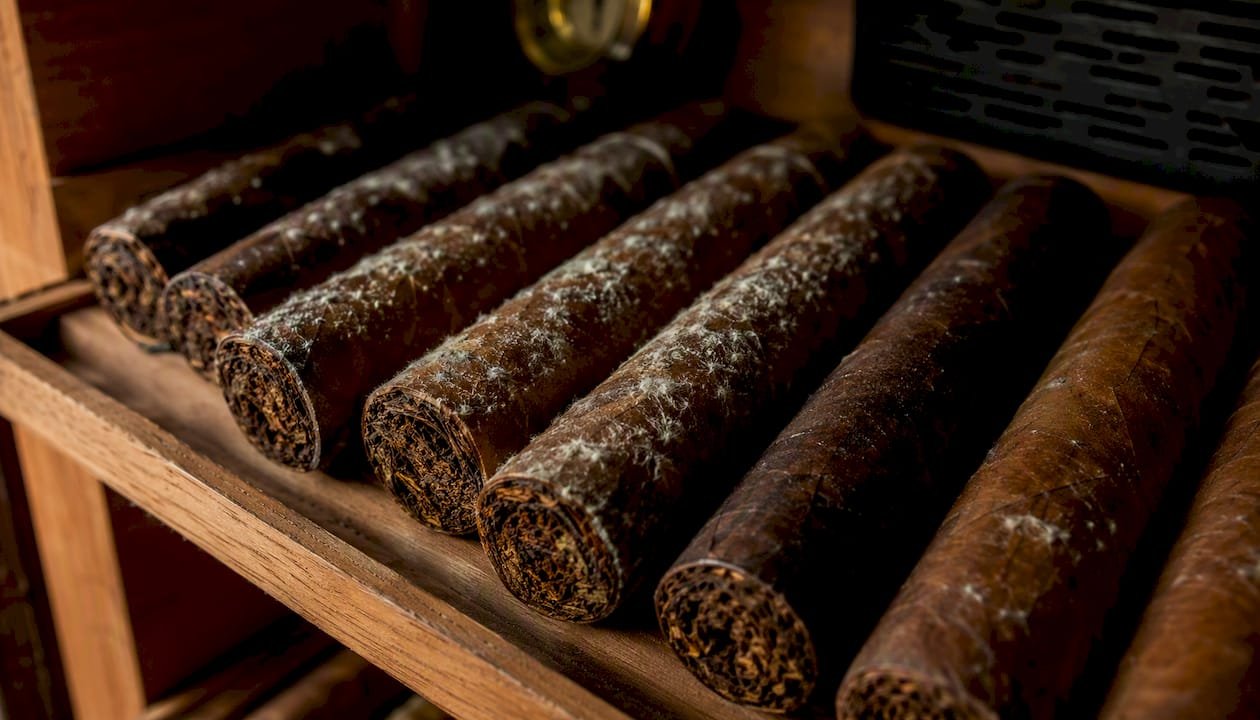
You spotted something white and fuzzy in your humidor. Stop. Before you do anything else, pull those cigars out and separate them from the rest of your collection. That single action, done in the next five minutes, is what determines whether you lose two sticks or two boxes.
Here is what to do right now:
- Remove all cigars from the humidor immediately and lay them on a clean, dry surface.
- Inspect each one under good light. Set aside any stick with visible growth, a musty smell, or soft spots.
- Place suspect cigars in a dry, ventilated container, not a sealed bag, at a separate location from your clean sticks.
- Dial humidity down toward the mid-60s (62–65% RH) in any temporary storage you use. Mold thrives above 72% RH.
- Do not smoke or brush any affected cigar yet. Brushing spreads spores; smoking a contaminated stick is a health risk.
- Leave the humidor closed except when necessary while you work through the cleaning steps below.
Treat every white growth as mold until you can prove otherwise. That is not overcaution; it is the current best-practice standard, and the reasoning is explained in detail below.
Pro Tip: Snap a photo of the growth before you disturb anything. The image helps you track whether it spreads during quarantine and gives you a reference point when comparing mold vs. plume characteristics.
Table of Contents
- Is that white fuzz mold or plume? Four tests under 60 seconds
- How to clean a moldy humidor step by step
- What to do with your humidification device after mold appears
- How to prevent mold in your humidor going forward
- Why we recommend treating white growth as mold by default
- Key Takeaways
- The part most guides get wrong about mold
- Protect your collection with the right storage from Thor’s Cigar Vault
- Further reading and sources
Is that white fuzz mold or plume? Four tests under 60 seconds
The distinction between cigar plume and mold matters, but the tests are fast. According to VDG Cigars, four quick checks together give you a reliable read: smell, foot inspection, texture under angled light, and a wipe test.
Smell. Hold the cigar an inch from your nose. Plume has no odor or carries the tobacco’s natural aroma. Mold smells musty, earthy, or faintly like a damp basement. Trust your nose first.
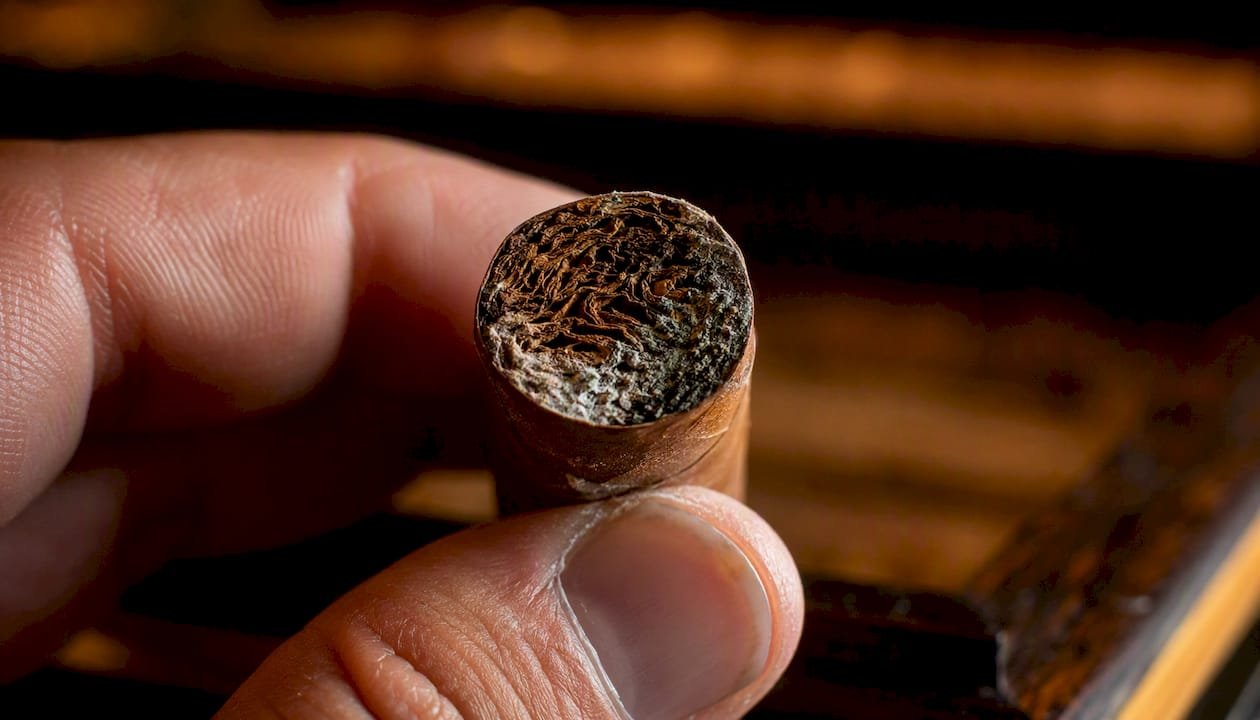
Foot check. Look at the cut end of the cigar. Mold often colonizes the foot before the wrapper because the exposed filler gives spores an easy entry point. Plume appears on the wrapper surface only.
Texture under angled light. Hold the cigar at a 45-degree angle to a lamp. Plume looks like a fine, even crystalline dusting, almost like powdered sugar. Mold has a raised, filamentous, or patchy texture. It does not lie flat.
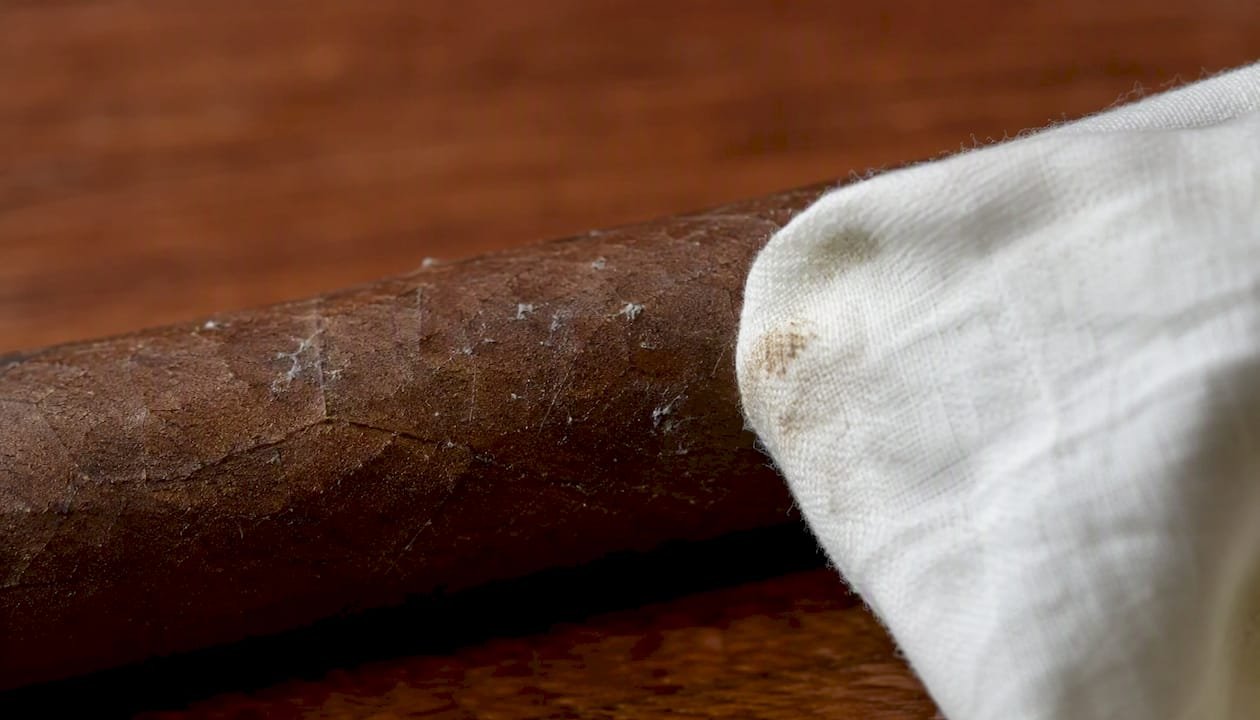
Wipe test. Gently drag a clean white cloth across the growth. Plume wipes off cleanly and leaves no stain. Mold smears, leaves residue, or the growth returns within 24–48 hours.
| Feature | Plume | Mold |
|---|---|---|
| Color | Neutral white only | White, blue, green, gray, or black |
| Pattern | Even, fine dusting across wrapper | Spots, patches, or clusters |
| Smell | None or natural tobacco | Musty, earthy, damp |
| Foot presence | Never | Common |
| Wipe test | Wipes clean, no residue | Smears or returns |
| Texture | Flat, crystalline | Raised, fuzzy, filamentous |
Any color beyond neutral white is mold, full stop. Any patchy or clustered pattern is mold. Cigarista’s 2026 guide recommends treating all white growth as mold by default because even lab-tested samples that looked like plume frequently returned fungal results.
Pro Tip: Use your phone’s macro mode or zoom in close before touching the cigar. Filamentous growth, the thread-like strands that signal mold, is often visible at 5x zoom before it is obvious to the naked eye.
How to clean a moldy humidor step by step
Work through this in order. Skipping steps, especially the drying windows, is the most common reason mold comes back.
“The standard remediation path for mold in a humidor is: remove, inspect, discard, clean, dry fully, then re-season. Rushing the drying phase reintroduces the moisture mold needs to return.” — Cigar World
What you need: disposable gloves, soft lint-free cloths, isopropyl alcohol (70% or higher), distilled water, a soft-bristle brush, and a well-ventilated workspace.
- Remove all cigars — and sort them into three groups: clearly moldy (discard), visibly suspect (quarantine), and clean (store separately in a sealed container at 62–65% RH).
Avoid bleach, ammonia, or any solvent cleaner. They damage Spanish cedar and leave chemical residues that transfer to your tobacco. Isopropyl alcohol evaporates cleanly and does not raise the grain the way water alone does.
What to do with your humidification device after mold appears
The humidification device is often the source of the problem, not just a bystander. How you handle it depends on the type.
Foam or gel units (the sponge-style humidifiers that came with most entry-level humidors): discard them. They are porous, cheap, and impossible to sterilize reliably. Replace with a better option.
Gel jars and crystal humidifiers: discard the gel medium and sterilize the container with isopropyl solution before refilling. If the container itself shows any discoloration, replace it entirely.
Boveda packs and similar sealed two-way humidity packs: discard after any mold event. They are single-use by design, and there is no way to verify the interior is uncontaminated. Boveda packs are inexpensive enough that replacement is always the right call here.
Electronic humidifiers (Cigar Oasis and similar active units): remove and clean the water reservoir thoroughly with isopropyl solution. Replace the wick or cartridge. If the unit has been running in a contaminated environment for more than a few days, replacing the cartridge is non-negotiable.
“Dirty humidifier tanks can grow bacteria and mold that pose real concerns, particularly for anyone with asthma or allergies.” — Mayo Clinic
Never use tap water in any humidification device. Cigar World’s expert guide flags tap water as a common source of the mineral deposits and microbial load that accelerate mold growth. Distilled water only.
After cleaning or replacing the device, verify your humidity with a reliable digital hygrometer. A Caliber-style unit gives you a reading accurate to within 1–2% RH, which is the resolution you need to catch a creeping humidity problem before it becomes a mold problem. Sealed storage options like CVault containers are worth considering for quarantine storage and as a long-term alternative for cigars you want to isolate from ambient humidity swings.
Pro Tip: Calibrate your hygrometer with a salt test or a Boveda calibration kit before trusting its readings. A hygrometer that reads 68% when the actual RH is 74% is worse than no hygrometer at all.
How to prevent mold in your humidor going forward
Prevention costs almost nothing compared to losing a box of aged cigars. The two biggest risk factors are humidity above 72% RH and poor air circulation, and both are easy to control.
Numeric targets to maintain:
| Parameter | Target range | Upper limit |
|---|---|---|
| Relative humidity (RH) | 65–70% | 72% |
| Temperature | 65–70°F | 72°F |
| Quarantine RH | 62–65% | 65% |
| Hygrometer check frequency | Every 2–3 days | Daily in summer |
- Keep cigars from touching the humidor walls. Direct contact traps moisture and creates micro-environments where mold starts.
- Do not over-pack. Cigars need airflow between them. If you cannot slide a finger between rows, the box is too full.
- Rotate cigars every few weeks. Bottom sticks get less airflow and are the first to show problems.
- Use two-way humidity packs rather than passive foam humidifiers. Boveda packs absorb excess moisture as well as release it, which prevents the RH spikes that invite mold.
- Check your hygrometer reading every 2–3 days during warm months. Ambient temperature swings in summer are the most common trigger for humidity spikes.
High humidity combined with stagnant air is the condition VDG Cigars identifies as the primary driver of mold colonization. A Caliber-style digital hygrometer and a pack of Boveda 65s together cost less than a single premium cigar and they eliminate the two most common failure points.
Why we recommend treating white growth as mold by default
The conservative stance is not arbitrary. Cigarista’s 2026 analysis found that when suspected plume samples were sent for lab testing, a significant portion returned results identifying fungal species. The burden of proof, in other words, sits with plume, not with mold.
This is the position Thor’s Cigar Vault takes, and it is grounded in the same evidence the broader cigar community has been building for years. A conservative approach protects your health, your remaining cigars, and the long-term value of any aged inventory you have built up.
Pro Tip: If you want certainty, some university extension labs and private mycology labs will test a swab sample for a modest fee. It is rarely necessary, but it is an option for expensive or irreplaceable cigars.
Key Takeaways
Treating white growth as mold by default, quarantining immediately, and maintaining 65–70% RH with a reliable hygrometer are the three actions that protect your collection from a mold event.
| Point | Details |
|---|---|
| Quarantine first | Remove and separate all cigars the moment you spot growth, before doing anything else. |
| Assume mold by default | Treat white growth as mold unless four quick tests (smell, foot, texture, wipe) convincingly show plume. |
| Discard flagged sticks | Any cigar with colored growth, foot involvement, or persistent odor goes in the trash, not back in the humidor. |
| Replace humidifier packs | Boveda packs and foam units are single-use after a mold event; never return a contaminated device to a clean humidor. |
| Maintain 65–70% RH | Use a Caliber-style digital hygrometer and two-way Boveda packs to hold humidity below the 72% mold threshold. |
| Thor’s Cigar Vault | Browse luxury humidors and humidity-control accessories to replace compromised equipment and protect your investment. |
The part most guides get wrong about mold
Most mold guides tell you to clean and move on. What they underestimate is the re-seasoning phase. Owners rush it, return their cigars at day seven, and find mold again at day fourteen. The wood is not fully stable yet. The residual moisture from cleaning, combined with the humidity you introduce during re-seasoning, creates a second window of vulnerability that is just as dangerous as the original event.
The other thing worth saying plainly: plume is rarer than the cigar community has historically believed. The romantic idea of crystallized oils blooming on a well-aged wrapper is real, but it is far less common than mold presenting as white fuzz. If you have been giving white growth the benefit of the doubt for years, you have probably been smoking mold. That is not a comfortable thought, but it is the honest one.
The practical upshot is simple: a $30 investment in a digital hygrometer and a sleeve of Boveda packs eliminates the conditions that cause most mold events. The cigars you are protecting are worth considerably more than that. At Thor’s Cigar Vault, the team is available to help you find the right storage setup for your collection size and climate, whether that is a replacement humidor, a sealed CVault-style container, or just the right humidity pack for your target RH. Reach out through the Thor’s Cigar Vault blog for additional care guides and storage advice.
Protect your collection with the right storage from Thor’s Cigar Vault
If a mold event has you rethinking your storage setup, the right tools make the difference between a one-time incident and a recurring problem. Thor’s Cigar Vault carries premium humidors, sealed storage options, and humidity-control accessories selected for collectors who take their cigars seriously.

For high-value sticks like the Arturo Fuente FFOX Opus X Perfecxion 4, proper storage is not optional. A quality humidor with a two-way humidity pack and a calibrated hygrometer is the minimum setup for protecting premium tobacco. Thor’s Cigar Vault stocks replacement humidors across a range of sizes, from desktop units to full cabinet models, along with Boveda-compatible accessories and travel cases like the Arturo Fuente Opus X Carbon Fiber Cigar Case for cigars on the move. New customers get 10% off their first order when they subscribe. Browse the full selection at Thor’s Cigar Vault and get your storage right before the next cigar goes in.
Further reading and sources
- Cigar Plume vs Mold: Is Plume Real? (2026) · Cigarista
- Cigar Mold vs Plume: The Complete Guide to Telling Them Apart – Vdg-cigars
- An Expert Guide To Cigar Mold | Cigar World
- Humidifiers: Ease skin, breathing symptoms – Mayo Clinic
- store.vivipacks.com
- shopboveda.mybigcommerce.com