12.5% Tariffs and Freight: Why Cigar Prices Rise for U.S. Smokers
Cigar prices are rising mainly because of a one-two punch: new Section 301 import tariffs on tobacco from Nicaragua, the Dominican Republic, and Honduras, layered on top of freight and logistics costs that have pushed some manufacturers to air shipping. Since roughly 99% of handmade premium cigars smoked in the U.S. come from those three countries, even a modest tariff or a shipping surcharge gets magnified by wholesale and retail markups before it ever reaches your humidor. The sections below break down the mechanics, the data, and what you can actually do about it.
TL;DR:
- Increased tariffs, especially the 12.5% duty on Dominican and Nicaraguan cigars, significantly raise wholesale costs, which then compound through retail markups.
- Rising freight costs, including surcharges for shifting from ocean to air shipping, push prices higher and cause inventory delays across the supply chain.
- About 60% of U.S. cigar imports come from Nicaragua, with tariffs hitting Nicaraguan products hardest, often leading to price divergences even within the same brand.
- The typical supply chain markup multiplies tariff effects, turning a small import fee into over a dollar of added retail cost per cigar.
- Buying smaller quantities, such as samplers or mystery packs, helps consumers manage volatile prices and avoid committing to full boxes at inflated costs.
Table of Contents
- Why Are Cigar Prices Going Up? The Tariff Mechanics
- Shipping and Freight Costs Are Squeezing Margins Too
- Nicaragua, Dominican Republic, and Honduras: Why Origin Changes Everything
- How a Small Tariff Turns Into a Big Retail Price Hike
- What the Industry Is Saying and Doing About It
- Smart Ways to Buy Cigars While Prices Stay Volatile
- What We’re Seeing at Thor’s Cigar Vault Right Now
- Where Cigar Prices Go From Here
- Try More, Spend Less With Thor’s Cigar Vault Samplers
- Sources
- FAQ
Why Are Cigar Prices Going Up? The Tariff Mechanics
The U.S. Trade Representative’s final action under Section 301 set the stage for this year’s price jump. The USTR’s Federal Register notice lists country- and product-specific duty rates rather than a flat tariff across the board, which matters a lot if your favorite blend comes from one country instead of another.
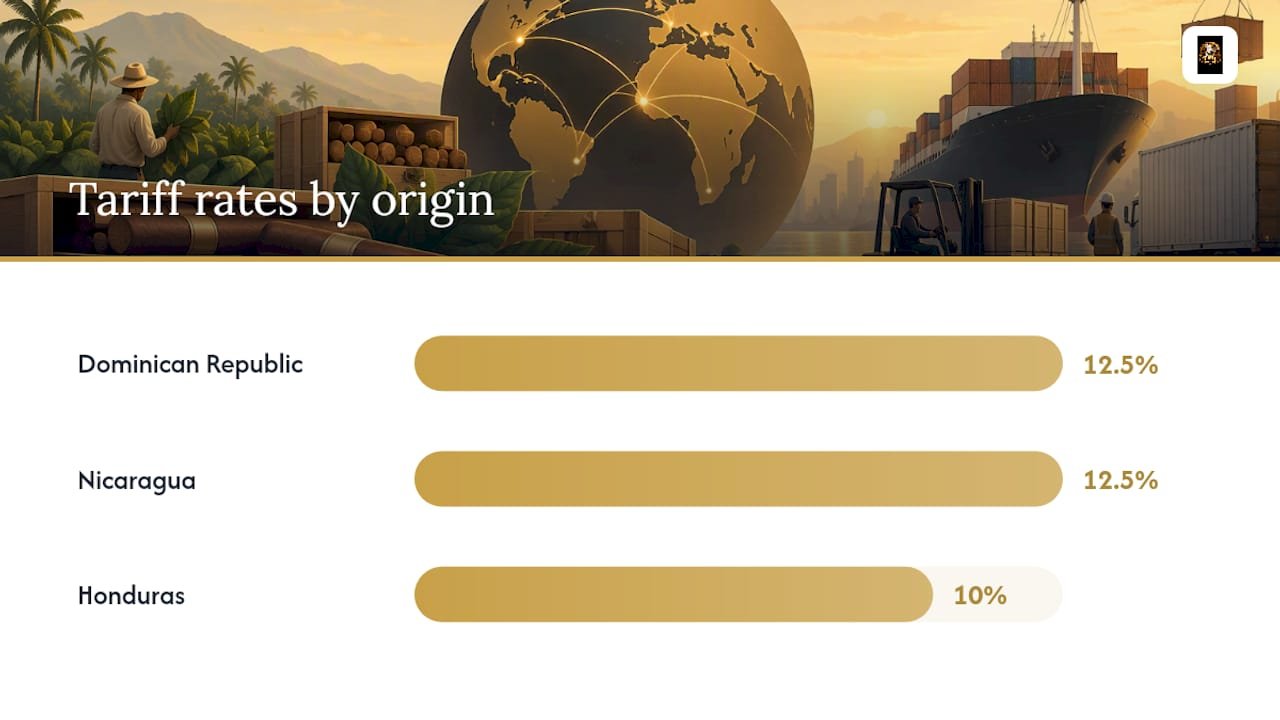
Here’s how the rates broke down once implementation hit importers:
- Dominican Republic: 12.5% duty on premium cigar imports
- Nicaragua: 12.5% duty on premium cigar imports
- Honduras: held at a 10% baseline rate
That gap sounds small on paper, but tariffs get assessed at the customs entry point, on the import value of the goods, not on the shelf price. A cigar that lands at $2.50 wholesale absorbs the duty immediately, and that inflated cost then travels through every markup layer that follows. Reporting on the final action noted only limited transit exemptions. This means most shipments already in the supply chain when the rule took effect still got caught by the new rates.
Statistic Callout: A 12.5% duty on a $3.00 wholesale cigar adds a noticeable amount before the cigar even reaches a distributor’s warehouse. By the time that cost clears two or three markup stages, it can result in a more than dollar increase on the retail price tag.
Shipping and Freight Costs Are Squeezing Margins Too
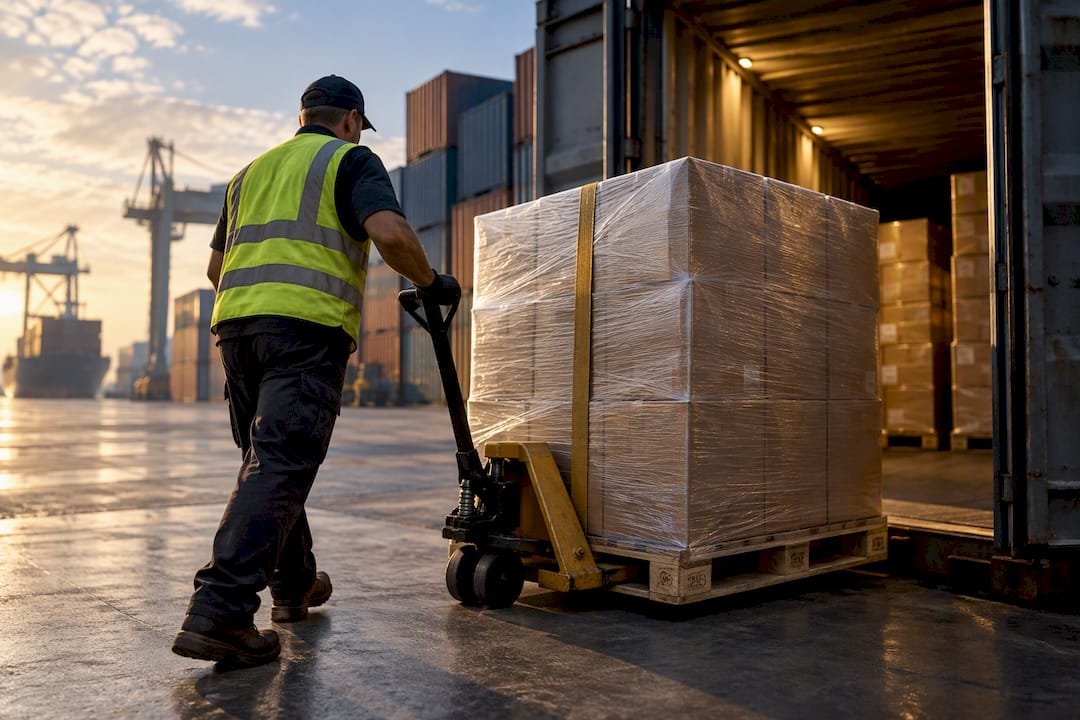
Tariffs get the headlines, but freight disruption is doing just as much damage behind the scenes. When ocean shipping routes out of Central America and the Caribbean became unreliable, several distributors shifted at least part of their volume to air freight, a much faster but far pricier option.
Premium tobacco doesn’t travel like a container of sneakers. It needs stable humidity and temperature control, which air cargo handling doesn’t always guarantee without extra packaging and insulation. That handling premium stacks directly on top of the higher freight rate itself.
The clearest public example: distributor Phoenicia applied a 6.5% surcharge tied directly to the sea-to-air switch when maritime shipping out of the region became too unpredictable to rely on.
- Ocean freight: slower, cheaper, but vulnerable to port delays and canceled sailings
- Air freight: faster and more reliable on timing, but far more expensive per unit
- Result: some importers front-loaded inventory before rate hikes took effect, which temporarily masked shortages but also tied up cash in stock nobody could discount
Statistic Callout: A 6.5% freight surcharge on a box of cigars adds a significant cost before it even reaches a retailer’s order sheet.
Nicaragua, Dominican Republic, and Honduras: Why Origin Changes Everything
Premium cigars aren’t interchangeable the way commodity goods are. A Nicaraguan puro and a Dominican-wrapped blend come from different soil, different curing houses, and now, different tariff brackets. That’s why two cigars that used to sit at the same price point can suddenly diverge.
Industry data shows just how concentrated U.S. supply really is: roughly 400 million handmade cigars are imported annually, with about 60% coming from Nicaragua, 24% from the Dominican Republic, and 15% from Honduras.
| Origin country | Share of U.S. imports | 2026 tariff rate |
|---|---|---|
| Nicaragua | ~60% | 12.5% |
| Dominican Republic | ~24% | 12.5% |
| Honduras | ~15% | 10% |
That last column explains a lot of the price confusion enthusiasts are seeing this year. A Honduran-made stick can dodge the steeper hit, while a Nicaraguan puro from the same brand’s lineup absorbs the full 12.5%. Add in country-specific shocks, like energy instability or labor supply reviews in any one of these regions, and a single country’s disruption can ripple through an entire brand’s catalog rather than staying contained.
How a Small Tariff Turns Into a Big Retail Price Hike
The cigar supply chain runs on keystone markups, where each stage roughly doubles its cost before passing the product along. That structure is normal in retail, but it means a tariff applied early in the chain doesn’t just add its own value. It gets multiplied at every step after it.
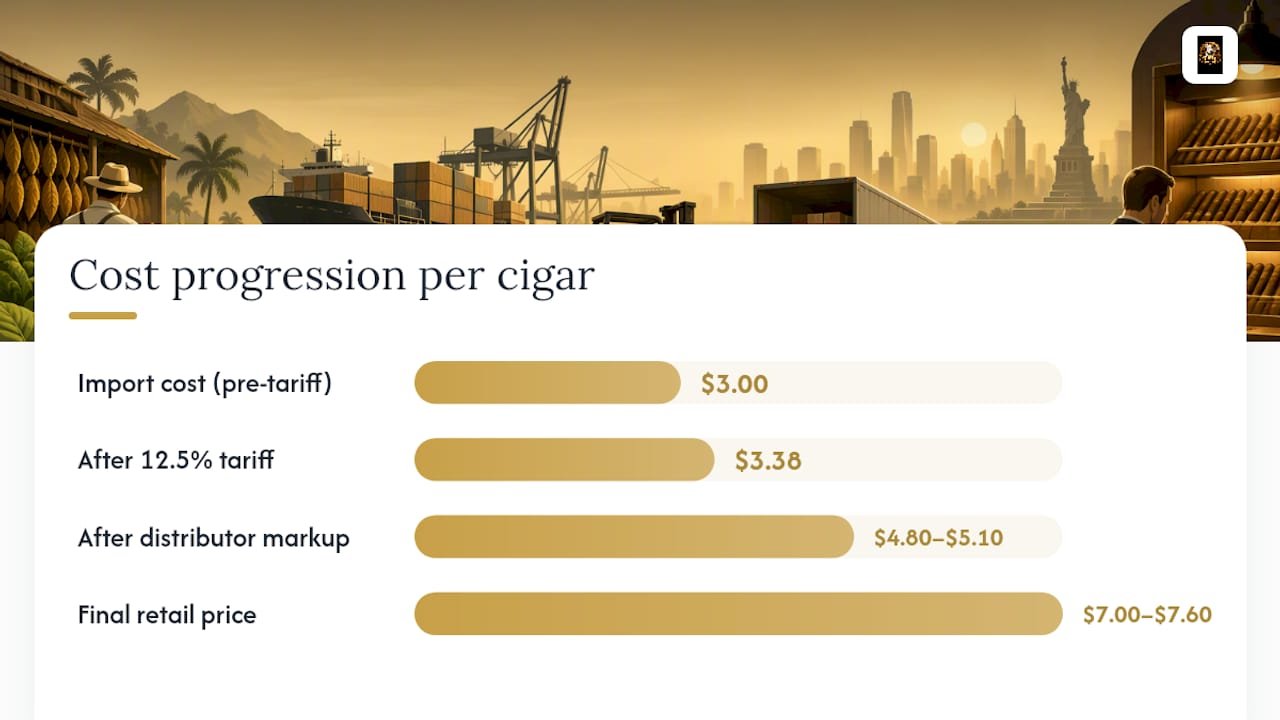
Here’s a simplified version of what that looks like for a single stick:
- Import cost before tariff: $3.00
- After a 12.5% tariff: $3.38
- Distributor markup (roughly 40 to 50%): around $4.80 to $5.10
- Retail markup (another 40 to 50%): final shelf price near $7.00 to $7.60
That’s a 40 cent tariff turning into more than a dollar of added retail cost once it clears the full chain. Because tariffs get applied at the import price rather than the finished retail value, this compounding effect is baked into the system, not a coincidence.
Statistic Callout: Multiply that same math across a box of 20 cigars and the tariff-driven increase alone can add a substantial additional amount before freight surcharges are considered.
Retailers generally choose one of three paths when costs rise like this: absorb the hit and shrink their own margin, pass the full increase straight through to the price tag, or apply a temporary surcharge they can roll back if tariffs ease later.
What the Industry Is Saying and Doing About It
Manufacturers aren’t quiet about this. STG raised U.S. cigar prices again this year, describing the move as a response to what industry leaders are calling a convergence of inflation, higher production costs, and tariffs hitting at the same time.
Trade groups have pushed back hard on how premium cigars get classified. The Cigar Rights of America has engaged directly with USTR’s tariff review, arguing that handmade premium cigars deserve different treatment than mass-market tobacco products.
Premium cigars are a distinct category from other tobacco products, and CRA frames blanket tariff treatment as effectively a tax on American retailers and consumers rather than on foreign manufacturers.
That framing matters because reshoring isn’t realistic here. The craft processes and regional terroir behind a Nicaraguan or Dominican leaf can’t be replicated domestically, so substitution isn’t a real option the way it might be for a manufactured good.
- Import volumes have shifted noticeably by origin as buyers and distributors react to differing duty rates
- Some importers front-loaded shipments ahead of rate changes to build a buffer of pre-tariff inventory
- Several manufacturers have flagged surcharges as temporary, contingent on whether tariff levels change
Smart Ways to Buy Cigars While Prices Stay Volatile
You don’t have to stop enjoying good cigars. You just have to buy smarter until pricing settles.
- Buy samplers instead of full boxes. You get to try multiple blends without committing to a 20 count box at a price that might drop or shift again in a few months.
- Stagger your restocks. Instead of one large order, spread purchases out so a single price jump doesn’t hit your whole collection at once.
- Prioritize what you actually smoke regularly. Stock up on daily rotation cigars first, and treat rare or limited releases as occasional splurges.
- Check your humidor’s calibration. A cigar that dries out or molds because of bad storage is money wasted no matter what you paid for it.
- Consider mystery packs for discovery. They’re a low-risk way to find a new favorite without paying full single-stick pricing while you experiment.
Pro Tip: Retailers see this pattern constantly: when single-stick prices climb, buyers who once bought one box start buying two samplers instead. It stretches the same budget across more variety, and you often end up finding a cheaper blend you like just as much as the one that got expensive.
What We’re Seeing at Thor’s Cigar Vault Right Now
Customer behavior at cigar retailers has shifted noticeably since tariff-driven price hikes started landing on invoices. Fewer full-box orders, more interest in trying before committing to a bigger purchase.
- Sampler packs have become a common entry point for customers testing new blends without the full box price tag
- Mystery packs are drawing more attention from buyers looking for value and discovery in the same purchase
- Interest in humidors has ticked up as customers focus on protecting the inventory they already own rather than expanding it
- Retailers are seeing customers shift toward samplers and subscription-style purchases as single-stick prices climb, a pattern that matches what’s happening industry-wide
Where Cigar Prices Go From Here
If tariffs stay in place through 2026, expect gradual price creep to continue, especially on Nicaraguan and Dominican blends carrying the 12.5% rate. If trade negotiations ease those rates, some of the recent surcharges could roll back, though freight costs may stay elevated regardless. Either way, buying in smaller, smarter batches protects you better than betting on a quick reversal.
— Kevin
Try More, Spend Less With Thor’s Cigar Vault Samplers
Thor’s Cigar Vault gives you a way to keep exploring premium tobacco without absorbing every tariff-driven price hike on a full box. Instead of committing to 20 sticks of a blend you’re not sure about yet, our samplers let you try several cigars at once, and our mystery packs are built for exactly this kind of price volatility, giving you curated variety at a lower entry cost than stocking up on a single brand.

Our full cigar collection includes rare and boutique blends from Nicaragua, the Dominican Republic, and Honduras, so you can compare origins and price points directly instead of guessing which region’s tariff exposure hits your wallet hardest. Browse the current sampler lineup and place your order before your next restock gets more expensive.
Sources
For primary documentation, review the USTR’s Section 301 final action, Cigar Rights of America’s tariff analysis, and CBP’s import guidance.
- Notice of Actions in Section 301 Investigations of Acts, Policies, and Practices of
- US finalizes new tariffs on premium cigar imports
- Tariffs and premium cigar demand
- Cuban cigar trade fractured by policy-driven logistics collapse
FAQ
Why are cigars getting so expensive?
Cigars are getting more expensive mainly because of the 2026 Section 301 tariffs on Nicaragua and Dominican Republic imports, combined with rising freight costs from sea-to-air shipping shifts. Those increases compound through wholesale and retail markups before reaching the shelf price.
What is the 135 rule for cigars?
The so-called “135 rule” isn’t a recognized cigar industry or regulatory standard, and definitions of it vary widely across forums and retailers. Rather than repeat an unverified rule, it’s more useful to focus on the tariff and freight factors covered above, which are the actual documented drivers of price change.
Is 1 or 2 cigars a week okay?
Smoking frequency and health risk are personal and medical questions that depend on individual health factors, not something a pricing article can answer responsibly. If you have concerns about tobacco use and health, the CDC’s tobacco resources are a better starting point than general guidance here.
Are Cuban cigars illegal in the U.S. in 2026?
Cuban cigars remain restricted for commercial import into the U.S. under long-standing trade rules, with CBP guidance governing personal import allowances for travelers. Commercial resale of Cuban-origin cigars is a separate and more complex legal question that depends on specific licensing rules.
Will cigar prices go back down?
Prices are unlikely to drop significantly unless tariff rates are reduced or freight costs stabilize, since both pressures are structural rather than temporary. Some manufacturer surcharges were explicitly framed as reversible if trade conditions ease, so partial rollbacks are possible but not guaranteed.