Jar Aging Cigars: How to Do It Right (and When Not To)
Yes, you can age cigars in a jar. A tightly sealed glass jar slows oxygen exchange, and with stable humidity at about 65% or lower, it can be a workable long-term home for cigars you want to leave alone for years. It only works if the cigars are already conditioned, the lid truly seals, and you have a calibrated hygrometer inside. Skip any of those and a jar is a good place to ruin a cigar.
Below: how a jar changes aging, the exact setup, humidity and temperature targets, how infused cigars fit in, how aged compares with fresh, how long a cigar lasts, and the problems to watch for.
TL;DR
- A sealed jar reduces oxygen exchange, so maturation is slower and the result is different from a standard humidor, not automatically better.
- Only put in cigars that are already at stable humidity. Aim for no more than 65% RH for long-term aging, and check with a calibrated hygrometer.
- Keep one blend per jar, keep the jar somewhere cool and untouched, and expect meaningful change over years, not weeks.
- Keep infused cigars in their own container so their aromas stay separate from your unflavored cigars.
- Check on stored cigars periodically for beetle damage, mold and dryness. Free shipping applies on orders over $125, and we ship to adults 21+ across the U.S.
Table of Contents
- What a jar actually does to a cigar
- Why cigars change with age
- Step-by-step: setting up a cigar jar
- Humidity and temperature targets
- How long should you wait?
- Infused and flavored cigars in a jar
- Aged versus fresh: which is better?
- How long does a cigar last?
- Problems to watch for in a sealed jar
- Jar versus humidor: which should you use?
- Cigars worth setting aside, and where to start
- FAQ
- Sources
What a jar actually does to a cigar
A cigar in a humidor sits in a box that breathes a little. Air moves in and out when you open the lid, the humidity source cycles, and the cedar adds its own aroma. A sealed jar removes most of that. Giuseppe Mitolo, writing in CigarsLover Magazine, describes jar storage as a viable but distinct environment for long-term maturation, because less oxygen reaches the tobacco.
The same article reports that after a few months in a sealed jar, cigars may lose some of their woody aromas and develop new, sometimes more delicate flavors. That matches what many collectors describe: less cedar influence, a more rounded profile, and sometimes a quieter cigar overall.
Two honest points follow from that:
- Slower is the point. If you want a cigar to change, a jar gives it a stable, low-disturbance setting. If you want to smoke it next week, a jar does nothing for you.
- Different is not the same as better. Some smokers prefer the cedar-touched character a humidor gives. Jar aging is a preference, and trying one cigar from each setup after a year is the best way to learn yours.
Why cigars change with age
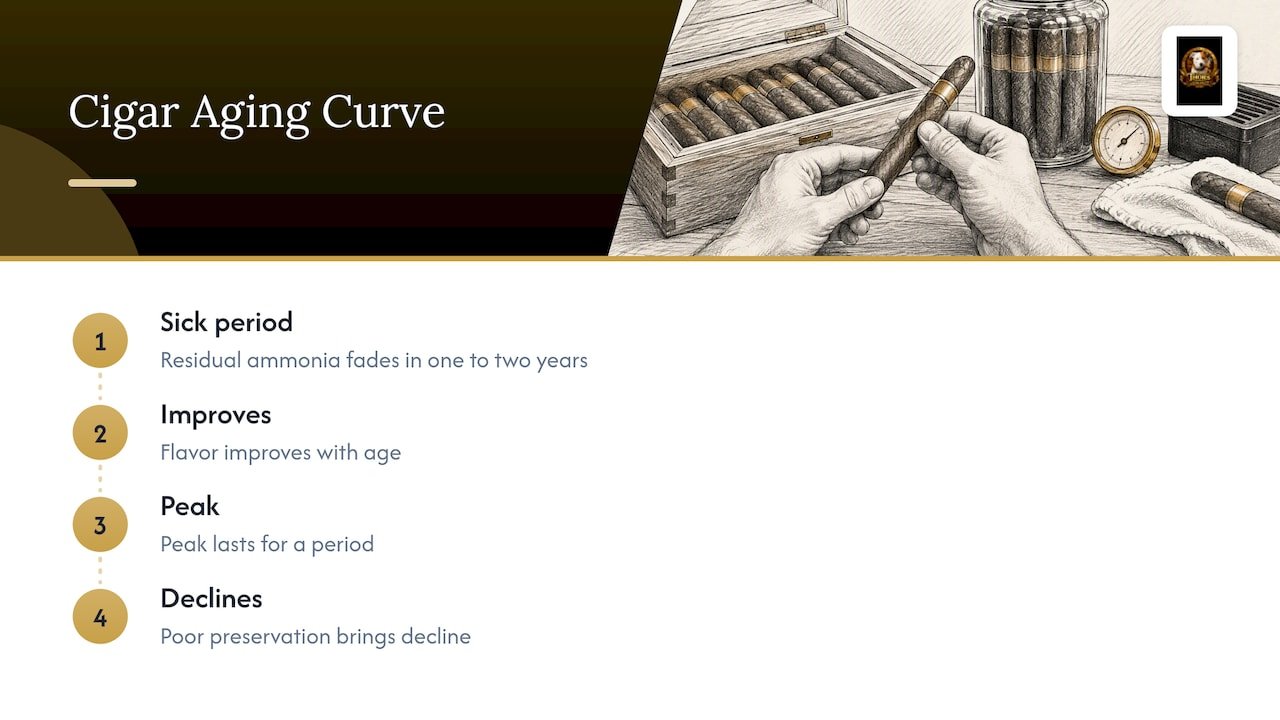
Fresh-rolled cigars go through a rough patch. The Cigar Journal notes that cigars have a “sick period” right after rolling caused by residual ammonia from fermentation, which typically fades within one to two years. Cigars from reputable makers have usually passed that stage before they reach a shop shelf, but the idea explains why very young cigars can taste harsh or sharp.
The same source describes a cigar’s life as a parabolic curve: it improves with age, reaches a peak that lasts for a period, then declines if it is poorly preserved. That curve is the whole reason to age cigars deliberately, and the reason to be careful about how.
Blend matters too. In Cigar Sense’s article on cigar aging, Franca Comparetto discusses the observations of Luigi Ferri, who is known for his extensive experience tasting aged cigars, including his view that cigars with more ligero generally have greater aging potential. Treat that as one experienced taster’s view rather than a rule, but it is a useful reason to age fuller-bodied blends first if you want to experiment.
Step-by-step: setting up a cigar jar
1. Pick the right jar
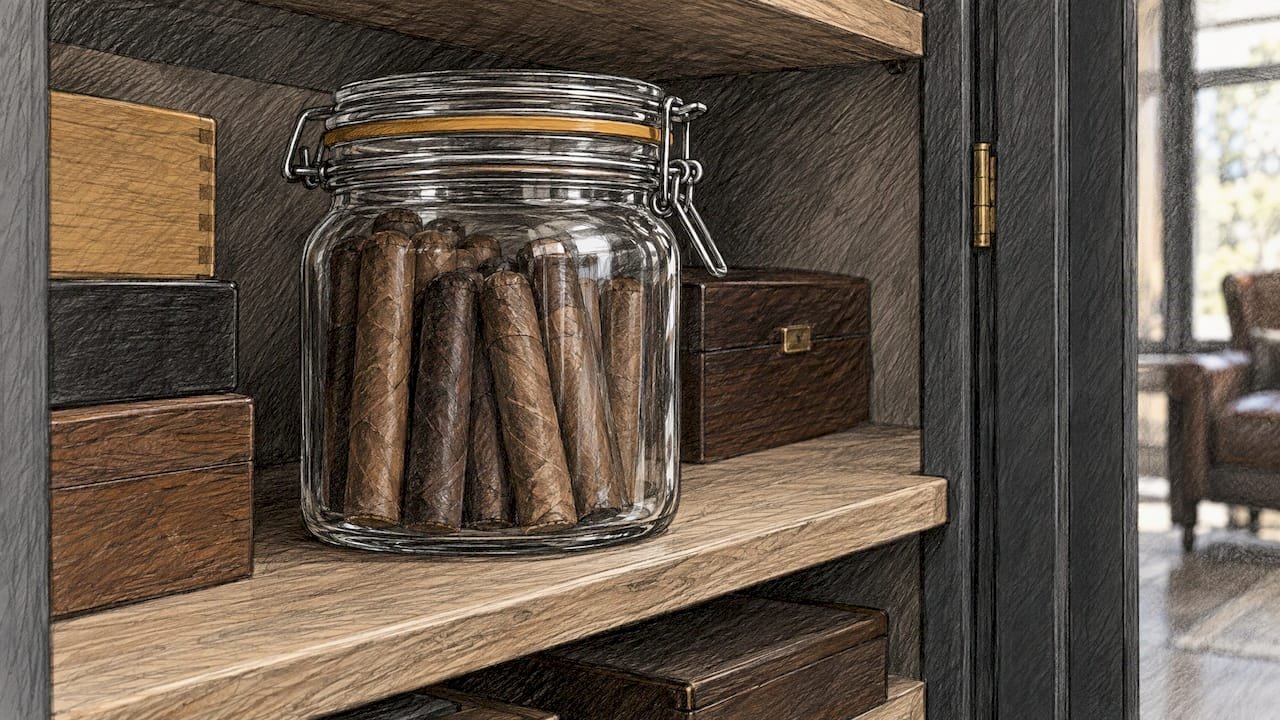
You want glass with a gasket lid that closes airtight. If you can smell cigar from the outside, the seal is leaking. Choose a size that holds your cigars with a little air around them, without crushing wrappers. A jar that is mostly full is also easier to keep stable than one that is mostly empty.
A jar can only act as a humidor when it seals tightly and has some form of humidity control, a point also made in Boveda’s explanation of what counts as a humidor: any container with controlled humidity qualifies, from a box to a tub to a room.
2. Condition the cigars first
CigarsLover advises putting only already-conditioned cigars into a sealed jar. Cigars that arrive dry, or have been sitting out, need to be brought back to a stable moisture level first. If you are starting from dry sticks, our guide to rehydrating dried cigars over 2 to 8 weeks walks through the slow, staged approach. Rushing it is how wrappers crack.
Never seal wet cigars in a jar and walk away. There is no airflow to dry out an overly damp cigar, and the moisture has nowhere to go.
3. Add a hygrometer and control the humidity
Put a small digital hygrometer inside. CigarsLover recommends avoiding loose wet sponges, because over-humidifying a sealed space causes problems. Use a two-way humidity control product made for the job, sized for the jar, and do not mix different humidity levels or different humidification products in the same container.
A hygrometer you cannot trust is worse than none. Check it with the 75% salt test before you rely on it.
4. Separate by blend
Keep one blend, or at least one brand’s family of blends, per jar. Cigars with strong, distinct flavors can swap aromas in a closed space over a long time. A jar of one cigar also makes tasting notes meaningful: when you open it in three years, you know exactly what changed.
5. Put it away and leave it
The less you move and open it, the better. A shelf, closet or cabinet that stays stable beats a spot by a window or an appliance. Write the date and contents on a label, and keep a small notebook with cigars, date jarred and starting humidity.
Humidity and temperature targets
| Setting | Target | Why |
|---|---|---|
| Humidity for long-term jar aging | No more than 65% RH | CigarsLover’s guidance for long-term aging; general storage runs roughly 65% to 72% |
| Temperature | About 65°F to 68°F, steady | Cigar Journal calls this range generally optimal for long-term storage |
| Humidity stability | Steady beats exact | The same Cigar Journal piece says stable humidity matters more than a constant temperature |
| Avoid | Very hot or very cold rooms | CigarsLover says temperature is less critical but extremes should be avoided |
A few notes on those numbers. CigarsLover describes about 65% to 72% RH as the general storage range and prefers no more than 65% for long-term aging. Many smokers keep their everyday humidor at around 69% to 70%, so a jar for aging sits a little drier than the humidor you smoke from. The Bespoke Unit aging guide suggests a similar idea: aging conditions a few percentage points below your normal RH, in the low-60s Fahrenheit to mid-60s, as laid out in their aging guide.
The lower humidity also works in your favor on the pest and mold side, covered below. For a deeper look at day-to-day humidor setup, see our guide to storing cigars at home.
How long should you wait?
Set expectations honestly. CigarsLover says significant results in a jar may take at least five years, and in some cases decades. Early checks tell you something, but a few months mostly shows you the aroma shift away from cedar rather than a transformed cigar.
A practical plan for a first experiment:
- Buy a five-pack or a sampler of one blend, or a box if you already like it.
- Smoke one cigar fresh and take notes on the opening, the middle and the finish.
- Jar the rest. Smoke one at around one year, and again at two or three.
- Compare your notes. Keep going only if you like where it is heading.
Smoking one at a time also protects you: if something is wrong with the jar, you find out with one cigar, not all of them.
Infused and flavored cigars in a jar
Infused cigars carry added flavor, whether that is a spirit, a spice or a sweet note, and that flavor is part of what you buy them for. Aging them is a different goal from aging a traditional blend. You are not waiting for ammonia to fade or for tobacco to mellow so much as keeping the flavor you chose from drifting.
Our advice, from experience handling and storing cigars:
- Give them their own jar. Infused aromas can travel to the unflavored cigars around them in a closed space. A dedicated container keeps your traditional cigars tasting like tobacco.
- Use the same discipline. Stable humidity, a steady cool spot and a calibrated hygrometer matter just as much.
- Do not count on years of improvement. The flavor you like is most vivid when the cigar is reasonably fresh, so smoke infused cigars on a shorter timeline than a traditional blend you are cellaring.
- Taste one early. If the flavor is fading faster than you like, move the rest to your smoking rotation.
The Cigar Keeper, a retail blog, suggests a humidity of about 65% to 68% for flavored cigars, which lines up with the lower end of the general range. For any specific brand, follow the maker’s guidance if it gives some.
Aged versus fresh: which is better?
Neither wins every time. They are different experiences.
Fresh cigars (a few months to a couple of years from the maker) often show more of the blend’s intended punch: stronger pepper, more obvious spice, firmer structure. If a cigar is a current release you have wanted to try, smoking it relatively fresh tells you what the blender intended in the first place.
Aged cigars tend to taste smoother and more integrated, with sharper edges softened and flavors that blend together instead of arriving one at a time. The Art of Aging view of a cigar shedding its youthful roughness is common among collectors, but it is a matter of taste, and some smokers prefer the brighter, younger profile.
A simple way to decide: buy two of the same cigar. Smoke one now. Age the other. Your own mouth is the best judge.
If you are new to premium cigars, start by smoking a variety before you age any. A sampler lets you find the blends worth cellaring without committing to a full box.
How long does a cigar last?
A properly stored cigar can last a very long time, and the answer to “can you smoke a 30-year-old cigar?” is that people do. Whether you should depends on how it was stored. The parabolic curve above is the guide: a cigar kept at stable humidity and temperature can hold well for decades, while one that dried out, got moldy or was eaten by beetles is finished within a short time.
If you find an old cigar, check it before you light it:
- The wrapper should be intact, not cracked or flaking.
- It should feel springy and evenly filled, not hard or brittle.
- It should smell of tobacco, not sour, musty or like mildew.
- There should be no tiny round holes or fine powder around it.
If it fails any of these, do not smoke it. If it passes, toast the foot gently and expect a flavor very different from a fresh stick. It may be mellow and soft, or it may be faded, and either is normal for something that old.
A dry cigar is a different matter from a bad one. A stick that has simply dried may be recovered, and our guide on fixing tight draws with dry boxing covers one way to handle cigars that are too moist, while the rehydration plan above covers dry ones.
Problems to watch for in a sealed jar
Mold
Too much humidity in a sealed space is the main reason cigars grow mold. This is the case for staying at or below 65% for long aging and for never leaving a wet sponge in the jar. Mold usually looks like white, blue or green fuzzy patches, or a cottony growth, and smells musty. Remove affected cigars and clean the jar before using it again.
Cigarette beetles
The University of Florida’s publication on the cigarette beetle says the pest occurs wherever stored tobacco, cigars or tobacco leaves are kept, and that the larvae damage the tobacco directly. It recommends checking stored items and discarding heavily infested ones. Tiny round exit holes in the wrapper and fine tobacco dust are the usual signs.
Texas A&M’s entomology program says cigarette beetles do best at 70% to 80% RH and 68°F to 86°F, and that development stops below 59°F or above 94°F. So a lower RH and a cooler spot, which you want for aging anyway, work against them. Inspect new cigars before they join your jar, and check the jar when you open it.
Dryness and a bad seal
If the gasket fails, the jar slowly loses humidity and the cigars dry out. Boveda notes that low humidity causes drying and cracked wrappers, while excess humidity raises mold risk. Look at your hygrometer every few weeks at first, then every month or two once it is stable.
Ammonia smell
Some forum posters worry that ammonia stays trapped in a sealed jar. The cigars can still age fine, but if you smell a sharp chemical note when you open it, let the cigar breathe in the open air for a few minutes before you smoke it.
Jar versus humidor: which should you use?
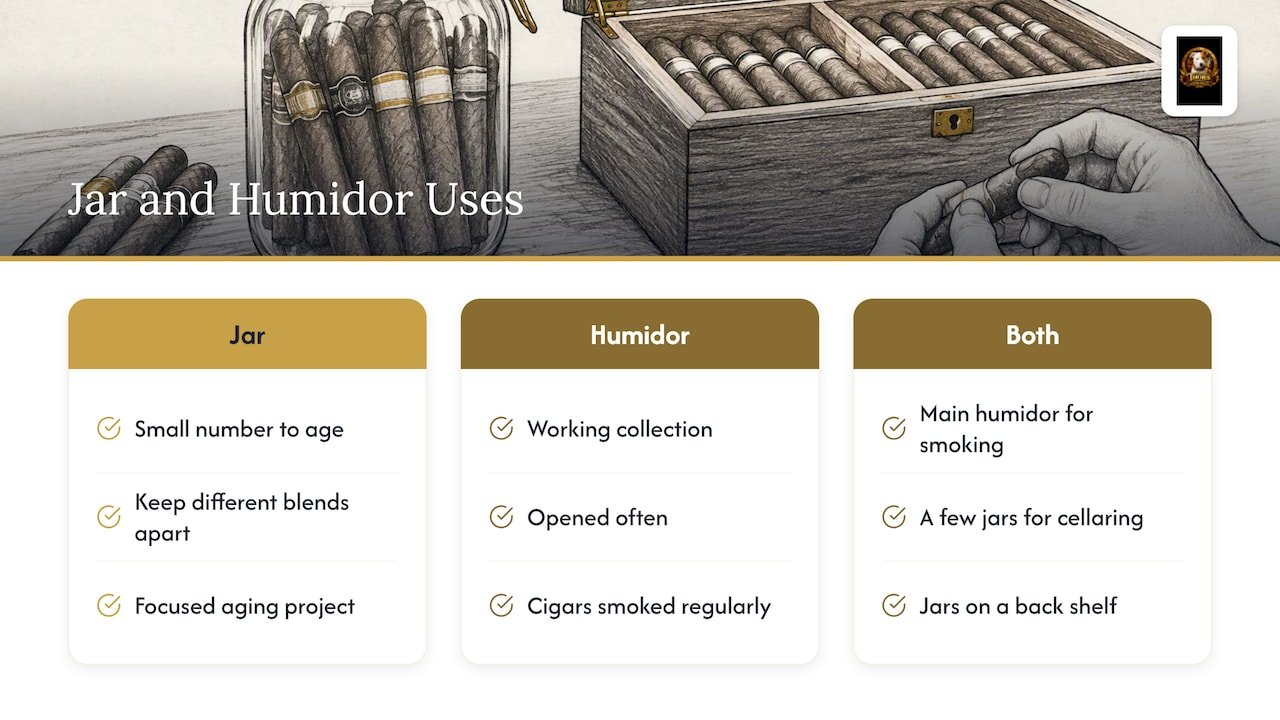
A jar is a good fit if you have a small number of cigars to age, want to keep them away from the ones you smoke weekly, or want to keep different blends apart. A humidor is better for a working collection you open often. Many collectors use both: a main humidor for smoking, and a few jars on a back shelf for cellaring.
If your collection is growing, an aging jar will not replace proper storage. Our comparison of electric and wooden humidors for 150 cigars will help you decide what to use for the cigars you smoke day to day.
Our take on jar aging
We sell cigars to people who want to smoke them, and also to people who want to hold them. Our advice is the same for both: start with cigars you already enjoy, and give them a stable home. A jar is a fine tool for a small, focused aging project. It rewards patience and one-blend-per-jar discipline.
For most customers, we suggest a sampler first. Find the two or three blends that you want to cellar, then buy more of those. That way you are aging cigars you like, not cigars you hope you will like in five years. For anything you smoke regularly, a good humidor is still the right home, and we carry Raching humidors for that.
Whatever you choose, do not skip the hygrometer and do not store cigars you are unsure about. A good cigar kept well is worth waiting for.
Kevin
Cigars worth setting aside, and where to start
We ship across the U.S. to adults 21+ only, and orders over $125 ship free. If you are building an aging stash, here is how we would approach it:
- Try before you commit. Our samplers let you smoke several blends before you pick which to jar.
- Look at limited runs. Collectors often put away limited releases, since a small production run is harder to replace later.
- Match the container to the plan. Our humidors and accessories cover everything from daily storage to hygrometers.

Browse the full range of cigars at Thor’s Cigar Vault for individual cigars from makers such as Arturo Fuente, Liga Privada, Aganorsa Leaf and Oliva.
FAQ
Is it safe to age cigars in a mason jar?
It can work if the jar has an airtight gasket, the cigars are already conditioned, and you have a calibrated hygrometer inside. Keep humidity at or below about 65% for long-term aging and avoid wet sponges. Check on the cigars regularly for mold and beetle damage.
How long should I age cigars in a jar?
Expect changes in aroma after a few months, but meaningful maturation usually takes years. CigarsLover puts significant results at five years or more. Smoke a test cigar at one year, then again at two or three, and keep notes.
Can I age infused cigars?
You can store them, but keep them in their own container so their aromas do not spread to other cigars. Use the same stable, moderate humidity. Their flavor is a big part of the appeal, so smoke them on a shorter timeline than a traditional blend you are cellaring.
What is the shelf life of a cigar?
A well-stored cigar can last decades, following a curve of improving, peaking and eventually declining. Poor storage shortens that fast. Dryness, mold and beetles are the main threats, so inspect an old cigar for cracks, a musty smell and small holes before you light it.
Ready to start your own aging project? Pick up a sampler to find the blends you love, then set a few aside.
Sources
- Jars: unconventional humidors, CigarsLover Magazine
- The Stages of Cigar Aging, Cigar Journal
- Cool Storage for Cigars, Part 2, Cigar Journal
- Cigarette Beetle, University of Florida IFAS
- Cigarette Beetles, Texas A&M Urban and Structural Entomology
- Of Cigar Aging, Cigar Sense
- Aging Cigars Guide, Bespoke Unit
- What is a Cigar Humidor, Boveda
- Humidity, Honesty & Humidors, Boveda