
Keeping Cigar Beetles Out of Your Humidor for Good
Keep your storage temperature below 70°F and quarantine every new box before it touches your main collection. That’s the whole prevention game in one sentence. Beetle eggs need sustained heat to hatch, so a cool, stable environment stops the problem before it starts.
If you already suspect an infestation, act now:
- Isolate any cigar with pinholes or dust in a sealed plastic bag immediately.
- Do not open it near your humidor.
- Start the staged freezer protocol: refrigerator, then freezer, then refrigerator again, then room temperature.
A single overlooked box can spread eggs across an entire collection within days once temperatures climb. Industry guidance from Tobacconist University backs the staged freeze cycle, and outfits like Thor’s Cigar Vault build their humidor recommendations around exactly this temperature discipline.
Key Takeaways
Temperature control below 70°F combined with strict quarantine of new arrivals prevents the vast majority of cigar beetle infestations before they start.
| Point | Details |
|---|---|
| Temperature is the trigger | Keep storage below 70°F since sustained heat above roughly 72°F wakes dormant eggs. |
| Quarantine every new box | Hold new cigars separately for two to three weeks before adding them to your main humidor. |
| Freeze suspect cigars in stages | Use the fridge, freezer, fridge, room temperature cycle with a minimum 72 hour freeze to kill all life stages. |
| One hole means treat the whole box | A single pinhole usually signals wider exposure, so isolate and treat the entire container. |
| Upgrade hardware for consistency | Thor’s Cigar Vault offers electric humidors and calibrated hygrometers that hold stable conditions far better than passive setups. |
Table of Contents
- Why Temperature Triggers Cigar Beetles Prevention Failures
- Your Cigar Storage Pest Prevention Checklist
- How to Spot Early Signs of a Cigar Beetle Infestation
- The Freezer Protocol for Cigar Beetle Control Methods
- Setting Up a Humidor That Keeps Beetles Out
- When Cigar Beetle Damage Calls for a Professional
- What I’ve Learned Protecting a Cigar Collection From Beetles
- Get Gear That Makes Cigar Beetles Prevention Effortless
- Sources
- FAQ
Why Temperature Triggers Cigar Beetles Prevention Failures
Heat, not humidity, is what wakes up a dormant beetle egg. Lasioderma serricorne, the tobacco beetle, lays eggs that can sit inactive inside a wrapped cigar for months if conditions stay cool. The moment sustained temperatures climb past roughly 72 to 73°F, combined with high humidity, those eggs hatch and larvae start tunneling.
The lifecycle runs through four stages:
- Egg — dormant, can survive weeks in cool conditions without hatching.
- Larva — the destructive stage, feeding through tobacco and leaving pinholes.
- Pupa — a brief transition before emerging as an adult.
- Adult — flies, mates, and lays the next generation of eggs.
At warmer temperatures, that entire cycle compresses dramatically. Cigar Aficionado reports the full lifecycle can complete in as little as 24 days when conditions sit in the 84 to 95°F range. That’s why a hot car trunk or a sunlit windowsill does more damage in a week than a stable humidor does in a year. Cool storage doesn’t kill an already-hatched larva, but it keeps the eggs from waking up in the first place, which is the entire point of temperature-first prevention.
Your Cigar Storage Pest Prevention Checklist
Temperature-first thinking should shape everything about where and how you store cigars. Somewhere below 70°F, ideally in the mid to high 60s, keeps you safely under the hatch threshold. For long-term aging, Habanos S.A. style guidance and entomological findings both point toward cooler, stable ranges rather than the warmer end of typical humidor advice, since a few degrees of buffer matters more than a perfect flavor curve.
Build these habits into your routine:
- Place your humidor away from windows, radiators, exterior walls, and anything electronic that generates heat.
- Check your hygrometer weekly and your thermometer whenever you notice a seasonal shift.
- Aim for relative humidity in the mid to high 60s. VDG Cigars notes this range balances flavor development against beetle risk better than the wetter 70%+ zone some guides recommend.
- Swap sponge-based humidification for two-way humidity packs, which hold a steadier line than active foam systems that can overshoot.
- Never assume cedar lining or cellophane wrapping stops beetles. Neither one is a barrier; cedar’s oils may deter some insects, but they don’t kill eggs already inside the tobacco, and cellophane is porous enough for beetles to bore through anyway.
Every new box deserves a quarantine period before it joins your main humidor. Hold new arrivals separately for two to three weeks, and if the source or storage history is unclear, pre-freeze them using the staged protocol before quarantine even begins.
Pro Tip: Keep a small secondary humidor or even a sealed Tupperware with its own hygrometer just for quarantine. It costs almost nothing and it’s the single easiest habit that keeps a bad box from becoming a bad year.
How to Spot Early Signs of a Cigar Beetle Infestation
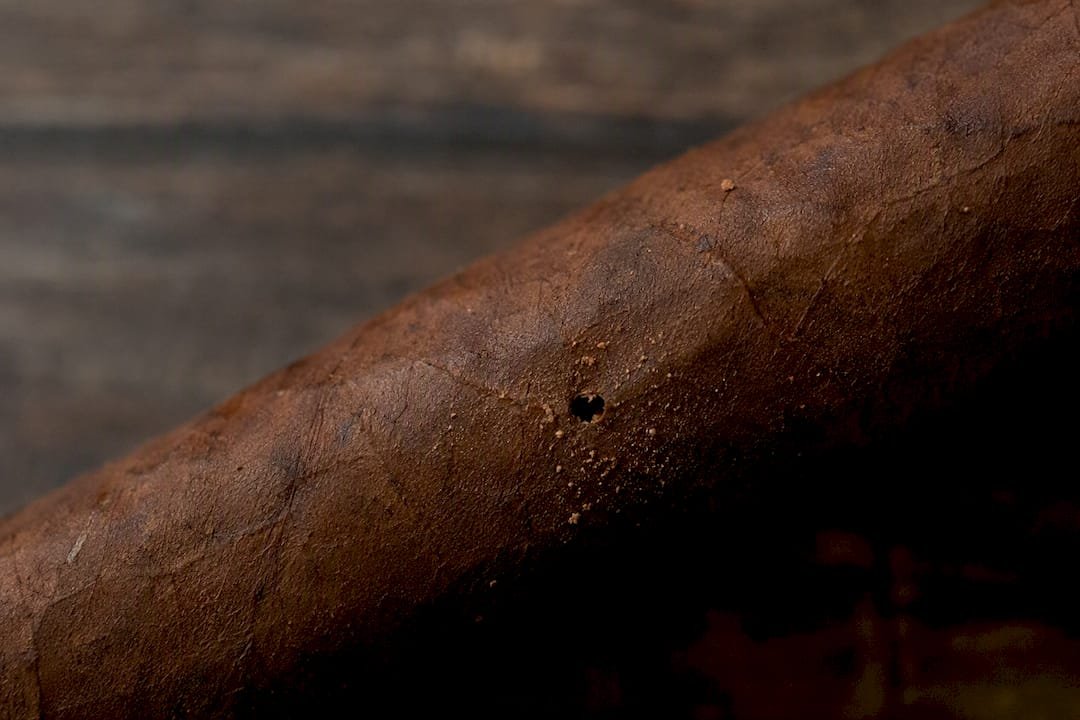
The two giveaways are pin-sized holes in the wrapper and fine tobacco dust collecting in the box or cellophane. Dead beetles, small dark specks about the size of a pinhead, are another reliable tell, especially if you find several clustered near one cigar.
Inspect methodically rather than glancing:
- Unwrap cigars fully under bright, direct light rather than ambient room lighting.
- Check box corners and seams, where dust tends to settle first.
- Look inside cedar trays and under the tissue paper lining, not just the visible tops.
- Roll each cigar gently between your fingers to feel for soft or hollow spots.
Pro Tip: A jeweler’s loupe or a $10 magnifier reveals holes that look like nothing to the naked eye. If you find even one damaged stick, treat the entire box, and arguably the entire humidor, as exposed. Cigar Aficionado makes the same point: a single pinhole usually means larvae already fed through more than one cigar nearby.
The Freezer Protocol for Cigar Beetle Control Methods
Freezing is the only home method that reliably kills every life stage: eggs, larvae, pupae, and adults. Cool storage alone can stop eggs from hatching, but VDG Cigars notes it won’t kill larvae that have already emerged, which is why suspected infestations call for the freezer, not just a colder shelf.
Follow this sequence exactly:
- Double-bag each suspect cigar in sealed plastic, pressing out excess air.
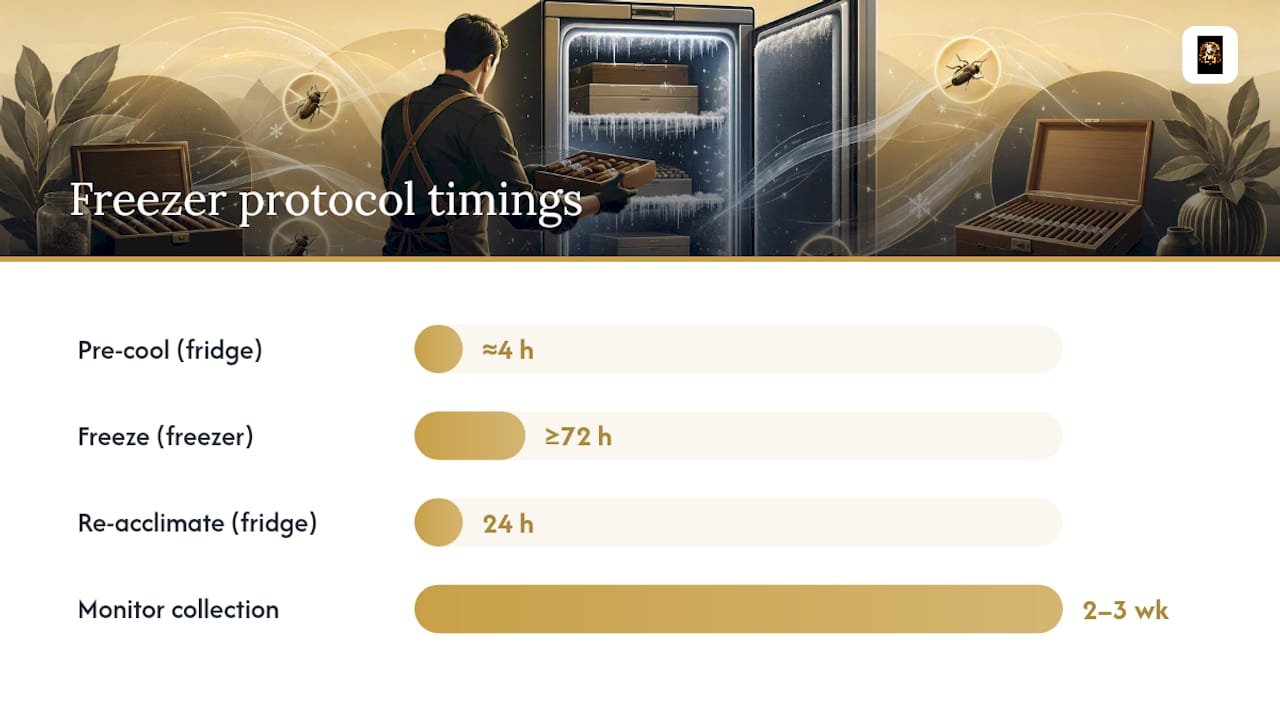
- Place the bagged cigars in the refrigerator for about four hours. This pre-cooling step prevents the wrapper from cracking under a sudden temperature drop.
- Move them to the freezer for a minimum of 72 hours. Tobacconist University treats this as the standard duration for killing eggs and larvae outright.
- Transfer back to the refrigerator for 24 hours to re-acclimate gradually.
- Bring to room temperature slowly before unbagging, ideally over several more hours.
While cigars are frozen, wipe down every surface of your humidor with a barely damp cloth, checking seams and tray undersides for dust. Discard any cigar that’s structurally collapsed or riddled with holes; salvage anything with a single small hole and no dust once it’s completed the full freeze cycle.
Treat every cigar that shared a box or a humidor shelf with an infested stick as exposed, not just the damaged one. Monitor the whole collection for another two to three weeks after treatment, checking daily for the first week.
Setting Up a Humidor That Keeps Beetles Out
Choose placement first, hardware second. A humidor sitting in a closet interior wall stays far more stable than one near a window or an entertainment console throwing off heat. For anyone in a warm climate or without reliable climate control, a thermoelectric humidor holds temperature far more consistently than a passive wooden box ever will, according to Luxury Wine Appliances, which notes that passive systems spike more in summer heat and during frequent opening.
Get the setup right in this order:
- Season a new wooden humidor fully before loading cigars, following the manufacturer’s seasoning process.
- Install a digital hygrometer and thermometer combo unit rather than the analog dial that ships with most boxes.
- Choose two-way humidification packs over a sponge or foam humidifier for steadier, self-regulating moisture.
- Calibrate your hygrometer every three to six months using a salt test or a calibration kit.
- For hot climates or unreliable air conditioning, consider an electric or thermoelectric unit built for stable interior temps.
- Keep the unit out of direct sunlight and away from any appliance that radiates heat.
- Log temperature and humidity readings weekly, even briefly, so a slow drift doesn’t go unnoticed.
- Open the humidor sparingly in extreme weather to avoid letting outside heat and humidity in.
Pro Tip: Two cheap hygrometers placed at opposite ends of a large humidor catch hot spots a single sensor misses, especially in cabinet-style units.
When Cigar Beetle Damage Calls for a Professional
Call in a pest control professional or consider disposal when damage spans multiple boxes with active larvae still visible after treatment, or when you’ve run the freezer protocol more than once without stopping reinfestation. Widespread outbreaks can escalate fast: TNext Cigar describes cases where a large portion of a collection was destroyed within about a week once conditions were right.
Escalate if you see:
- Live beetles or larvae in more than one storage location in your home.
- Repeated reinfestation after two full freeze cycles.
- Extremely rare or vintage sticks where even minor risk isn’t acceptable.
At that point, professional fumigation or, in severe cases, controlled disposal of unsalvageable stock protects the rest of your collection better than another round of DIY treatment.
What I’ve Learned Protecting a Cigar Collection From Beetles
Every serious mistake I’ve seen collectors make traces back to skipping quarantine because a box “looked fine” straight out of the shop. Beetle eggs don’t announce themselves. They ride in silently and wait for a warm week to hatch.
Thor’s Cigar Vault fields questions about humidor setup and pest prevention regularly, and the pattern holds: readers who follow the temperature-first approach, combined with disciplined quarantine, essentially never deal with an active infestation. The steps in this guide work. What fails people isn’t the method, it’s skipping a step because it feels unnecessary in the moment.
Get Gear That Makes Cigar Beetles Prevention Effortless
If you want beetle risk close to zero without babysitting a thermometer every day, the fastest fix is hardware, not vigilance. A temperature-stable electric humidor or a converted wineador holds conditions far more consistently than a passive wooden box left to the mercy of your living room.

Thor’s Cigar Vault stocks the gear that makes the prevention steps above nearly automatic: calibrated digital hygrometers, two-way humidity packs, and luxury humidors built for stable temperature control. If you’re protecting sticks worth quarantining carefully, like a boxed Artesano Del Tobacco The Squid, the right storage setup pays for itself the first time it prevents a wipeout. Browse the shop for humidors and monitoring gear, or check out the full collection to get your setup right from day one.
Sources
- Fighting Tobacco Beetles | Cigar Aficionado
- Tobacco Beetles in Cigars: Complete Prevention Guide — VDG Cigars
FAQ
What temperature kills cigar beetle eggs?
Eggs stay dormant below roughly 70°F, but freezing for at least 72 hours is what actually kills eggs, larvae, and adults.
Does freezing damage cigar wrappers?
Not if you stage it correctly. Cooling in the refrigerator before and after the freezer prevents the sudden temperature shock that cracks wrappers.
How long should I quarantine new cigars?
Two to three weeks in a separate container is standard, longer if the cigars came from an unknown storage history or a humid climate.
Can I still smoke a cigar with one small beetle hole?
If it completed a full freeze cycle and shows no dust or structural damage, it’s generally safe to smoke, though flavor near the hole may be affected.
Do cedar humidors prevent beetle infestations?
No. Cedar’s oils may offer mild deterrence, but they don’t kill eggs already inside the tobacco, so temperature control still matters more than the wood itself.